

The Project Gutenberg eBook of The Brick moon and other stories, by Edward Everett Hale.
The best science kits for toddlersBrick Moon
and
Other Stories
by EDWARD EVERETT HALE
Short Story Index Reprint Series
Preface
TO read these stories again, thirty and more years after they werewritten, is to recall many memories, sad or glad, with which this readerneed not be interrupted. But I have to make sure that they areintelligible to readers of a generation later than that for which theywere written.
The story of The Brick Moon was begun in my dear brother Nathan’sworking-room in Union College, Schenectady, in the year 1870, when hewas professor of the English language there. The account of the firstplan of the moon is a sketch, as accurate as was needed, of the old chatand dreams, plans and jokes, of our college days, before he leftCambridge in 1838. As I learned almost everything I know through hiscare and love and help, directly or indirectly, it is a pleasure to saythis here. The story was published in the “Atlantic Monthly,” in 1870and 1871. It was the last story I wrote for that magazine, beforeassuming the charge of “Old and New,” a magazine which I edited from1870 to 1876, and for which I wrote “Ten Times One is Ten,” which hasbeen printed in the third volume of this series.
Among the kind references to “The Brick Moon” which I have received fromsympathetic friends, I now recall with the greatest pleasure one sent meby Mr. Asaph Hall, the distinguished astronomer of the NationalObservatory. In sending me the ephemeris of the two moons of Mars, whichhe revealed to this world of ours, he wrote, “The smaller of these moonsis the veritable Brick Moon.” That, in the moment of triumph for thegreatest astronomical discovery of a generation, Dr. Hall should havetime or thought to give to my little parable,—this was praise indeed.
Writing in 1870, I said, as the reader will see on page 66, that GeorgeOrcutt did not tell how he used a magnifying power of 700. Nor did Ichoose to tell then, hoping that in some fortunate winter I might beable myself to repeat his process, greatly to the convenience ofastronomers who have not Alvan Clark’s resources at hand, or who have tosatisfy themselves with glass lenses of fifteen inches, or even thirty,in diameter. But no such winter has come round to me, and I will nowgive Orcutt’s invention to the world. He had unlimited freezing power.So have we now, as we had not then. With this power he made an ice lens,ten feet in diameter, which was easily rubbed, by the delicate hands ofthe careful women around him, to precisely the surface which he needed.Let me hope that before next winter passes some countryman orcountrywoman of mine will have equalled his success, and with an icelens will surpass all the successes of the glasses of our time.
The plan of “Crusoe in New York” was made when I was enjoying theprincely hospitality of Henry Whitney Bellows in New York. The parsonagein that city commanded a view of a “lot” not built on, which would havegiven for many years a happy home to any disciple of Mayor Pingree, if asomewhat complicated social order had permitted. The story was firstpublished in Frank Leslie’s illustrated paper. In reading it in 1899, Iam afraid that the readers of a hard, money generation may not know that“scrip” was in the sixties the name for small change.
I regard a knowledge of every detail of the original Robinson Crusoe aswell-nigh a necessity in education. Girls may occasionally be excused,but never boys. It ought to be unnecessary, therefore, to say that someof the narrative passages of Crusoe in New York are taken, word forword, from the text of Defoe. If I do state this for the benefit of afew unfortunate ladies who are not familiar with that text, it isbecause I think no one among many courteous critics has observed it.
“The Survivor’s Story” is one of eight short stories which werepublished in the first Christmas number of “Old and New.”
Of the other stories I think no explanation is needed, but such as wasgiven at the time of their publication and is reprinted with each ofthem here.
EDWARD E. HALE. ROXBURY,
July 6, 1899.
CONTENTS
THE BRICK MOON
CRUSOE IN NEW YORK
BREAD ON THE WATERS
THE LOST PALACE
99 LINWOOD STREET
IDEALS
ONE CENT
THANKSGIVING AT THE POLLS
THE SURVIVOR’S STORY
THE INSPECTOR OF GAS-METERS’ STORY
THE BRICK MOON
[From the papers of Captain FREDERIC INGHAM.]
I
PREPARATION
I HAVE no sort of objection now to telling the whole story. Thesubscribers, of course, have a right to know what became of their money.The astronomers may as well know all about it, before they announce anymore asteroids with an enormous movement in declination. Andexperimenters on the longitude may as well know, so that they may actadvisedly in attempting another brick moon or in refusing to do so.
It all began more than thirty years ago, when we were in college; asmost good things begin. We were studying in the book which has graysides and a green back, and is called “Cambridge Astronomy” because itis translated from the French. We came across this business of thelongitude, and, as we talked, in the gloom and glamour of the old SouthMiddle dining-hall, we had going the usual number of students’ storiesabout rewards offered by the Board of Longitude for discoveries in thatmatter,—stories, all of which, so far as I know, are lies. Like allboys, we had tried our hands at perpetual motion. For me, I was sure Icould square the circle, if they would give me chalk enough. But as tothis business of the longitude, it was reserved for Q.[1] to make thehappy hit and to explain it to the rest of us.
I wonder if I can explain it to an unlearned world, which has notstudied the book with gray sides and a green cambric back. Let us try.
You know then, dear world, that when you look at the North Star, italways appears to you at just the same height above the horizon or whatis between you and the horizon: say the Dwight School-house, or thehouses in Concord Street; or to me, just now, North College. You knowalso that, if you were to travel to the North Pole, the North Star wouldbe just over your head. And, if you were to travel to the equator, itwould be just on your horizon, if you could see it at all through thered, dusty, hazy mist in the north, as you could not. If you were justhalf-way between pole and equator, on the line between us and Canada,the North Star would be half-way up, or 45° from the horizon. So youwould know there that you were 45° from the equator. Then in Boston, youwould find it was 42° 20’ from the horizon. So you know there that youare 42° 20’ from the equator. At Seattle again you would find it was 47°40’ high, so our friends at Seattle know that they are at 47° 40’ fromthe equator. The latitude of a place, in other words, is found veryeasily by any observation which shows how high the North Star is; if youdo not want to measure the North Star, you may take any star when it isjust to north of you, and measure its height; wait twelve hours, and ifyou can find it, measure its height again. Split the difference, andthat is the altitude of the pole, or the latitude of you, the observer.
“Of course we know this,” says the graduating world. “Do you supposethat is what we borrow your book for, to have you spell out yourmiserable elementary astronomy?” At which rebuff I should shrinkdistressed, but that a chorus of voices an octave higher comes up with,“Dear Mr. Ingham, we are ever so much obliged to you; we did not know itat all before, and you make it perfectly clear.”
Thank you, my dear, and you, and you. We will not care what the otherssay. If you do understand it, or do know it, it is more than Mr. CharlesReade knew, or he would not have made his two lovers on the island guessat their latitude, as they did. If they had either of them been educatedat a respectable academy for the Middle Classes, they would have faredbetter.
Now about the longitude.
The latitude, which you have found, measures your distance north orsouth from the equator or the pole. To find your longitude, you want tofind your distance east or west from the meridian of Greenwich. Now, ifany one would build a good tall tower at Greenwich, straight into thesky,—say a hundred miles into the sky,—of course if you and I wereeast or west of it, and could see it, we could tell how far east or westwe were by measuring the apparent height of the tower above our horizon.If we could see so far, when the lantern with a Drummond’s light, “everso bright,” on the very top of the tower, appeared to be on our horizon,we should know we were eight hundred and seventy-three miles away fromit. The top of the tower would answer for us as the North Star does whenwe are measuring the latitude. If we were nearer, our horizon would makea longer angle with the line from the top to our place of vision. If wewere farther away, we should need a higher tower.
But nobody will build any such tower at Greenwich, or elsewhere on thatmeridian, or on any meridian. You see that to be of use to the half theworld nearest to it, it would have to be so high that the diameter ofthe world would seem nothing in proportion. And then, for the other halfof the world you would have to erect another tower as high on the otherside. It was this difficulty that made Q. suggest the expedient of theBrick Moon.
For you see that if, by good luck, there were a ring like Saturn’s whichstretched round the world, above Greenwich and the meridian ofGreenwich, and if it would stay above Greenwich, turning with the world,any one who wanted to measure his longitude or distance from Greenwichwould look out of window and see how high this ring was above hishorizon. At Greenwich it would be over his head exactly. At New Orleans,which is quarter round the world from Greenwich, it would be just in hishorizon. A little west of New Orleans you would begin to look for theother half of the ring on the west instead of the east; and if you wenta little west of the Feejee Islands the ring would be over your headagain. So if we only had a ring like that, not round the equator of theworld,—as Saturn’s ring is around Saturn,—but vertical to the plane ofthe equator, as the brass ring of an artificial globe goes, only farhigher in proportion,—“from that ring,” said Q., pensively, “we couldcalculate the longitude.”
Failing that, after various propositions, he suggested the Brick Moon.The plan was this: If from the surface of the earth, by a giganticpeashooter, you could shoot a pea upward from Greenwich, aimed northwardas well as upward; if you drove it so fast and far that when its powerof ascent was exhausted, and it began to fall, it should clear theearth, and pass outside the North Pole; if you had given it sufficientpower to get it half round the earth without touching, that pea wouldclear the earth forever. It would continue to rotate above the NorthPole, above the Feejee Island place, above the South Pole and Greenwich,forever, with the impulse with which it had first cleared our atmosphereand attraction. If only we could see that pea as it revolved in thatconvenient orbit, then we could measure the longitude from that, as soonas we knew how high the orbit was, as well as if it were the ring ofSaturn.
“But a pea is so small!”
“Yes,” said Q., “but we must make a large pea.” Then we fell to work onplans for making the pea very large and very light. Large,—that itmight be seen far away by storm-tossed navigators: light,—that it mightbe the easier blown four thousand and odd miles into the air; lest itshould fall on the heads of the Greenlanders or the Patagonians; lestthey should be injured and the world lose its new moon. But, of course,all this lath-and-plaster had to be given up. For the motion through theair would set fire to this moon just as it does to other aerolites, andall your lath-and-plaster would gather into a few white drops, which noRosse telescope even could discern. “No,” said Q. bravely, “at the leastit must be very substantial. It must stand fire well, very well. Ironwill not answer. It must be brick; we must have a Brick Moon.”
Then we had to calculate its size. You can see, on the old moon, anedifice two hundred feet long with any of the fine refractors of ourday. But no such refractors as those can be carried by the poor littlefishermen whom we wanted to befriend, the bones of whose ships lie whiteon so many cliffs, their names unreported at any Lloyd’s or by any Ross,
Themselves the owners and their sons the crew.On the other hand, we did not want our moon two hundred and fiftythousand miles away, as the old moon is, which I will call the Thornbushmoon, for distinction. We did not care how near it was, indeed, if itwere only far enough away to be seen, in practice, from almost the wholeworld. There must be a little strip where they could not see it from thesurface, unless we threw it infinitely high. “But they need not lookfrom the surface,” said Q.; “they might climb to the mast-head. And ifthey did not see it at all, they would know that they were ninetydegrees from the meridian.”
This difficulty about what we call “the strip,” however, led to animprovement in the plan, which made it better in every way. It was clearthat even if “the strip” were quite wide, the moon would have to be agood way off, and, in proportion, hard to see. If, however, we wouldsatisfy ourselves with a moon four thousand miles away, THAT could beseen on the earth’s surface for three or four thousand miles on eachside; and twice three thousand, or six thousand, is one fourth of thelargest circumference of the earth. We did not dare have it nearer thanfour thousand miles, since even at that distance it would be eclipsedthree hours out of every night; and we wanted it bright and distinct,and not of that lurid, copper, eclipse color. But at four thousandmiles’ distance the moon could be seen by a belt of observers six oreight thousand miles in diameter. “Start, then, two moons,”—this was mycontribution to the plan. “Suppose one over the meridian of Greenwich,and the other over that of New Orleans. Take care that there is a littledifference in the radii of their orbits, lest they ‘collide’ some foulday. Then, in most places, one or other, perhaps two will come in sight.So much the less risk of clouds: and everywhere there may be one, exceptwhen it is cloudy. Neither need be more than four thousand miles off; somuch the larger and more beautiful will they be. If on the old Thornbushmoon old Herschel with his reflector could see a town-house two hundredfeet long, on the Brick Moon young Herschel will be able to see a dab ofmortar a foot and a half long, if he wants to. And people without thereflector, with their opera-glasses, will be able to see sufficientlywell.” And to this they agreed: that eventually there must be two BrickMoons. Indeed, it were better that there should be four, as each must bebelow the horizon half the time. That is only as many as Jupiter has.But it was also agreed that we might begin with one.
Why we settled on two hundred feet of diameter I hardly know. I think itwas from the statement of dear John Farrar’s about the impossibility ofthere being a state house two hundred feet long not yet discovered, onthe sunny side of old Thornbush. That, somehow, made two hundred ourfixed point. Besides, a moon of two hundred feet diameter did not seemquite unmanageable. Yet it was evident that a smaller moon would be ofno use, unless we meant to have them near the world, when there would beso many that they would be confusing, and eclipsed most of the time. Andfour thousand miles is a good way off to see a moon even two hundredfeet in diameter.
Small though we made them on paper, these two-hundred-foot moons werestill too much for us. Of course we meant to build them hollow. But evenif hollow there must be some thickness, and the quantity of brick wouldat best be enormous. Then, to get them up! The pea-shooter, of course,was only an illustration. It was long after that time that Rodman andother guns sent iron balls five or six miles in distance,—say twomiles, more or less, in height.
Iron is much heavier than hollow brick, but you can build no gun with abore of two hundred feet now,—far less could you then. No.
Q. again suggested the method of shooting oft the moon. It was not to beby any of your sudden explosions. It was to be done as all great thingsare done,—by the gradual and silent accumulation of power. You all knowthat a flywheel—heavy, very heavy on the circumference, light, verylight within it—was made to save up power, from the time when it wasproduced to the time when it was wanted. Yes? Then, before we began evento build the moon, before we even began to make the brick, we wouldbuild two gigantic fly-wheels, the diameter of each should be “ever sogreat,” the circumference heavy beyond all precedent, and thunderingstrong, so that no temptation might burst it. They should revolve, theiredges nearly touching, in opposite directions, for years, if it werenecessary, to accumulate power, driven by some waterfall now wasted tothe world. One should be a little heavier than the other. When the BrickMoon was finished, and all was ready, IT should be gently rolled down agigantic groove provided for it, till it lighted on the edge of bothwheels at the same instant. Of course it would not rest there, not theten-thousandth part of a second. It would be snapped upward, as a dropof water from a grindstone. Upward and upward; but the heavier wheelwould have deflected it a little from the vertical. Upward and northwardit would rise, therefore, till it had passed the axis of the world. Itwould, of course, feel the world’s attraction all the time, which wouldbend its flight gently, but still it would leave the world more and morebehind. Upward still, but now southward, till it had traversed more thanone hundred and eighty degrees of a circle. Little resistance, indeed,after it had cleared the forty or fifty miles of visible atmosphere.“Now let it fall,” said Q., inspired with the vision. “Let it fall, andthe sooner the better! The curve it is now on will forever clear theworld; and over the meridian of that lonely waterfall,—if only we haverightly adjusted the gigantic flies,—will forever revolve, in itsobedient orbit, the—
BRICK MOON,
the blessing of all seamen,—as constant in all change as its oldersister has been fickle, and the second cynosure of all lovers upon thewaves, and of all girls left behind them.” “Amen,” we cried, and then wesat in silence till the clock struck ten; then shook each other gravelyby the hand, and left the South Middle dining-hall.
Of waterfalls there were plenty that we knew.
Fly-wheels could be built of oak and pine, and hooped with iron.Fly-wheels did not discourage us.
But brick? One brick is, say, sixty-four cubic inches only. Thismoon,—though we made it hollow,—see,—it must take twelve millionbrick.
The brick alone will cost sixty thousand dollars!
The brick alone would cost sixty thousand dollars. There the scheme ofthe Brick Moon hung, an airy vision, for seventeen years,—the yearsthat changed us from young men into men. The brick alone, sixty thousanddollars! For, to boys who have still left a few of their college billsunpaid, who cannot think of buying that lovely little Elzevir whichSmith has for sale at auction, of which Smith does not dream of thevalue, sixty thousand dollars seems as intangible as sixty millionsestertia. Clarke, second, how much are sixty million sestertia statedin cowries? How much in currency, gold being at 1.37¼? Right; go up.Stop, I forget myself!
So, to resume, the project of the Brick Moon hung in the ideal, an airyvision, a vision as lovely and as distant as the Brick Moon itself, atthis calm moment of midnight when I write, as it poises itself over theshoulder of Orion, in my southern horizon. Stop! I anticipate. Let mekeep—as we say in Beadle’s Dime Series—to the even current of mystory.
Seventeen years passed by, we were no longer boys, though we felt so.For myself, to this hour, I never enter board meeting, committeemeeting, or synod, without the queer question, what would happen shouldany one discover that this bearded man was only a big boy disguised?that the frockcoat and the round hat are none of mine, and that, if Ishould be spurned from the assembly, as an interloper, a judiciouspublic, learning all the facts, would give a verdict, “Served himright.” This consideration helps me through many bored meetings whichwould be else so dismal. What did my old copy say?—
“Boards are made of wood, they are long and narrow.”But we do not get on!
Seventeen years after, I say, or should have said, dear Orcutt enteredmy room at Naguadavick again. I had not seen him since the Commencementday when we parted at Cambridge. He looked the same, and yet not thesame. His smile was the same, his voice, his tender look of sympathywhen I spoke to him of a great sorrow, his childlike love of fun. Hiswaistband was different, his pantaloons were different, his smooth chinwas buried in a full beard, and he weighed two hundred pounds if heweighed a gramme. O, the good time we had, so like the times of old!Those were happy days for me in Naguadavick. At that moment my doublewas at work for me at a meeting of the publishing committee of theSandemanian Review, so I called Orcutt up to my own snuggery, and wetalked over old times; talked till tea was ready. Polly came up throughthe orchard and made tea for us herself there. We talked on and on, tillnine, ten at night, and then it was that dear Orcutt asked me if Iremembered the Brick Moon. Remember it? of course I did. And withoutleaving my chair I opened the drawer of my writing-desk, and handed hima portfolio full of working-drawings on which I had engaged myself formy “third”[2] all that winter. Orcutt was delighted. He turned them overhastily but intelligently, and said: “I am so glad. I could not thinkyou had forgotten. And I have seen Brannan, and Brannan has notforgotten.” “Now do you know,” said he, “in all this railroading ofmine, I have not forgotten. When I built the great tunnel for theCattawissa and Opelousas, by which we got rid of the old inclinedplanes, there was never a stone bigger than a peach-stone within twohundred miles of us. I baked the brick of that tunnel on the line withmy own kilns. Ingham, I have made more brick, I believe, than any manliving in the world!”
“You are the providential man,” said I.
“Am I not, Fred? More than that,” said he; “I have succeeded in thingsthe world counts worth more than brick. I have made brick, and I havemade money!”
“One of us make money?” asked I, amazed.
“Even so,” said dear Orcutt; “one of us has, made money.” And heproceeded to tell me how. It was not in building tunnels, nor in makingbrick. No! It was by buying up the original stock of the Cattawissa andOpelousas, at a moment when that stock had hardly a nominal price in themarket. There were the first mortgage bonds, and the second mortgagebonds, and the third, and I know not how much floating debt; and worsethan all, the reputation of the road lost, and deservedly lost. Everylocomotive it had was asthmatic. Every car it had bore the marks ofunprecedented accidents, for which no one was to blame. Rival lines, Iknow not how many, were cutting each other’s throats for its legitimatebusiness. At this juncture dear George invested all his earnings as acontractor, in the despised original stock,—he actually bought it for3¼ per cent,—good shares that had cost a round hundred to every wretchwho had subscribed. Six thousand eight hundred dollars—every cent hehad—did George thus invest. Then he went himself to the trustees of thefirst mortgage, to the trustees of the second, and to the trustees ofthe third, and told them what he had done.
Now it is personal presence that moves the world. Dear Orcutt has foundthat out since, if he did not know it before. The trustees who wouldhave sniffed had George written to them, turned round from their desks,and begged him to take a chair, when he came to talk with them. Had heput every penny he was worth into that stock? Then it was worthsomething which they did not know of, for George Orcutt was no foolabout railroads. The man who bridged the Lower Rapidan when a freshetwas running was no fool.
“What were his plans?”
George did not tell—no, not to lordly trustees—what his plans were. Hehad plans, but he kept them to himself. All he told them was that he hadplans. On those plans he had staked his all. Now, would they or wouldthey not agree to put him in charge of the running of that road, fortwelve months, on a nominal salary? The superintendent they had had wasa rascal. He had proved that by running away. They knew that George wasnot a rascal. He knew that he could make this road pay expenses, paybond-holders, and pay a dividend,—a thing no one else had dreamed offor twenty years. Could they do better than try him?
Of course they could not, and they knew they could not. Of course theysniffed and talked, and waited, and pretended they did not know, andthat they must consult, and so forth and so on. But of course they alldid try him, on his own terms. He was put in charge of the running ofthat road.
In one week he showed he should redeem it. In three months he did redeemit!
He advertised boldly the first day: “Infant children at treble price.”
The novelty attracted instant remark. And it showed many things. First,it showed he was a humane man, who wished to save human life. He wouldleave these innocents in their cradles, where they belonged.
Second, and chiefly, the world of travellers saw that the Crichton, theAmadis, the perfect chevalier of the future, had arisen,—a railroadmanager caring for the comfort of his passengers!
The first week the number of the C. and O.’s passengers was doubled: ina week or two more freight began to come in, in driblets, on the linewhich its owners had gone over. As soon as the shops could turn themout, some cars were put on, with arms on which travellers could resttheir elbows, with head-rests where they could take naps if they wereweary. These excited so much curiosity that one was exhibited in themuseum at Cattawissa and another at Opelousas. It may not be generallyknown that the received car of the American roads was devised to securea premium offered by the Pawtucket and Podunk Company. Their receiptswere growing so large that they feared they should forfeit theircharter. They advertised, therefore, for a car in which no man couldsleep at night or rest by day,—in which the backs should be straight,the heads of passengers unsupported, the feet entangled in a vice, theelbows always knocked by the passing conductor. The pattern was producedwhich immediately came into use on all the American roads. But on theCattawissa and Opelousas this time-honored pattern was set aside.
Of course you see the result. Men went hundreds of miles out of theirway to ride on the C. and O. The third mortgage was paid off; a reservefund was piled up for the second; the trustees of the first lived indread of being paid; and George’s stock, which he bought at 3¼, rose to147 before two years had gone by! So was it that, as we sat together inthe snuggery, George was worth well-nigh three hundred thousand dollars.Some of his eggs were in the basket where they were laid; some he hadtaken out and placed in other baskets; some in nests where various henswere brooding over them. Sound eggs they were, wherever placed; and suchwas the victory of which George had come to tell.
One of us had made money!
On his way he had seen Brannan. Brannan, the pure-minded, right-minded,shifty man of tact, man of brain, man of heart, and man of word, whoheld New Altona in the hollow of his hand. Brannan had made no money.Not he, nor ever will. But Brannan could do much what he pleased in thisworld, without money. For whenever Brannan studied the rights and thewrongs of any enterprise, all men knew that what Brannan decided aboutit was well-nigh the eternal truth; and therefore all men of sense wereaccustomed to place great confidence in his prophecies. But, more thanthis, and better, Brannan was an unconscious dog, who believed in thepeople. So, when he knew what was the right and what was the wrong, hecould stand up before two or three thousand people and tell them whatwas right and what was wrong, and tell them with the same simplicity andfreshness with which he would talk to little Horace on his knee. Of thethousands who heard him there would not be one in a hundred who knewthat this was eloquence. They were fain to say, as they sat in theirshops, talking, that Brannan was not eloquent. Nay, they went so far asto regret that Brannan was not eloquent! If he were only as eloquent asCarker was or as Barker was, how excellent he would be! But when, amonth after, it was necessary for them to do anything about the thing hehad been speaking of, they did what Brannan had told them to do;forgetting, most likely, that he had ever told them, and fancying thatthese were their own ideas, which, in fact, had, from his liquid,ponderous, transparent, and invisible common sense, distilledunconsciously into their being. I wonder whether Brannan ever knew thathe was eloquent. What I knew, and what dear George knew, was, that hewas one of the leaders of men!
Courage, my friends, we are steadily advancing to the Brick Moon!
For George had stopped, and seen Brannan; and Brannan had not forgotten.Seventeen years Brannan had remembered, and not a ship had been lost ona lee-shore because her longitude was wrong,—not a baby had wailed itslast as it was ground between wrecked spar and cruel rock,—not aswollen corpse unknown had been flung up upon the sand and been buriedwith a nameless epitaph,—but Brannan had recollected the Brick Moon,and had, in the memory-chamber which rejected nothing, stored away thestory of the horror. And now George was ready to consecrate a roundhundred thousand to the building of the Moon; and Brannan was ready, inthe thousand ways in which wise men move the people to and fro, topersuade them to give to us a hundred thousand more; and George had cometo ask me if I were not ready to undertake with them the final greateffort, of which our old calculations were the embryo. For this I wasnow to contribute the mathematical certainty and the lore borrowed fromnaval science, which should blossom and bear fruit when the Brick Moonwas snapped like a cherry from the ways on which it was built, waslaunched into the air by power gathered from a thousand freshets, and,poised at last in its own pre-calculated region of the ether, shouldbegin its course of eternal blessings in one unchanging meridian!
Vision of Beneficence and Wonder! Of course I consented.
Oh that you were not so eager for the end! Oh that I might tell you,what now you will never know,—of the great campaign which we then andthere inaugurated! How the horrible loss of the Royal Martyr, whoselongitude was three degrees awry, startled the whole world, and gave usa point to start from. How I explained to George that he must notsubscribe the one hundred thousand dollars in a moment. It must come inbits, when “the cause” needed a stimulus, or the public neededencouragement. How we caught neophyte editors, and explained to themenough to make them think the Moon was well-nigh their own invention andtheir own thunder. How, beginning in Boston, we sent round to all themen of science, all those of philanthropy, and all those of commerce,three thousand circulars, inviting them to a private meeting at George’sparlors at the Revere. How, besides ourselves, and some nice,respectable-looking old gentlemen Brannan had brought over from Podunkwith him, paying their fares both ways, there were present only threemen,—all adventurers whose projects had failed,—besides therepresentatives of the press. How, of these representatives, someunderstood the whole, and some understood nothing. How, the next day,all gave us “first-rate notices.” How, a few days after, in the lowerHorticultural Hall, we had our first public meeting. How Haliburtonbrought us fifty people who loved him,—his Bible class, most ofthem,—to help fill up; how, besides these, there were not three personswhom we had not asked personally, or one who could invent an excuse tostay away. How we had hung the walls with intelligible andunintelligible diagrams. How I opened the meeting. Of that meeting,indeed, I must tell something.
First, I spoke. I did not pretend to unfold the scheme. I did notattempt any rhetoric. But I did not make any apologies. I told themsimply of the dangers of lee-shores. I told them when they were mostdangerous,—when seamen came upon them unawares. I explained to themthat, though the costly chronometer, frequently adjusted, made adelusive guide to the voyager who often made a harbor, still theadjustment was treacherous, the instrument beyond the use of the poor,and that, once astray, its error increased forever. I said that webelieved we had a method which, if the means were supplied for theexperiment, would give the humblest fisherman the very certainty ofsunrise and of sunset in his calculations of his place upon the world.And I said that whenever a man knew his place in this world, it wasalways likely all would go well. Then I sat down.
Then dear George spoke,—simply, but very briefly. He said he was astranger to the Boston people, and that those who knew him at all knewhe was not a talking man. He was a civil engineer, and his business wasto calculate and to build, and not to talk. But he had come here to saythat he had studied this new plan for the longitude from the Top to theBottom, and that he believed in it through and through. There was hisopinion, if that was worth anything to anybody. If that meeting resolvedto go forward with the enterprise, or if anybody proposed to, he shouldoffer his services in any capacity, and without any pay, for itssuccess. If he might only work as a bricklayer, he would work as abricklayer. For he believed, on his soul, that the success of thisenterprise promised more for mankind than any enterprise which was everlikely to call for the devotion of his life. “And to the good ofmankind,” he said, very simply, “my life is devoted.” Then he sat down.
Then Brannan got up. Up to this time, excepting that George had droppedthis hint about bricklaying, nobody had said a word about the Moon, farless hinted what it was to be made of. So Ben had the whole to open. Hedid it as if he had been talking to a bright boy of ten years old. Hemade those people think that he respected them as his equals. But, infact, he chose every word, as if not one of them knew anything. Heexplained, as if it were rather more simple to explain than to take forgranted. But he explained as if, were they talking, they might beexplaining to him. He led them from point to point,—oh! so much moreclearly than I have been leading you,—till, as their mouths dropped alittle open in their eager interest, and their lids forgot to wink intheir gaze upon his face, and so their eyebrows seemed a little liftedin curiosity,—till, I say, each man felt as if he were himself theinventor, who had bridged difficulty after difficulty; as if, indeed,the whole were too simple to be called difficult or complicated. Theonly wonder was that the Board of Longitude, or the Emperor Napoleon, orthe Smithsonian, or somebody, had not sent this little planet on itsvoyage of blessing long before. Not a syllable that you would havecalled rhetoric, not a word that you would have thought prepared; andthen Brannan sat down.
That was Ben Brannan’s way. For my part, I like it better thaneloquence.
Then I got up again. We would answer any questions, I said. Werepresented people who were eager to go forward with this work. (Alas!except Q., all of those represented were on the stage.) We could not goforward without the general assistance of the community. It was not anenterprise which the government could be asked to favor. It was not anenterprise which would yield one penny of profit to any human being. Wehad therefore, purely on the ground of its benefit to mankind, broughtit before an assembly of Boston men and women.
Then there was a pause, and we could hear our watches tick, and ourhearts beat. Dear George asked me in a whisper if he should say anythingmore, but I thought not. The pause became painful, and then Tom Coram,prince of merchants, rose. Had any calculation been made of the probablecost of the experiment of one moon?
I said the calculations were on the table. The brick alone would cost$60,000. Mr. Orcutt had computed that $214,729 would complete twofly-wheels and one moon. This made no allowance for whitewashing themoon, which was not strictly necessary. The fly-wheels and water-powerwould be equally valuable for the succeeding moons, it any wereattempted, and therefore the second moon could be turned off, it washoped, for $159,732.
Thomas Coram had been standing all the time I spoke, and in an instanthe said: “I am no mathematician. But I have had a ship ground to piecesunder me on the Laccadives because our chronometer was wrong. You need$250,000 to build your first moon. I will be one of twenty men tofurnish the money; or I will pay $10,000 to-morrow for this purpose, toany person who may be named as treasurer, to be repaid to me if the moonis not finished this day twenty years.”
That was as long a speech as Tom Coram ever made. But it was pointed.The small audience tapped applause.
Orcutt looked at me, and I nodded. “I will be another, of the twentymen,” cried he. “And I another,” said an old bluff Englishman, whomnobody had invited; who proved to be a Mr. Robert Boll, a Sheffield man,who came in from curiosity. He stopped after the meeting; said he shouldleave the country the next week, and I have never seen him since. Buthis bill of exchange came all the same.
That was all the public subscribing. Enough more than we had hoped for.We tried to make Coram treasurer, but he refused. We had to makeHaliburton treasurer, though we should have liked a man better knownthan he then was. Then we adjourned. Some nice ladies then came up, andgave, one a dollar, and one five dollars, and one fifty, and so on,—andsome men who have stuck by ever since. I always, in my own mind, calleach of those women Damaris, and each of those men Dionysius. But thoseare not their real names.
How I am wasting time on an old story! Then some of these ladies camethe next day and proposed a fair; and out of that, six months after,grew the great Longitude Fair, that you will all remember, if you wentto it, I am sure. And the papers the next day gave us first-ratereports; and then, two by two, with our subscription-books, we went atit. But I must not tell the details of that subscription. There were twoor three men who subscribed $5,000 each, because they were perfectlycertain the amount would never be raised. They wanted, for once, to getthe credit of liberality for nothing. There were many men and many womenwho subscribed from one dollar up to one thousand, not because theycared a straw for the longitude, nor because they believed in the leastin the project; but because they believed in Brannan, in Orcutt, in Q.,or in me. Love goes far in this world of ours. Some few men subscribedbecause others had done it: it was the thing to do, and they must not beout of fashion. And three or four, at least, subscribed because eachhour of their lives there came up the memory of the day when the newscame that the —— was lost, George, or Harry, or John, in the ——, andthey knew that George, or Harry, or John might have been at home, had itbeen easier than it is to read the courses of the stars!
Fair, subscriptions, and Orcutt’s reserve,—we counted up $162,000, ornearly so. There would be a little more when all was paid in.
But we could not use a cent, except Orcutt’s and our own littlesubscriptions, till we had got the whole. And at this point it seemed asif the whole world was sick of us, and that we had gathered every pennythat was in store for us. The orange was squeezed dry!
II
HOW WE BUILT IT
The orange was squeezed dry! And how little any of us knew,—skilfulGeorge Orcutt, thoughtful Ben Brannan, loyal Haliburton, ingenious Q.,or poor painstaking I,—how little we knew, or any of us, where wasanother orange, or how we could mix malic acid and tartaric acid, andcitric acid and auric acid and sugar and water so as to imitateorange-juice, and fill up the bank-account enough to draw in theconditioned subscriptions, and so begin to build the MOON. How often, asI lay awake at night, have I added up the different subscriptions insome new order, as if that would help the matter: and how steadily theyhave come out one hundred and sixty-two thousand dollars, or even less,when I must needs, in my sleepiness, forget somebody’s name! SoHaliburton put into railroad stocks all the money he collected, and therest of us ground on at our mills, or flew up on our own wings towardsHeaven. Thus Orcutt built more tunnels, Q. prepared for morecommencements, Haliburton calculated more policies, Ben Brannan createdmore civilization, and I, as I could, healed the hurt of my people ofNaguadavick for the months there were left to me of my stay in thatthriving town.
None of us had the wit to see how the problem was to be wrought outfurther. No. The best things come to us when we have faithfully and wellmade all the preparation and done our best; but they come in some waythat is none of ours. So was it now, that to build the BRICK MOON it wasnecessary that I should be turned out of Naguadavick ignominiously, andthat Jeff. Davis and some seven or eight other bad men should create theGreat Rebellion. Hear how it happened.
Dennis Shea, my Double,—otherwise, indeed, called by my name andlegally so,—undid me, as my friends supposed, one evening at a publicmeeting called by poor Isaacs in Naguadavick. Of that transaction I haveno occasion here to tell the story. But of that transaction oneconsequence is that the BRICK MOON now moves in ether. I stop writing,to rest my eye upon it, through a little telescope of Alvan Clark’shere, which is always trained near it. It is moving on as placidly asever.
It came about thus. The morning after poor Dennis, whom I have longsince forgiven, made his extraordinary speeches, without any authorityfrom me, in the Town Hall at Naguadavick, I thought, and my wife agreedwith me, that we had better both leave town with the children. Auchmuty,our dear friend, thought so too. We left in the seven o’clockAccommodation for Skowhegan, and so came to Township No. 9 in the 3dRange, and there for years we resided. That whole range of townships wasset off under a provision admirable in its character, that the firstsettled minister in each town should receive one hundred acres of landas the “minister’s grant,” and the first settled schoolmaster eighty. ToNo. 9, therefore, I came. I constituted a little Sandemanian church.Auchmuty and Delafield came up and installed me, and with these hands Ibuilt the cabin in which, with Polly and the little ones, I have sincespent many happy nights and days. This is not the place for me topublish a map, which I have by me, of No. 9, nor an account of its manyadvantages for settlers. Should I ever print my papers called“Stay-at-home Robinsons,” it will be easy with them to explain itstopography and geography. Suffice it now to say, that, with Alice andBertha and Polly, I took tramps up and down through the lumbermen’sroads, and soon knew the general features of the lay of the land. Norwas it long, of course, before we came out one day upon the curiousland-slides, which have more than once averted the flow of the LittleCarrotook River, where it has washed the rocks away so far as to letdown one section more of the overlying yielding yellow clay.
Think how my eyes flashed, and my wife’s, as, struggling though awilderness of moosewood, we came out one afternoon on this front ofyellow clay! Yellow clay of course, when properly treated by fire, isbrick! Here we were surrounded by forests, only waiting to be burned;yonder was clay, only waiting to be baked. Polly looked at me, and Ilooked at her, and with one voice, we cried out, “The MOON!”
For here was this shouting river at our feet, whose power had beenrunning to waste since the day when the Laurentian hills first heavedthemselves above the hot Atlantic; and that day, I am informed by Mr.Agassiz, was the first day in the history of this solid world. Here waswater-power enough for forty fly-wheels, were it necessary to sendheavenward twenty moons. Here was solid timber enough for a hundreddams, yet only one was necessary to give motion to the fly-wheels. Herewas retirement,—freedom from criticism, an escape from the journalists,who would not embarrass us by telling of every cracked brick which hadto be rejected from the structure. We had lived in No. 9 now for sixweeks, and not an “own correspondent” of them all had yet told what Rev.Mr. Ingham had for dinner.
Of course I wrote to George Orcutt at once of our great discovery, andhe came up at once to examine the situation. On the whole, it pleasedhim. He could not take the site I proposed for the dam, because thisvery clay there made the channel treacherous, and there was danger thatthe stream would work out a new career. But lower down we found a stonygorge with which George was satisfied; he traced out a line for arailway by which, of their own weight, the brick-cars could run to thecentrings; he showed us where, with some excavations, the fly-wheelscould be placed exactly above the great mill-wheels, that no power mightbe wasted, and explained to us how, when the gigantic structure wasfinished, the BRICK MOON would gently roll down its ways upon the rapidwheels, to be launched instant into the sky!
Shall I ever forget that happy October day of anticipation?
We spent many of those October days in tentative surveys. Alice andBertha were our chain-men, intelligent and obedient. I drove for Georgehis stakes, or I cut away his brush, or I raised and lowered the shieldat which he sighted and at noon Polly appeared with her baskets, and wewould dine al fresco, on a pretty point which, not many months after,was wholly covered by the eastern end of the dam. When the field-workwas finished we retired to the cabin for days, and calculated and drew,and drew and calculated. Estimates for feeding Irishmen, estimates ofhay for mules,—George was sure he could work mules better thanoxen,—estimates for cement, estimates for the preliminary saw-mills,estimates for rail for the little brick-road, for wheels, for spikes,and for cutting ties; what did we not estimate for—on a basis almostwholly new, you will observe. For here the brick would cost us less thanour old conceptions,—our water-power cost us almost nothing,—but ourstores and our wages would cost us much more.
These estimates are now to me very curious,—a monument, indeed, to dearGeorge’s memory, that in the result they proved so accurate. I wouldgladly print them here at length, with some illustrative cuts, but thatI know the impatience of the public, and its indifference to detail. Ifwe are ever able to print a proper memorial of George, that, perhaps,will be the fitter place for them. Suffice it to say that with thesubtractions thus made from the original estimates,—even with theadditions forced upon us by working in a wilderness,—George wassatisfied that a money charge of $197,327 would build and start THEMOON. As soon as we had determined the site, we marked off eighty acres,which contained all the essential localities, up and down the littleCarrotook River,—I engaged George for the first schoolmaster in No. 9,and he took these eighty acres for the schoolmaster’s reservation. Aliceand Bertha went to school to him the next day, taking lessons in civilengineering; and I wrote to the Bingham trustees to notify them that Ihad engaged a teacher, and that he had selected his land.
Of course we remembered, still, that we were near forty thousand dollarsshort of the new estimates, and also that much of our money would not bepaid us but on condition that two hundred and fifty thousand wereraised. But George said that his own subscription was wholly unhampered:with that we would go to work on the preliminary work of the dam, and onthe flies. Then, if the flies would hold together,—and they should holdif mortise and iron could hold them,—they might be at work summers andwinters, days and nights, storing up Power for us. This would encouragethe subscribers, it would encourage us; and all this preliminary workwould be out of the way when we were really ready to begin upon theMOON.
Brannan, Haliburton, and Q. readily agreed to this when they wereconsulted. They were the other trustees under an instrument which we hadgot St. Leger[3] to draw up. George gave up, as soon as he might, hisother appointments; and taught me, meanwhile, where and how I was to riga little saw-mill, to cut some necessary lumber. I engaged a gang of mento cut the timber for the dam, and to have it ready; and, with the nextspring, we were well at work on the dam and on the flies! These needed,of course, the most solid foundation. The least irregularity of theirmovement might send the MOON awry.
Ah me! would I not gladly tell the history of every bar of iron whichwas bent into the tires of those flies, and of every log which wasmortised into its place in the dam, nay, of every curling mass of foamwhich played in the eddies beneath, when the dam was finished, and thewaste water ran so smoothly over? Alas! that one drop should be wastedof water that might move a world, although a small one! I almost daresay that I remember each and all these,—with such hope and happinessdid I lend myself, as I could, each day to the great enterprise; lendingto dear George, who was here and there and everywhere, and was this andthat and everybody,—lending to him, I say, such poor help as I couldlend, in whatever way. We waked, in the two cabins in those happy days,just before the sun came up, when the birds were in their loudest clamorof morning joy. Wrapped each in a blanket, George and I stepped out fromour doors, each trying to call the other, and often meeting on the grassbetween. We ran to the river and plunged in,—oh, how cold itwas!—laughed and screamed like boys, rubbed ourselves aglow, and ranhome to build Polly’s fire beneath the open chimney which stood besidemy cabin. The bread had risen in the night. The water soon boiled abovethe logs. The children came laughing out upon the grass, barefoot, andfearless of the dew. Then Polly appeared with her gridiron andbear-steak, or with her griddle and eggs, and, in fewer minutes thanthis page has cost me, the breakfast was ready for Alice to carry, dishby dish, to the white-clad table on the piazza. Not Raphael and Adammore enjoyed their watermelons, fox-grapes, and late blueberries! And,in the long croon of the breakfast, we revenged ourselves for the hastewith which it had been prepared.
When we were well at table, a horn from the cabins below sounded thereveille for the drowsier workmen. Soon above the larches rose the blueof their smokes; and when we were at last nodding to the children, tosay that they might leave the table, and Polly was folding her napkin asto say she wished we were gone, we would see tall Asaph Langdon, thenforeman of the carpenters, sauntering up the valley with a roll ofpaper, or an adze, or a shingle with some calculations on it,—withsomething on which he wanted Mr. Orcutt’s directions for the day.
An hour of nothings set the carnal machinery of the day agoing. We fedthe horses, the cows, the pigs, and the hens. We collected the eggs andcleaned the hen-houses and the barns. We brought in wood enough for theday’s fire, and water enough for the day’s cooking and cleanliness.These heads describe what I and the children did. Polly’s life duringthat hour was more mysterious. That great first hour of the day isdevoted with women to the deepest arcana of the Eleusinian mysteries ofthe divine science of housekeeping. She who can meet the requisitions ofthat hour wisely and bravely conquers in the Day’s Battle. But what shedoes in it, let no man try to say! It can be named, but not described,in the comprehensive formula, “Just stepping round.”
That hour well given to chores and to digestion, the children went toMr. Orcutt’s open-air school, and I to my rustic study,—a separatecabin, with a rough square table in it, and some book-boxes equallyrude. No man entered it, excepting George and me. Here for two hours Iworked undisturbed,—how happy the world, had it neither postman nordoor-bell!—worked upon my Traces of Sandemanianism in the Sixth andSeventh Centuries, and then was ready to render such service to TheCause and to George as the day might demand. Thus I rode to Lincoln orto Foxcroft to order supplies; I took my gun and lay in wait onChairback for a bear; I transferred to the hewn lumber the angles orbevels from the careful drawings: as best I could, I filled an apostle’spart, and became all things to all these men around me. Happy thosedays!—and thus the dam was built; in such Arcadian simplicity wasreared the mighty wheel; thus grew on each side the towers which were tosupport the flies; and thus, to our delight not unmixed with wonder, atlast we saw those mighty flies begin to turn. Not in one day, nor inten; but in a year or two of happy life,—full of the joy of joys,—the“joy of eventful living.”
Yet, for all this, $162,000 was not $197,000, far less was it $250,000;and but for Jeff. Davis and his crew the BRICK MOON would not have beenborn.
But at last Jeff. Davis was ready. “My preparations being completed,”wrote General Beauregard, “I opened fire on Fort Sumter.” Little did heknow it,—but in that explosion the BRICK MOON also was lifted into thesky!
Little did we know it, when, four weeks after, George came up from thesettlements, all excited with the news! The wheels had been turning nowfor four days, faster of course and faster. George had gone down formoney to pay off the men, and he brought us up the news that theRebellion had begun.
“The last of this happy life,” he said; “the last, alas, of our dearMOON.” How little he knew and we!
But he paid off the men, and they packed their traps and disappeared,and, before two months were over, were in the lines before the enemy.George packed up, bade us sadly good-by, and before a week had offeredhis service to Governor Fenton in Albany. For us, it took rather longer;but we were soon packed; Polly took the children to her sister’s, and Iwent on to the Department to offer my service there. No sign of lifeleft in No. 9, but the two gigantic Fly-Wheels, moving faster and fasterby day and by night, and accumulating Power till it was needed. If onlythey would hold together till the moment came!
So we all ground through the first slow year of the war. George in hisplace, I in mine, Brannan in his,—we lifted as we could. But how heavythe weight seemed! It was in the second year, when the second large loanwas placed, that Haliburton wrote to me,—I got the letter, I think, atHilton Head,—that he had sold out every penny of our railroad stocks,at the high prices which railroad stocks then bore, and had invested thewhole fifty-nine thousand in the new Governments. “I could not call aboard meeting,” said Haliburton, “for I am here only on leave ofabsence, and the rest are all away. But the case is clear enough. If thegovernment goes up, the MOON will never go up; and, for one, I do notlook beyond the veil.” So he wrote to us all, and of course we allapproved.
So it was that Jeff. Davis also served. Deep must that man go into thePit who does not serve, though unconscious. For thus it was that, in thefourth year of the war, when gold was at 290, Haliburton was receivingon his fifty-nine thousand dollars seventeen per cent interest incurrency; thus was it that, before the war was over, he had piled up,compounding his interest, more than fifty per cent addition to hiscapital; thus was it that, as soon as peace came, all his stocks were ata handsome percentage; thus was it that, before I returned from SouthAmerica, he reported to all the subscribers that the fullquarter-million was secured: thus was it that, when I returned afterthat long cruise of mine in the Florida, I found Polly and the childrenagain at No. 9, George there also, directing a working party of nearlyeighty bricklayers and hodmen, the lower centrings well-nigh filled totheir diameter, and the BRICK MOON, to the eye, seeming almost halfcompleted.
Here it is that I regret most of all that I cannot print theworking-drawings with this paper. If you will cut open the seed-vesselof Spergularia Rubra, or any other carpel that has a free centralplacenta, and observe how the circular seeds cling around the circularcentre, you will have some idea of the arrangement of a transversehorizontal section of the completed MOON. Lay three croquet-balls on thepiazza, and call one or two of the children to help you poise seven inone plane above the three; then let another child place three more abovethe seven, and you have the CORE of the MOON completely. If you want amore poetical illustration, it was what Mr. Wordsworth calls a mass
“Of conglobated bubbles undissolved.”Any section through any diameter looked like an immense rose-window, ofsix circles grouped round a seventh. In truth, each of these sectionswould reveal the existence of seven chambers in the moon,—each a sphereitself,—whose arches gave solidity to the whole; while yet, of thewhole moon, the greater part was air. In all there were thirteen ofthese moonlets, if I am so to call them; though no one section, ofcourse, would reveal so many. Sustained on each side by their groinedarches, the surface of the whole moon was built over them and underthem,—simply two domes connected at the bases. The chambers themselveswere made lighter by leaving large, round windows or open circles in theparts of their vaults farthest from their points of contact, so thateach of them looked not unlike the outer sphere of a Japanese ivory nestof concentric balls. You see the object was to make a moon, which, whenleft to its own gravity, should be fitly supported or braced within.Dear George was sure that, by this constant repetition of arches, weshould with the least weight unite the greatest strength. I believe itstill, and experience has proved that there is strength enough.
When I went up to No. 9, on my return from South America, I found thelower centring up, and half full of the working-bees,—who were reallyKeltic laborers,—all busy in bringing up the lower half-dome of theshell. This lower centring was of wood, in form exactly like a Romanamphitheatre if the seats of it be circular; on this the lower orinverted brick dome was laid. The whole fabric was on one of theterraces which were heaved up in some old geological cataclysm, whensome lake gave way, and the Carrotook River was born. The level washigher than that of the top of the fly-wheels, which, with an awfulvelocity now, were circling in their wild career in the ravine below.Three of the lowest moonlets, as I have called them,—separatecroquet-balls, if you take my other illustration,—had been completed;their centrings had been taken to pieces and drawn out through theholes, and were now set up again with other new centrings for the secondstory of cells.
I was received with wonder and delight. I had telegraphed my arrival,but the despatches had never been forwarded from Skowhegan. Of course,we all had a deal to tell; and, for me, there was no end to inquirieswhich I had to make in turn. I was never tired of exploring the variousspheres, and the nameless spaces between them. I was never tired oftalking with the laborers. All of us, indeed, became skilfulbricklayers; and on a pleasant afternoon you might see Alice and Bertha,and George and me, all laying brick together,—Polly sitting in theshade of some wall which had been built high enough, and reading to usfrom Jean Ingelow or Monte-Cristo or Jane Austen, while little Clarabrought to us our mortar. Happily and lightly went by that summer.Haliburton and his wife made us a visit; Ben Brannan brought up his wifeand children; Mrs. Haliburton herself put in the keystone to the centralchamber, which had always been named G on the plans; and at hersuggestion, it was named Grace now, because her mother’s name wasHannah. Before winter we had passed the diameter of I, J, and K, thethree uppermost cells of all; and the surrounding shell was closing inupon them. On the whole, the funds had held out amazingly well. Thewages had been rather higher than we meant; but the men had no chancesat liquor or dissipation, and had worked faster than we expected; and,with our new brick-machines, we made brick inconceivably fast, whiletheir quality was so good that dear George said there was never solittle waste. We celebrated Thanksgiving of that year together,—myfamily and his family. We had paid off all the laborers; and there wereleft, of that busy village, only Asaph Langdon and his family, LeviJordan and Levi Ross, Horace Leonard and Seth Whitman with theirs.“Theirs,” I say, but Ross had no family. He was a nice young fellow whowas there as Haliburton’s representative, to take care of the accountsand the pay-roll; Jordan was the head of the brick-kilns; Leonard, ofthe carpenters; and Whitman, of the commissariat,—and a good commissaryWhitman was.
We celebrated Thanksgiving together! Ah me! what a cheerful, pleasanttime we had; how happy the children were together! Polly and I and ourbairns were to go to Boston the next day. I was to spend the winter inone final effort to get twenty-five thousand dollars more if I could,with which we might paint the MOON, or put on some ground felspathicgranite dust, in a sort of paste, which in its hot flight through theair might fuse into a white enamel. All of us who saw the MOON were sodelighted with its success that we felt sure “the friends” would notpause about this trifle. The rest of them were to stay there to watchthe winter, and to be ready to begin work the moment the snow had gone.Thanksgiving afternoon, how well I remember it,—that good fellow,Whitman, came and asked Polly and me to visit his family in their newquarters. They had moved for the winter into cells B and E, so lofty,spacious, and warm, and so much drier than their log cabins. Mrs.Whitman, I remember, was very cheerful and jolly; made my children eatanother piece of pie, and stuffed their pockets with raisins; and thenwith great ceremony and fun we christened room B by the name of Bertha,and E, Ellen, which was Mrs. Whitman’s name. And the next day we badethem all good-by, little thinking what we said, and with endlesspromises of what we would send and bring them in the spring.
Here are the scraps of letters from Orcutt, dear fellow, which tell whatmore there is left to tell:—
“December 10th.
“ ... After you left we were a little blue, and hung round loosefor a day or two. Sunday we missed you especially, but Asaph made agood substitute, and Mrs. Leonard led the singing. The next day wemoved the Leonards into L and M, which we christened Leonard andMary (Mary is for your wife). They are pretty dark, but very dry.Leonard has swung hammocks, as Whitman did.
“Asaph came to me Tuesday and said he thought they had better turnto and put a shed over the unfinished circle, and so take occasionof warm days for dry work there. This we have done, and theoccupation is good for us....”
“December 25th.
I have had no chance to write for a fortnight. The truth is, thatthe weather has been so open that I let Asaph go down to No. 7 andto Wilder’s, and engage five-and-twenty of the best of the men,who, we knew, were hanging round there. We have all been at workmost of the time since, with very good success. H is now whollycovered in, and the centring is out. The men have named itHaliburton. I is well advanced. J is as you left it. The work hasbeen good for us all, morally.”
“February 11th.
“ ... We got your mail unexpectedly by some lumbermen on their wayto the 9th Range. One of them has cut himself, and takes this down.
“You will be amazed to hear that I and K are both done. We have hadsplendid weather, and have worked half the time. We had a greatjollification when K was closed in,—called it Kilpatrick, forSeth’s old general. I wish you could just run up and see us. Youmust be quick, if you want to put in any of the last licks.
“March 12th.
“DEAR FRED,—I have but an instant. By all means make yourpreparations to be here by the end of the month or early in nextmonth. The weather has been faultless, you know. Asaph got in adozen more men, and we have brought up the surface farther than youcould dream. The ways are well forward, and I cannot see why, ifthe freshet hold off a little, we should not launch her by the 10thor 12th. I do not think it worth while to wait for paint or enamel.Telegraph Brannan that he must be here. You will be amused by ourquarters. We, who were the last outsiders, move into A and Dto-morrow, for a few weeks. It is much warmer there. “Ever yours,
G. O.”
I telegraphed Brannan, and in reply he came with his wife and hischildren to Boston. I told him that he could not possibly get up there,as the roads then were; but Ben said he would go to Skowhegan, and takehis chance there. He would, of course, communicate with me as soon as hegot there. Accordingly I got a note from him at Skowhegan, saying he hadhired a sleigh to go over to No. 9; and in four days more I got thisletter:—
March 27th.
DEAR FRED,—I am most glad I came, and I beg you to bring your wifeas soon as possible. The river is very full, the wheels, to whichLeonard has added two auxiliaries, are moving as if they could nothold out long, the ways are all but ready, and we think we must notwait. Start with all hands as soon as you can. I had no difficultyin coming over from Skowhegan. We did it in two days.
This note I sent at once to Haliburton; and we got all the childrenready for a winter journey, as the spectacle of the launch of theMOON was one to be remembered their life long. But it was clearlyimpossible to attempt, at that season, to get the subscriberstogether. Just as we started, this despatch from Skowhegan wasbrought me,—the last word I got from them:—
Stop for nothing. There is a jam below us in the stream, and wefear back-water.
ORCUTT.
Of course we could not go faster than we could. We missed no connection.At Skowhegan, Haliburton and I took a cutter, leaving the ladies andchildren to follow at once in larger sleighs. We drove all night,changed horses at Prospect, and kept on all the next day. At No. 7 wehad to wait over night. We started early in the morning, and came downthe Spoonwood Hill at four in the afternoon, in full sight of our littlevillage.
It was quiet as the grave! Not a smoke, not a man, not an adze-blow, northe tick of a trowel. Only the gigantic fly-wheels were whirling as Isaw them last.
There was the lower Coliseum-like centring, somewhat as I first saw it.
But where was the Brick Dome of the MOON?
“Good Heavens! has it fallen on them all?” cried I.
Haliburton lashed the beast till he fairly ran down that steep hill. Weturned a little point, and came out in front of the centring. There wasno MOON there! An empty amphitheatre, with not a brick nor a splinterwithin!
We were speechless. We left the cutter. We ran up the stairways to theterrace. We ran by the familiar paths into the centring. We came outupon the ways, which we had never seen before. These told the story toowell! The ground and crushed surface of the timbers, scorched by therapidity with which the MOON had slid down, told that they had done theduty for which they were built.
It was too clear that in some wild rush of the waters the ground hadyielded a trifle. We could not find that the foundations had sunk morethan six inches, but that was enough. In that fatal six inches’ declineof the centring, the MOON had been launched upon the ways just as Georgehad intended that it should be when he was ready. But it had slid, notrolled, down upon these angry fly-wheels, and in an instant, with allour friends, it had been hurled into the sky!
“They have gone up!” said Haliburton; “She has gone up!” said I;—bothin one breath. And with a common instinct, we looked up into the blue.
But of course she was not there.
Not a shred of letter or any other tidings could we find in any of theshanties. It was indeed six weeks since George and Fanny and theirchildren had moved into Annie and Diamond,—two unoccupied cells of theMOON,—so much more comfortable had the cells proved than the cabins,for winter life. Returning to No. 7, we found there many of thelaborers, who were astonished at what we told them. They had been paidoff on the 30th, and told to come up again on the 15th of April, to seethe launch. One of them, a man named Rob Shea, told me that George kepthis cousin Peter to help him move back into his house the beginning ofthe next week.
And that was the last I knew of any of them for more than a year. Atfirst I expected, each hour, to hear that they had fallen somewhere. Buttime passed by, and of such a fall, where man knows the world’s surface,there was no tale. I answered, as best I could, the letters of theirfriends; by saying I did not know where they were, and had not heardfrom them. My real thought was, that if this fatal MOON did indeed passour atmosphere, all in it must have been burned to death in the transit.But this I whispered to no one save to Polly and Annie and Haliburton.In this terrible doubt I remained, till I noticed one day in the“Astronomical Record” the memorandum, which you perhaps remember, of theobservation, by Dr. Zitta, of a new asteroid, with an enormous movementin declination.
III
FULFILMENT
Looking back upon it now, it seems inconceivable that we said as littleto each other as we did, of this horrible catastrophe. That night we didnot pretend to sleep. We sat in one of the deserted cabins, now talkingfast, now sitting and brooding, without speaking, perhaps, for hours.Riding back the next day to meet the women and children, we stillbrooded, or we discussed this “if,” that “if,” and yet others. But afterwe had once opened it all to them,—and when we had once answered thechildren’s horribly naive questions as best we could,—we very seldomspoke to each other of it again. It was too hateful, all of it, to talkabout. I went round to Tom Coram’s office one day, and told him all Iknew. He saw it was dreadful to me, and, with his eyes full, justsqueezed my hand, and never said one word more. We lay awake nights,pondering and wondering, but hardly ever did I to Haliburton or he to meexplain our respective notions as they came and went. I believe mygeneral impression was that of which I have spoken, that they were allburned to death on the instant, as the little aerolite fused in itspassage through our atmosphere. I believe Haliburton’s thought moreoften was that they were conscious of what had happened, and gasped outtheir lives in one or two breathless minutes,—so horribly long!—asthey shot outside of our atmosphere. But it was all too terrible forwords. And that which we could not but think upon, in those dreadfulwaking nights, we scarcely whispered even to our wives.
Of course I looked and he looked for the miserable thing. But we lookedin vain. I returned to the few subscribers the money which I had scrapedtogether towards whitewashing the moon,—“shrouding its guilty face withinnocent white” indeed! But we agreed to spend the wretched trifle ofthe other money, left in the treasury after paying the last bills, forthe largest Alvan Clark telescope that we could buy; and we werefortunate in obtaining cheap a second-hand one which came to the hammerwhen the property of the Shubael Academy was sold by the mortgagees. Butwe had, of course, scarce a hint whatever as to where the miserableobject was to be found. All we could do was to carry the glass to No. 9,to train it there on the meridian of No. 9, and take turns every nightin watching the field, in the hope that this child of sorrow might driftacross it in its path of ruin. But, though everything else seemed todrift by, from east to west, nothing came from south to north, as weexpected. For a whole month of spring, another of autumn, another ofsummer, and another of winter, did Haliburton and his wife and Polly andI glue our eyes to that eye-glass, from the twilight of evening to thetwilight of morning, and the dead hulk never hove in sight. Whereverelse it was, it seemed not to be on that meridian, which was where itought to be and was made to be! Had ever any dead mass of matter wroughtsuch ruin to its makers, and, of its own stupid inertia, so falsifiedall the prophecies of its birth! Oh, the total depravity of things!
It was more than a year after the fatal night,—if it all happened inthe night, as I suppose,—that, as I dreamily read through the“Astronomical Record” in the new reading-room of the College Library atCambridge, I lighted on this scrap:—
“Professor Karl Zitta of Breslau writes to the AstronomischeNachrichtento claim the discovery of a new asteroid observed by himon the night of March 31st.
| App. A. R. | App. Decl. | |||
| Bresl. M. T. | h. m. s. | h. m. s. | ° ′ ″ | Size. |
| March 31 | 12 53 51.9 | 15 39 52.32 | -23 50 26.1 | 12.9 |
| April 1 | 1 3 2.1 | 15 39 52.32 | -23 9 1.9 | 12.9 |
He proposes for the asteroid the name of Phoebe. Dr. Zitta states thatin the short period which he had for observing Phoebe, for an hour aftermidnight, her motion in R. A. seemed slight and her motion indeclination very rapid.”
After this, however, for months, nay even to this moment, nothing morewas heard of Dr. Zitta of Breslau.
But, one morning, before I was up, Haliburton came banging at my door onD Street. The mood had taken him, as he returned from some privatetheatricals at Cambridge, to take the comfort of the new reading-room atnight, and thus express in practice his gratitude to the overseers ofthe college for keeping it open through all the twenty-four hours. PoorHaliburton, he did not sleep well in those times! Well, as he read awayon the Astronomische Nachrichtenitself, what should he find but this inGerman, which he copied for me, and then, all on foot in the rain anddarkness, tramped over with, to South Boston:—
“The most enlightened head professor Dr. Gmelin writes to the directorof the Porpol Astronomik at St. Petersburg, to claim the discovery of anasteroid in a very high southern latitude, of a wider inclination of theorbit, as will be noticed, than any asteroid yet observed.
“Planet’s apparent α 21h.20m.51s.40. Planet’s apparent δ—39° 31′11″.9. Comparison star α.
“Dr. Gmelin publishes no separate second observation, but is confidentthat the declination is diminishing. Dr. Gmelin suggests for the name ofthis extra-zodiacal planet ‘Io,’ as appropriate to its wanderings fromthe accustomed ways of planetary life, and trusts that the verydistinguished Herr Peters, the godfather of so many planets, willrelinquish this name, already claimed for the asteroid (85) observed byhim, September 15, 1865.”
I had run down stairs almost as I was, slippers and dressing-gown beingthe only claims I had on society. But to me, as to Haliburton, thisstuff about “extra-zodiacal wandering” blazed out upon the page, andthough there was no evidence that the “most enlightened” Gmelin foundanything the next night, yet, if his “diminishing” meant anything, therewas, with Zitta’s observation,—whoever Zitta might be,—something tostart upon. We rushed upon some old bound volumes of the Record andspotted the “enlightened Gmelin.” He was chief of a college at Taganrog,where perhaps they had a spyglass. This gave us the parallax of hisobservation. Breslau, of course, we knew, and so we could place Zitta’s,and with these poor data I went to work to construct, if I could, anorbit for this Io-Phoebe mass of brick and mortar. Haliburton, notstrong in spherical trigonometry, looked out logarithms for me tillbreakfast, and, as soon as it would do, went over to Mrs. Bowdoin, toborrow her telescope, ours being left at No. 9.
Mrs. Bowdoin was kind, as she always was, and at noon Haliburtonappeared in triumph with the boxes on P. Nolan’s job-wagon. We alwaysemploy P., in memory of dear old Phil. We got the telescope rigged, andwaited for night, only, alas! to be disappointed again. Io had wanderedsomewhere else, and, with all our sweeping back and forth on thetentative curve I had laid out, Io would not appear. We spent that nightin vain.
But we were not going to give it up so. Phoebe might have gone round theworld twice before she became Io; might have gone three times, four,five, six,—nay, six hundred,—who knew? Nay, who knew how far offPhoebe-Io was or Io-Phoebe? We sent over for Annie, and she and Pollyand George and I went to work again. We calculated in the next weeksixty-seven orbits on the supposition of so many different distancesfrom our surface. I laid out on a paper, which we stuck up on the wallopposite, the formula, and then one woman and one man attacked each setof elements, each having the Logarithmic Tables, and so in a week’sworking-time the sixty-seven orbits were completed. Seventy-sevenpossible places for Io-Phoebe to be in on the forthcoming Fridayevening. Of these sixty-seven, forty-one were observable above ourhorizon that night.
She was not in one of the forty-one, nor near it.
But Despair, if Giotto be correct, is the chief of sins. So has hedepicted her in the fresco of the Arena in Padua. No sin, that, of ours!After searching all that Friday night, we slept all Saturday (sleepingafter sweeping). We all came to the Chapel, Sunday, kept awake there,and taught our Sunday classes special lessons on Perseverance. On Mondaywe began again, and that week we calculated sixty-seven more orbits. Iam sure I do not know why we stopped at sixty-seven. All of these wereon the supposition that the revolution of the Brick Moon, or Io-Phoebe,was so fast that it would require either fifteen days to complete itsorbit, or sixteen days, or seventeen days, and so on up to eighty-onedays. And, with these orbits, on the next Friday we waited for thedarkness. As we sat at tea, I asked if I should begin observing at thesmallest or at the largest orbit. And there was a great clamor ofdiverse opinions. But little Bertha said, “Begin in the middle.”
“And what is the middle?” said George, chaffing the little girl.
But she was not to be dismayed. She had been in and out all the week,and knew that the first orbit was of fifteen days and the last ofeighty-one; and, with true Lincoln School precision, she said, “The meanof the smallest orbit and the largest orbit is forty-eight days.”
“Amen!” said I, as we all laughed. “On forty-eight days we will begin.”
Alice ran to the sheets, turned up that number, and read, “R. A. 27°11’. South declination 34° 49’.”
“Convenient place,” said George; “good omen, Bertha, my darling! If wefind her there, Alice and Bertha and Clara shall all have new dolls.”
It was the first word of pleasantry that had been spoken about thehorrid thing since Spoonwood Hill!
Night came at last. We trained the glass on the fated spot. I bade Pollytake the eye-glass. She did so, shook her head uneasily, screwed thetube northward herself a moment, and then screamed, “It is there! it isthere,—a clear disk,—gibbous shape,—and very sharp on the upper edge.Look! look! as big again as Jupiter!”
Polly was right! The Brick Moon was found!
Now we had found it, we never lost it. Zitta and Gmelin, I suppose, hadhad foggy nights and stormy weather often. But we had some one at theeye-glass all that night, and before morning had very respectableelements, good measurements of angular distance when we got one, fromanother star in the field of our lowest power. For we could see her evenwith a good French opera-glass I had, and with a night-glass which Iused to carry on the South Atlantic Station. It certainly was anextraordinary illustration of Orcutt’s engineering ability, that, flyingoff as she did, without leave or license, she should have gained sonearly the orbit of our original plan,—nine thousand miles from theearth’s centre, five thousand from the surface. He had always stuck tothe hope of this, and on his very last tests of the Flies he had saidthey, were almost up to it. But for this accuracy of his, I can hardlysuppose we should have found her to this hour, since she had failed, bywhat cause I then did not know, to take her intended place on themeridian of No. 9. At five thousand miles the MOON appeared as large asthe largest satellite of Jupiter appears. And Polly was right in thatfirst observation, when she said she got a good disk with that admirableglass of Mrs. Bowdoin.
The orbit was not on the meridian of No. 9, nor did it remain on anymeridian. But it was very nearly South and North,—an enormous motion indeclination with a very slight RETROGRADE motion in Right Ascension. Atfive thousand miles the MOON showed as large as a circle two miles and athird in diameter would have shown on old Thornbush, as we always calledher older sister. We longed for an eclipse of Thornbush by B. M., but nosuch lucky chance is on the cards in any place accessible to us for manyyears. Of course, with a MOON so near us the terrestrial parallax isenormous.
Now, you know, dear reader, that the gigantic reflector of Lord Rosse,and the exquisite fifteen-inch refractors of the modern observatories,eliminate from the chaotic rubbish-heap of the surface of old Thornbushmuch smaller objects than such a circle as I have named. If you haveread Mr. Locke’s amusing Moon Hoax as often as I have, you have thosedetails fresh in your memory. As John Farrar taught us when all thisbegan,—and as I have said already,—if there were a State House inThornbush two hundred feet long, the first Herschel would have seen it.His magnifying power was 6450; that would have brought this deaf anddumb State House within some forty miles. Go up on Mt. Washington andsee white sails eighty miles away, beyond Portland, with your naked eye,and you will find how well he would have seen that State House with hisreflector. Lord Rosse’s statement is, that with his reflector he can seeobjects on old Thornbush two hundred and fifty-two feet long. If he cando that he can see on our B. M. objects which are five feet long; and,of course, we were beside ourselves to get control of some instrumentwhich had some approach to such power. Haliburton was for at oncebuilding a reflector at No. 9; and perhaps he will do it yet, forHaliburton has been successful in his paper-making and lumbering. But Iwent to work more promptly.
I remembered, not an apothecary, but an observatory, which had beendormant, as we say of volcanoes, now for ten or a dozen years,—nomatter why! The trustees had quarrelled with the director, or the fundshad given out, or the director had been shot at the head of hisdivision,—one of those accidents had happened which will happen even inobservatories which have fifteen-inch equatorials; and so the equatorialhere had been left as useless as a cannon whose metal has been strainedor its reputation stained in an experiment. The observatory at Tamworth,dedicated with such enthusiasm,—“another light-house in the skies,” hadbeen, so long as I have said, worthless to the world. To Tamworth,therefore, I travelled. In the neighborhood of the observatory I tooklodgings. To the church where worshipped the family which lived in theobservatory buildings I repaired; after two Sundays I establishedacquaintance with John Donald, the head of this family. On the eveningof the third, I made acquaintance with his wife in a visit to them.Before three Sundays more he had recommended me to the survivingtrustees as his successor as janitor to the buildings. He himself hadaccepted promotion, and gone, with his household, to keep a store forHaliburton in North Ovid. I sent for Polly and the children, toestablish them in the janitor’s rooms; and, after writing to her, withtrembling eye I waited for the Brick Moon to pass over the field of thefifteen-inch equatorial.
Night came. I was “sole alone”! B. M. came, more than filled the fieldof vision, of course! but for that I was ready. Heavens! how changed.Red no longer, but green as a meadow in the spring. Still I couldsee—black on the green—the large twenty-foot circles which Iremembered so well, which broke the concave of the dome; and, on theupper edge—were these palm-trees? They were. No, they were hemlocks, bytheir shape, and among them were moving to and fro — — — — — flies? Ofcourse, I cannot see flies! But something is moving,—coming, going.One, two, three, ten; there are more than thirty in all! They are menand women and their children!
Could it be possible? It was possible! Orcutt and Brannan and the restof them had survived that giddy flight through the ether, and were goingand coming on the surface of their own little world, bound to it by itsown attraction and living by its own laws!
As I watched, I saw one of them leap from that surface. He passed whollyout of my field of vision, but in a minute, more or less, returned. Whynot! Of course the attraction of his world must be very small, while heretained the same power of muscle he had when he was here. They must behorribly crowded, I thought. No. They had three acres of surface, andthere were but thirty-seven of them. Not so much crowded as people arein Roxbury, not nearly so much as in Boston; and, besides, these peopleare living underground, and have the whole of their surface for theirexercise.
I watched their every movement as they approached the edge and as theyleft it. Often they passed beyond it, so that I could see them no more.Often they sheltered themselves from that tropical sun beneath thetrees. Think of living on a world where from the vertical heat of thehottest noon of the equator to the twilight of the poles is a walk ofonly fifty paces! What atmosphere they had, to temper and diffuse thoserays, I could not then conjecture.
I knew that at half-past ten they would pass into the inevitable eclipsewhich struck them every night at this period of their orbit, and must, Ithought, be a luxury to them, as recalling old memories of night whenthey were on this world. As they approached the line of shadow, somefifteen minutes before it was due, I counted on the edge thirty-sevenspecks arranged evidently in order; and, at one moment, as by onesignal, all thirty-seven jumped into the air,—high jumps. Again theydid it, and again. Then a low jump; then a high one. I caught the ideain a moment. They were telegraphing to our world, in the hope of anobserver. Long leaps and short leaps,—the long and short of Morse’sTelegraph Alphabet,—were communicating ideas. My paper and pencil hadbeen of course before me. I jotted down the despatch, whose language Iknew perfectly:—
“Show ‘I understand’ on the Saw-Mill Flat.”
“Show ‘I understand’ on theSaw-Mill Flat.”
“Show ‘I understand’ on the Saw-Mill Flat.”
By “I understand” they meant the responsive signal given, in alltelegraphy, by an operator who has received and understood a message.
As soon as this exercise had been three times repeated, they proceededin a solid body—much the most apparent object I had had until now—toCircle No. 3, and then evidently descended into the MOON.
The eclipse soon began, but I knew the MOON’S path now, and followed thedusky, coppery spot without difficulty. At 1.33 it emerged, and in avery few moments I saw the solid column pass from Circle No. 3 again,deploy on the edge again, and repeat three times the signal:—
“Show ‘I understand’ on the Saw-Mill Flat.”
“Show ‘I understand’ on theSaw-Mill Flat.”
“Show ‘I understand’ on the Saw-Mill Flat.”
It was clear that Orcutt had known that the edge of his little worldwould be most easy of observation, and that he had guessed that themoments of obscuration and of emersion were the moments when observerswould be most careful. After this signal they broke up again, and Icould not follow them. With daylight I sent off a despatch toHaliburton, and, grateful and happy in comparison, sank into the firstsleep not haunted by horrid dreams, which I had known for years.
Haliburton knew that George Orcutt had taken with him a good Dolland’srefractor, which he had bought in London, of a two-inch glass. He knewthat this would give Orcutt a very considerable power, if he could onlyadjust it accurately enough to find No. 9 in the 3d Range. Orcutt hadchosen well in selecting the “Saw-Mill Flat,” a large meadow, easilydistinguished by the peculiar shape of the mill-pond which we had made.Eager though Haliburton was to join me, he loyally took moneys, caughtthe first train to Skowhegan, and, travelling thence, in thirty-sixhours more was again descending Spoonwood Hill, for the first time sinceour futile observations. The snow lay white upon the Flat. With Rob.Shea’s help, he rapidly unrolled a piece of black cambric twenty yardslong, and pinned it to the crust upon the snow; another by its side, andanother. Much cambric had he left. They had carried down with themenough for the funerals of two Presidents. Haliburton showed the symbolsfor “I understand,” but he could not resist also displaying..—.—,which are the dots and lines to represent O. K., which, he says, is theshortest message of comfort. And not having exhausted the space on theFlat, he and Robert, before night closed in, made a gigantic O. K.,fifteen yards from top to bottom, and in marks that were fifteen feetthrough. I had telegraphed my great news to Haliburton on Monday night.Tuesday night he was at Skowhegan. Thursday night he was at No. 9.Friday he and Rob. stretched their cambric. Meanwhile, every day Islept. Every night I was glued to the eye-piece. Fifteen minutes beforethe eclipse every night this weird dance of leaps two hundred feet high,followed by hops of twenty feet high, mingled always in the steady orderI have described, spelt out the ghastly message: “Show ‘I understand’ onthe Saw-Mill Flat.”
And every morning, as the eclipse ended, I saw the column creep along tothe horizon, and again, as the duty of opening day, spell out thesame:—
“Show ‘I understand’ on the Saw-Mill Flat.”
They had done this twice in every twenty-four hours for nearly twoyears. For three nights steadily I read these signals twice each night;only these, and nothing more.
But Friday night all was changed. After “Attention,” that dreadful“Show” did not come, but this cheerful signal:—
“Hurrah. All well. Air, food, and friends! what more can man require?Hurrah.”
How like George! How like Ben Brannan! How like George’s wife! How likethem all! And they were all well! Yet poor _I_ could not answer. Nay, Icould only guess what Haliburton had done. But I have never, I believe,been so grateful since I was born.
After a pause, the united line of leapers resumed their jumps and hops.Long and short spelled out:—
“Your O. K. is twice as large as it need be.”
Of the meaning of this, lonely _I_ had, of course, no idea.
“I have a power of seven hundred,” continued George. How did he getthat? He has never told us. But this I can see, that all our analogiesdeceive us,—of views of the sea from Mt. Washington, or of the BostonState House from Wachusett. For in these views we look through forty oreighty miles of dense terrestrial atmosphere. But Orcutt was lookingnearly vertically through an atmosphere which was, most of it, rareindeed, and pure indeed, compared with its lowest stratum.
In the record-book of my observations these despatches are entered as 12and 13. Of course it was impossible for me to reply. All I could do wasto telegraph these in the morning to Skowhegan, sending them to the careof the Moores, that they might forward them. But the next night showedthat this had not been necessary.
Friday night George and the others went on for a quarter of an hour.Then they would rest, saying, “two,” “three,” or whatever their nextsignal time would be. Before morning I had these despatches:—
14. “Write to all hands that we are doing well. Langdon’s baby is namedIo, and Leonard’s is named Phoebe.”
How queer that was! What a coincidence! And they had some humor there.
15 was: “Our atmosphere stuck to us. It weighs three tenths of aninch—our weight.”
16. “Our rain-fall is regular as the clock. We have made a cistern ofKilpatrick.”
This meant the spherical chamber of that name.
17. “Write to Darwin that he is all right. We began with lichens andhave come as far as palms and hemlocks.”
These were the first night’s messages. I had scarcely covered theeye-glasses and adjusted the equatorial for the day, when the bellannounced the carriage in which Polly and the children came from thestation to relieve me in my solitary service as janitor. I had the joyof showing her the good news. This night’s work seemed to fill our cup.For all the day before, when I was awake, I had been haunted by the fearof famine for them. True, I knew that they had stored away in chambersH, I, and J the pork and flour which we had sent up for the workmenthrough the summer, and the corn and oats for the horses. But this couldnot last forever.
Now, however, that it proved that in a tropical climate they wereforming their own soil, developing their own palms, and eventually eventheir bread-fruit and bananas, planting their own oats and maize, anddeveloping rice, wheat, and all other cereals, harvesting these six,eight, or ten times—for aught I could see—in one of our years,—why,then, there was no danger of famine for them. If, as I thought, theycarried up with them heavy drifts of ice and snow in the two chamberswhich were not covered in when they started, why, they had waters intheir firmament quite sufficient for all purposes of thirst and ofablution. And what I had seen of their exercise showed that they were instrength sufficient for the proper development of their little world.
Polly had the messages by heart before an hour was over, and the littlegirls, of course, knew them sooner than she.
Haliburton, meanwhile, had brought out the Shubael refractor (AlvanClark), and by night of Friday was in readiness to see what he couldsee. Shubael of course gave him no such luxury of detail as did myfifteen-inch equatorial. But still he had no difficulty in making outgroves of hemlock, and the circular openings. And although he could notmake out my thirty-seven flies, still when 10.15 came he saw distinctlythe black square crossing from hole Mary to the edge, and beginning itsDervish dances. They were on his edge more precisely than on mine. ForOrcutt knew nothing of Tamworth, and had thought his best chance was todisplay for No. 9. So was it that, at the same moment with me,Haliburton also was spelling out Orcutt & Co.’s joyous “Hurrah!”
“Thtephen,” lisps Celia, “promith that you will look at yon moon [oldThombush] at the inthtant I do.” So was it with me and Haliburton.
He was of course informed long before the Moores’ messenger came, that,in Orcutt’s judgment, twenty feet of length were sufficient for hissignals. Orcutt’s atmosphere, of course, must be exquisitely clear.
So, on Saturday, Rob. and Haliburton pulled up all their cambric andarranged it on the Flat again, in letters of twenty feet, in thislegend:—
RAH. AL WEL.Haliburton said he could not waste flat or cambric on spelling.
He had had all night since half-past ten to consider what next was mostimportant for them to know; and a very difficult question it was, youwill observe. They had been gone nearly two years, and much hadhappened. Which thing was, on the whole, the most interesting andimportant? He had said we were all well. What then?
Did you never find yourself in the same difficulty? When your husbandhad come home from sea, and kissed you and the children, and wondered attheir size, did you never sit silent and have to think what you shouldsay? Were you never fairly relieved when little Phil said, blustering,“I got three eggs to-day.” The truth is, that silence is verysatisfactory intercourse, if we only know all is well. When De Sauty gothis original cable going, he had not much to tell after all; only thatconsols were a quarter per cent higher than they were the day before.“Send me news,” lisped he—poor lonely myth!—from Bull’s Bay toValentia,—“send me news; they are mad for news.” But how if there be nonews worth sending? What do I read in my cable despatch to-day? Onlythat the Harvard crew pulled at Putney yesterday, which I knew before Iopened the paper, and that there had been a riot in Spain, which I alsoknew. Here is a letter just brought me by the mail from Moreau, TazewellCounty, Iowa. It is written by Follansbee, in a good cheerful hand. Howglad I am to hear from Follansbee! Yes; but do I care one straw whetherFollansbee planted spring wheat or winter wheat? Not I. All I care foris Follansbee’s way of telling it. All these are the remarks by whichHaliburton explains the character of the messages he sent in reply toGeorge Orcutt’s autographs, which were so thoroughly satisfactory.
Should he say Mr. Borie had left the Navy Department and Mr. Robesoncome in? Should he say the Lords had backed down on the DisendowmentBill? Should he say the telegraph had been landed at Duxbury? Should hesay Ingham had removed to Tamworth? What did they care for this? Whatdoes anybody ever care for facts? Should he say that the State Constablewas enforcing the liquor law on whiskey, but was winking at lager? Allthis would take him a week, in the most severe condensation,—and forwhat good? as Haliburton asked. Yet these were the things that thenewspapers told, and they told nothing else. There was a nice littlepoem of Jean Ingelow’s in a Transcript Haliburton had with him. He saidhe was really tempted to spell that out. It was better worth it than allthe rest of the newspaper stuff, and would be remembered a thousandyears after that was forgotten. “What they wanted,” says Haliburton,“was sentiment. That is all that survives and is eternal.” So he andRob. laid out their cambric thus:—
RAW. AL WEL. SO GLAD.Haliburton hesitated whether he would not add, “Power 5000,” to indicatethe full power I was using at Tamworth. But he determined not to, and, Ithink, wisely. The convenience was so great, of receiving the signal atthe spot where it could be answered, that for the present he thought itbest that they should go on as they did. That night, however, to hisdismay, clouds gathered and a grim snow-storm began. He got noobservations; and the next day it stormed so heavily that he could notlay his signals out. For me at Tamworth, I had a heavy storm all day,but at midnight it was clear; and as soon as the regular eclipse waspast, George began with what we saw was an account of the great anaclysmwhich sent them there. You observe that Orcutt had far greater power ofcommunicating with us than we had with him. He knew this. And it wasfortunate he had. For he had, on his little world, much more of interestto tell than we had on our large one.
18. “It stormed hard. We were all asleep, and knew nothing till morning;the hammocks turned so slowly.”
Here was another revelation and relief. I had always supposed that ifthey knew anything before they were roasted to death, they had had onewild moment of horror. Instead of this, the gentle slide of the MOON hadnot wakened them, the flight upward had been as easy as it was rapid,the change from one centre of gravity to another had of course beenslow,—and they had actually slept through the whole. After the dancershad rested once, Orcutt continued:—
19. “We cleared E. A. in two seconds, I think. Our outer surface fusedand cracked somewhat. So much the better for us.”
They moved so fast that the heat of their friction through the air couldnot propagate itself through the whole brick surface. Indeed, therecould have been but little friction after the first five or ten miles.By E. A. he means earth’s atmosphere.
His 20th despatch is: “I have no observations of ascent. But by theoryour positive ascent ceased in two minutes five seconds, when we fellinto our proper orbit, which, as I calculate, is 5,109 miles from yourmean surface.”
In all this, observe, George dropped no word of regret through thesefive thousand miles.
His 21st despatch is: “Our rotation on our axis is made once in sevenhours, our axis being exactly vertical to the plane of our own orbit.But in each of your daily rotations we get sunned all round.”
Of course, they never had lost their identity with us, so far as ourrotation and revolution went: our inertia was theirs; all the fatal,Fly-Wheels had given them was an additional motion in space of theirown.
This was the last despatch before daylight of Sunday morning; and theterrible snow-storm of March, sweeping our hemisphere, cut off ourcommunication with them, both at Tamworth and No. 9, for several days.
But here was ample food for reflection. Our friends were in a world oftheir own, all thirty-seven of them well, and it seemed they had twomore little girls added to their number since they started. They hadplenty of vegetables to eat, with prospect of new tropical varietiesaccording to Dr. Darwin. Rob. Shea was sure that they carried up hens;he said he knew Mrs. Whitman had several Middlesexes and Mrs. Leonardtwo or three Black Spanish fowls, which had been given her by somefriends in Foxcroft. Even if they had not yet had time enough for theseto develop into Alderneys and venison, they would not be without animalfood.
When at last it cleared off, Haliburton had to telegraph: “Repeat from21”; and this took all his cambric, though he had doubled his stock.Orcutt replied the next night:
22. “I can see your storms. We have none. When we want to change climatewe can walk in less than a minute from midsummer to the depth of winter.But in the inside we have eleven different temperatures, which do notchange.”
On the whole there is a certain convenience in such an arrangement. WithNo. 23 he went back to his story:—
It took us many days, one or two of our months, to adjust ourselves toour new condition. Our greatest grief is that we are not on themeridian. Do you know why?”
Loyal George! He was willing to exile himself and his race from the mostof mankind, if only the great purpose of his life could be fulfilled.But his great regret was that it was not fulfilled. He was not on themeridian. I did not know why. But Haliburton, with infinite labor, speltout on the Flat,
CYC. PROJECT. AD FIN.,by which he meant, “See article Projectiles in the Cyclopaedia at theend”; and there indeed is the only explanation to be given. When youfire a shot, why does it ever go to the right or left of the plane inwhich it is projected? Dr. Hutton ascribes it to a whirling motionacquired by the bullet by friction with the gun. Euler thinks it duechiefly to the irregularity of the shape of the ball. In our case the B.M. was regular enough. But on one side, being wholly unprepared forflight, she was heavily stored with pork and corn, while her otherchambers had in some of them heavy drifts of snow, and some only a fewmen and women and hens.
Before Orcutt saw Haliburton’s advice, he had sent us 24 and 25.
24. “We have established a Sandemanian church, and Brannan preaches. Myson Edward and Alice Whitman are to be married this evening.”
This despatch unfortunately did not reach Haliburton, though I got it.So, all the happy pair received for our wedding-present was the adviceto look in the Cyclopaedia at article Projectiles near the end.
25 was:—
“We shall act ‘As You Like It’ after the wedding. Dead-head tickets forall of the old set who will come.”
Actually, in one week’s reunion we had come to joking.
The next night we got 26:
“Alice says she will not read the Cyclopaedia in the honeymoon, but ismuch obliged to Mr. Haliburton for his advice.”
“How did she ever know it was I?” wrote the matter-of-fact Haliburton tome.
27. “Alice wants to know if Mr. Haliburton will not send here for somerags; says we have plenty, with little need for clothes.”
And then despatches began to be more serious again. Brannan and Orcutthad failed in the great scheme for the longitude, to which they hadsacrificed their lives,—if, indeed, it were a sacrifice to retire withthose they love best to a world of their own. But none the less did theydevote themselves, with the rare power of observation they had, to thebenefit of our world. Thus, in 28:
“Your North Pole is an open ocean. It was black, which we think meanswater, from August 1st to September 29th. Your South Pole is on anisland bigger than New Holland. Your Antarctic Continent is a greatcluster of islands.”
29. “Your Nyanzas are only two of a large group of African lakes. Thegreen of Africa, where there is no water, is wonderful at our distance.”
30. “We have not the last numbers of ‘Foul Play.’ Tell us, in a word ortwo, how they got home. We can see what we suppose their island was.”
31. “We should like to know who proved Right in ‘He Knew He was Right.’”
This was a good night’s work, as they were then telegraphing. As soon asit cleared, Haliburton displayed,—
BEST HOPES. CARRIER DUCKS.This was Haliburton’s masterpiece. He had no room for more, however, andwas obliged to reserve for the next day his answer to No. 31, which wassimply,
SHE.A real equinoctial now parted us for nearly a week, and at the end ofthat time they were so low in our northern horizon that we could notmake out their signals; we and they were obliged to wait till they hadpassed through two-thirds of their month before we could communicateagain. I used the time in speeding to No. 9. We got a few carpenterstogether, and arranged on the Flat two long movable black platforms,which ran in and out on railroad-wheels on tracks, from under greenplatforms; so that we could display one or both as we chose, and thenwithdraw them. With this apparatus we could give forty-five signals in aminute, corresponding to the line and dot of the telegraph; and thuscould compass some twenty letters in that time, and make out perhaps twohundred and fifty words in an hour. Haliburton thought that, with someimprovements, he could send one of Mr. Buchanan’s messages up inthirty-seven working-nights.
IV
INDEPENDENCE
I own to a certain mortification in confessing that after thisinterregnum, forced upon us by so long a period of non-intercourse, wenever resumed precisely the same constancy of communication as thatwhich I have tried to describe at the beginning. The apology for thisbenumbment, if I may so call it, will suggest itself to the thoughtfulreader.
It is indeed astonishing to think that we so readily accept a positionwhen we once understand it. You buy a new house. You are fool enough totake out a staircase that you may put in a bathing-room. This will bedone in a fortnight, everybody tells you, and then everybody begins.Plumbers, masons, carpenters, plasterers, skimmers, bell-hangers,speaking-tube men, men who make furnace-pipe, paper-hangers, men whoscrape off the old paper, and other men who take off the old paint withalkali, gas men, city-water men, and painters begin. To them are joineda considerable number of furnace-men’s assistants, stovepipe-men’sassistants, mason’s assistants, and hodmen who assist the assistants ofthe masons, the furnace-men, and the pipe-men. For a day or two theseall take possession of the house and reduce it to chaos. In the languageof Scripture, they enter in and dwell there. Compare, for the details,Matt. xii. 45. Then you revisit it at the end of the fortnight, and findit in chaos, with the woman whom you employed to wash the attics theonly person on the scene. You ask her where the paper-hanger is; and shesays he can do nothing because the plaster is not dry. You ask why theplaster is not dry, and are told it is because the furnace-man has notcome. You send for him, and he says he did come, but the stove-pipe manwas away. You send for him, and he says he lost a day in coming, butthat the mason had not cut the right hole in the chimney. You go andfind the mason, and he says they are all fools, and that there isnothing in the house that need take two days to finish.
Then you curse, not the day in which you were born, but the day in whichbath-rooms were invented. You say, truly, that your father and mother,from whom you inherit every moral and physical faculty you prize, neverhad a bath-room till they were past sixty, yet they thrived, and theirchildren. You sneak through back streets, fearful lest your friendsshall ask you when your house will be finished. You are sunk inwretchedness, unable even to read your proofs accurately, far less ableto attend the primary meetings of the party with which you vote, or todischarge any of the duties of a good citizen. Life is wholly embitteredto you.
Yet, six weeks after, you sit before a soft-coal fire in your new house,with the feeling that you have always lived there. You are not evengrateful that you are there. You have forgotten the plumber’s name; andif you met in the street that nice carpenter that drove things through,you would just nod to him, and would not think of kissing him orembracing him.
Thus completely have you accepted the situation.
Let me confess that the same experience is that with which, at thiswriting, I regard the BRICK MOON. It is there in ether. I cannot keepit. I cannot get it down. I cannot well go to it,—though possibly thatmight be done, as you will see. They are all very happy there,—muchhappier, as far as I can see, than if they lived in sixth floors inParis, in lodgings in London, or even in tenement-houses in PhoenixPlace, Boston. There are disadvantages attached to their position; butthere are also advantages. And what most of all tends to our acceptingthe situation is, that there is “nothing that we can do about it,” as Q.says, but to keep up our correspondence with them, and to express oursympathies.
For them, their responsibilities are reduced in somewhat the sameproportion as the gravitation which binds them down,—I had almost saidto earth,—which binds them down to brick, I mean. This decrease ofresponsibility must make them as light-hearted as the loss ofgravitation makes them light-bodied.
On which point I ask for a moment’s attention. And as these sheets leavemy hand, an illustration turns up which well serves me. It is the 23d ofOctober. Yesterday morning all wakeful women in New England were surethere was some one under the bed. This is a certain sign of anearthquake. And when we read the evening newspapers, we were made surethere had been an earthquake. What blessings the newspapers are,—andhow much information they give us! Well, they said it was not verysevere, here, but perhaps it was more severe elsewhere; hopes reallyarising in the editorial mind that in some Caraccas or Lisbon allchurches and the cathedral might have fallen. I did not hope for that.But I did have just the faintest feeling that IF—if if—it should provethat the world had blown up into six or eight pieces, and they had goneoff into separate orbits, life would be vastly easier for all of us, onwhichever bit we happened to be.
That thing has happened, they say, once. Whenever the big planet betweenMars and Jupiter blew up, and divided himself into one hundred and twoor more asteroids, the people on each one only knew there had been anearthquake when and after they read their morning journals. And then,all that they knew at first was that telegraphic communication hadceased beyond—say two hundred miles. Gradually people and despatchescame in, who said that they had parted company with some of the otherislands and continents. But, as I say, on each piece the people not onlyweighed much less, but were much lighter-hearted, had lessresponsibility.
Now will you imagine the enthusiasm here, at Miss Hale’s school, when itshould be announced that geography, in future, would be confined to thestudy of the region east of the Mississippi and west of theAtlantic,—the earth having parted at the seams so named. No more studyof Italian, German, French, or Sclavonic,—the people speaking thoselanguages being now in different orbits or other worlds. Imagine alsothe superior ease of the office-work of the A. B. C. F. M. and kindredsocieties, the duties of instruction and civilizing, of evangelizing ingeneral, being reduced within so much narrower bounds. For you and mealso, who cannot decide what Mr. Gladstone ought to do with the landtenure in Ireland, and who distress ourselves so much about it inconversation, what a satisfaction to know that Great Britain is flungoff with one rate of movement, Ireland with another, and the Isle of Manwith another, into space, with no more chance of meeting again thanthere is that you shall have the same hand at whist to-night that youhad last night! Even Victoria would sleep easier, and I am sure Mr.Gladstone would.
Thus, I say, were Orcutt’s and Brannan’s responsibilities so diminished,that after the first I began to see that their contracted position hadits decided compensating ameliorations.
In these views, I need not say, the women of our little circle nevershared. After we got the new telegraph arrangement in goodrunning-order, I observed that Polly and Annie Haliburton had manyprivate conversations, and the secret came out one morning, when, risingearly in the cabins, we men found they had deserted us; and then, goingin search of them, found them running the signal boards in and out asrapidly as they could, to tell Mrs. Brannan and the bride, Alice Orcutt,that flounces were worn an inch and a half deeper, and that peopletrimmed now with harmonizing colors and not with contrasts. I did notsay that I believed they wore fig-leaves in B. M., but that was myprivate impression.
After all, it was hard to laugh at the girls, as these ladies will becalled, should they live to be as old as Helen was when she charmed theTrojan senate (that was ninety-three, if Heyne be right in hiscalculations). It was hard to laugh at them because this was simplebenevolence, and the same benevolence led to a much more practicalsuggestion when Polly came to me and told me she had been putting upsome baby things for little Io and Phoebe, and some playthings for theolder children, and she thought we might “send up a bundle.”
Of course we could. There were the Flies still moving! or we might goourselves!
[And here the reader must indulge me in a long parenthesis. I beg him tobear me witness that I never made one before. This parenthesis is on thetense that I am obliged to use in sending to the press these minutes.The reader observes that the last transactions mentioned happen in Apriland May, 1871. Those to be narrated are the sequence of those alreadytold. Speaking of them in 1870 with the coarse tenses of the Englishlanguage is very difficult. One needs, for accuracy, a sure future, asecond future, a paulo-post future, and a paulum-ante future, none ofwhich does this language have. Failing this, one would be glad of ana-orist,—tense without time,—if the grammarians will not swoon athearing such language. But the English tongue hath not that, either.Doth the learned reader remember that the Hebrew—language of historyand prophecy—hath only a past and a future tense, but hath no present?Yet that language succeeded tolerably in expressing the present griefsor joys of David and of Solomon. Bear with me, then, O critic! if evenin 1870 I use the so-called past tenses in narrating what remaineth ofthis history up to the summer of 1872. End of the parenthesis.]
On careful consideration, however, no one volunteers to go. To go, ifyou observe, would require that a man envelop himself thickly inasbestos or some similar non-conducting substance, leap boldly on therapid Flies, and so be shot through the earth’s atmosphere in twoseconds and a fraction, carrying with him all the time in anon-conducting receiver the condensed air he needed, and landing quietlyon B. M. by a pre-calculated orbit. At the bottom of our hearts I thinkwe were all afraid. Some of us confessed to fear; others said, and saidtruly, that the population of the Moon was already dense, and that itdid not seem reasonable or worth while, on any account, to make itdenser. Nor has any movement been renewed for going. But the plan of thebundle of “things” seemed more feasible, as the things would not requireoxygen. The only precaution seemed to be that which was necessary forprotecting the parcel against combustion as it shot through the earth’satmosphere. We had not asbestos enough. It was at first proposed to packthem all in one of Professor Horsford’s safes. But when I telegraphedthis plan to Orcutt, he demurred. Their atmosphere was but shallow, andwith a little too much force the corner of the safe might knock a verybad hole in the surface of his world. He said if we would send up firsta collection of things of no great weight, but of considerable bulk, hewould risk that, but he would rather have no compact metals.
I satisfied myself, therefore, with a plan which I still think good.Making the parcel up in heavy old woollen carpets, and cording it withworsted cords, we would case it in a carpet-bag larger than itself andfill in the interstice with dry sand, as our best non-conductor; cordingthis tightly again, we would renew the same casing with more sand; andso continually offer surfaces of sand and woollen, till we had fiveseparate layers between the parcel and the air. Our calculation was thata perceptible time would be necessary for the burning and disintegratingof each sand-bag. If each one, on the average, would stand two-fifths ofa second, the inner parcel would get through the earth’s atmosphereunconsumed. If, on the other hand, they lasted a little longer, the bag,as it fell on B. M., would not be unduly heavy. Of course we could taketheir night for the experiment, so that we might be sure they should allbe in bed and out of the way.
We had very funny and very merry times in selecting things importantenough and at the same time bulky and light enough to be safe. Alice andBertha at once insisted that there must be room for the children’splaythings. They wanted to send the most approved of the old ones, andto add some new presents. There was a woolly sheep in particular, and awatering-pot that Rose had given Fanny, about which there was somesentiment; boxes of dominos, packs of cards, magnetic fishes, bows andarrows, checker-boards and croquet sets. Polly and Annie were moreconsiderate. Down to Coleman and Company they sent an order for pins,needles, hooks and eyes, buttons, tapes, and I know not what essentials.India-rubber shoes for the children Mrs. Haliburton insisted on sending.Haliburton himself bought open-eye-shut-eye dolls, though I felt thatwax had been, since Icarus’s days, the worst article in such anadventure. For the babies he had india-rubber rings: he had tin cows andcarved wooden lions for the bigger children, drawing-tools for thoseolder yet, and a box of crochet tools for the ladies. For my part Ipiled in literature,—a set of my own works, the Legislative Reports ofthe State of Maine, Jean Ingelow, as I said or intimated, and bothvolumes of the “Earthly Paradise.” All these were packed in sand, baggedand corded,—bagged, sanded and corded again,—yet again andagain,—five times. Then the whole awaited Orcutt’s orders and ourcalculations.
At last the moment came. We had, at Orcutt’s order, reduced therevolutions of the Flies to 7230, which was, as nearly as he knew, thespeed on the fatal night. We had soaked the bag for near twelve hours,and, at the moment agreed upon, rolled it on the Flies and saw it shotinto the air. It was so small that it went out of sight too soon for usto see it take fire.
Of course we watched eagerly for signal time. They were all in bed on B.M. when we let fly. But the despatch was a sad disappointment.
107. “Nothing has come through but two croquet balls and a china horse.But we shall send the boys hunting in the bushes, and we may find more.”
108. “Two Harpers and an Atlantic, badly singed. But we can read all butthe parts which were most dry.”
109. “We see many small articles revolving round us which may perhapsfall in.”
They never did fall in, however. The truth was that all the bags hadburned through. The sand, I suppose, went to its place, wherever thatwas. And all the other things in our bundle became little asteroids oraerolites in orbits of their own, except a well-disposed score or two,which persevered far enough to get within the attraction of Brick Moonand to take to revolving there, not having hit quite square, as thecroquet balls did. They had five volumes of the “Congressional Globe”whirling round like bats within a hundred feet of their heads. Anotherbody, which I am afraid was “The Ingham Papers,” flew a little higher,not quite so heavy. Then there was an absurd procession of the woollysheep, a china cow, a pair of india-rubbers, a lobster Haliburton hadchosen to send, a wooden lion, the wax doll, a Salter’s balance, the“New York Observer,” the bow and arrows, a Nuremberg nanny-goat, Rose’swatering-pot, and the magnetic fishes, which gravely circled round andround them slowly and made the petty zodiac of their petty world.
We have never sent another parcel since, but we probably shall atChristmas, gauging the Flies perhaps to one revolution more. The truthis, that although we have never stated to each other in words ourdifference of opinion or feeling, there is a difference of habit ofthought in our little circle as to the position which the B. M. holds.Somewhat similar is the difference of habit of thought in whichdifferent statesmen of England regard their colonies.
Is B. M. a part of our world, or is it not? Should its inhabitants beencouraged to maintain their connections with us, or is it better forthem to “accept the situation” and gradually wean themselves from us andfrom our affairs? It would be idle to determine this question in theabstract: it is perhaps idle to decide any question of casuistry in theabstract. But, in practice, there are constantly arising questions whichreally require some decision of this abstract problem for theirsolution.
For instance, when that terrible breach occurred in the Sandemanianchurch, which parted it into the Old School and New School parties,Haliburton thought it very important that Brannan and Orcutt and thechurch in B. M. under Brannan’s ministry should give in their adhesionto our side. Their church would count one more in our registry, and theweight of its influence would not be lost. He therefore spent eight ornine days in telegraphing, from the early proofs, a copy of the addressof the Chautauqua Synod to Brannan, and asked Brannan if he were notwilling to have his name signed to it when it was printed. And the onlything which Haliburton takes sorely in the whole experience of the BrickMoon, from the beginning, is that neither Orcutt nor Brannan has eversent one word of acknowledgment of the despatch. Once, when Haliburtonwas very low-spirited, I heard him even say that he believed they hadnever read a word of it, and that he thought he and Rob. Shea had hadtheir labor for their pains in running the signals out and in.
Then he felt quite sure that they would have to establish civilgovernment there. So he made up an excellent collection of books,—DeLolme on the British Constitution; Montesquieu on Laws; Story, Kent,John Adams, and all the authorities here; with ten copies of his ownaddress delivered before the Young Men’s Mutual Improvement Society ofPodunk, on the “Abnormal Truths of Social Order.” He telegraphed to knowwhat night he should send them, and Orcutt replied:—
129. “Go to thunder with your old law-books. We have not had a primarymeeting nor a justice court since we have been here, and, D. V., wenever will have.”
Haliburton says this is as bad as the state of things in Kansas, when,because Frank Pierce would not give them any judges or laws to theirmind, they lived a year or so without any. Orcutt added in his nextdespatch:—
130. “Have not you any new novels? Send up Scribe and the ‘ArabianNights’ and ‘Robinson Crusoe’ and the ‘Three Guardsmen,’ and Mrs.Whitney’s books. We have Thackeray and Miss Austen.”
When he read this, Haliburton felt as if they were not only light-footedbut light-headed. And he consulted me quite seriously as to telegraphingto them “Pycroft’s Course of Reading.” I coaxed him out of that, and hesatisfied himself with a serious expostulation with George as to the wayin which their young folks would grow up. George replied by telegraphingBrannan’s last sermon, I Thessalonians iv. II. The sermon had fourheads, must have occupied an hour and a half in delivery, and took fivenights to telegraph. I had another engagement, so that Haliburton had tosit it all out with his eye to Shubael, and he has never entered on thatline of discussion again. It was as well, perhaps, that he got enough ofit.
The women have never had any misunderstandings. When we had received twoor three hundred despatches from B. M., Annie Haliburton came to me andsaid, in that pretty way of hers, that she thought they had a right totheir turn again. She said this lore about the Albert Nyanza and theNorth Pole was all very well, but, for her part, she wanted to know howthey lived, what they did, and what they talked about, whether they tooksummer journeys, and how and what was the form of society wherethirty-seven people lived in such close quarters. This about “the formof society” was merely wool pulled over my eyes. So she said she thoughther husband and I had better go off to the Biennial Convention atAssampink, as she knew we wanted to do, and she and Bridget and Pollyand Cordelia would watch for the signals, and would make the replies.She thought they would get on better if we were out of the way.
So we went to the convention, as she called it, which was really notproperly a convention, but the Forty-fifth Biennial General Synod, andwe left the girls to their own sweet way.
Shall I confess that they kept no record of their own signals, and didnot remember very accurately what they were? “I was not going to keep astring of ‘says I’s’ and ‘says she’s,’” said Polly, boldly. “it shallnot be written on my tomb that I have left more annals for people tofile or study or bind or dust or catalogue.” But they told us that theyhad begun by asking the “bricks” if they remembered what Maria Theresasaid to her ladies-in-waiting.[4] Quicker than any signal had ever beenanswered, George Orcutt’s party replied from the Moon, “We hear, and weobey.” Then the women-kind had it all to themselves. The brick-womenexplained at once to our girls that they had sent their men round to theother side to cut ice, and that they were manning the telescope, andrunning the signals for themselves, and that they could have a nice talkwithout any bother about the law-books or the magnetic pole. As I say, Ido not know what questions Polly and Annie put; but—to give them theirdue—they had put on paper a coherent record of the results arrived atin the answers; though, what were the numbers of the despatches, or inwhat order they came, I do not know; for the session of the synod keptus at Assampink for two or three weeks
Mrs. Brannan was the spokesman. “We tried a good many experiments aboutday and night. It was very funny at first not to know when it would belight and when dark, for really the names day and night do not express agreat deal for us. Of course the pendulum clocks all went wrong till themen got them overhauled, and I think watches and clocks both will soongo out of fashion. But we have settled down on much the old hours,getting up, without reference to daylight, by our great gong, at youreight o’clock. But when the eclipse season comes, we vary from that forsignalling.
“We still make separate families, and Alice’s is the seventh. We triedhotel life and we liked it, for there has never been the first quarrelhere. You can’t quarrel here, where you are never sick, never tired, andneed not be ever hungry. But we were satisfied that it was nicer for thechildren and for all round to live separately and come together atparties, to church, at signal time, and so on. We had something to saythen, something to teach, and something to learn.
“Since the carices developed so nicely into flax, we have had one greatcomfort, which we had lost before, in being able to make and use paper.We have had great fun, and we think the children have made greatimprovement in writing novels for the Union. The Union is the old Unionfor Christian work that we had in dear old No. 9. We have two serialnovels going on, one called ‘Diana of Carrotook,’ and the other called‘Ups and Downs’; the first by Levi Ross, and the other by my Blanche.They are really very good, and I wish we could send them to you. Butthey would not be worth despatching.
“We get up at eight; dress, and fix up at home; a sniff of air, aspeople choose; breakfast; and then we meet for prayers outside. Where wemeet depends on the temperature; for we can choose any temperature wewant, from boiling water down, which is convenient. After prayers anhour’s talk, lounging, walking, and so on; no flirting, but a favoritetime with the young folks.
“Then comes work. Three hours’ head-work is the maximum in that line. Ofwomen’s work, as in all worlds, there are twenty-four in one of yourdays, but for my part I like it. Farmers and carpenters have their ownlaws, as the light serves and the seasons. Dinner is seven hours afterbreakfast began; always an hour long, as breakfast was. Then every humanbeing sleeps for an hour. Big gong again, and we ride, walk, swim,telegraph, or what not, as the case may be. We have no horses yet, butthe Shanghaes are coming up into very good dodos and ostriches, quitebig enough for a trot for the children.
“Only two persons of a family take tea at home. The rest always go outto tea without invitation. At 8 P. M. big gong again, and we meet in‘Grace,’ which is the prettiest hall, church, concert-room, that youever saw. We have singing, lectures, theatre, dancing, talk, or what themistress of the night determines, till the curfew sounds at ten, andthen we all go home. Evening prayers are in the separate households, andevery one is in bed by midnight. The only law on the statute-book isthat every one shall sleep nine hours out of every twenty-four.
“Only one thing interrupts this general order. Three taps on the gongmeans ‘telegraph,’ and then, I tell you, we are all on hand.
“You cannot think how quickly the days and years go by!”
Of course, however, as I said, this could not last. We could not subdueour world and be spending all our time in telegraphing our dear B. M.Could it be possible—perhaps it was possible—that they there hadsomething else to think of and to do besides attending to our affairs?Certainly their indifference to Grant’s fourth Proclamation, and to Mr.Fish’s celebrated protocol in the Tahiti business, looked that way.Could it be that that little witch of a Belle Brannan really cared morefor their performance of “Midsummer Night’s Dream,” or her father’sbirthday, than she cared for that pleasant little account I telegraphedup to all the children, of the way we went to muster when we were boystogether? Ah well! I ought not to have supposed that all worlds werelike this old world. Indeed, I often say this is the queerest world Iever knew. Perhaps theirs is not so queer, and it is I who am theoddity.
Of course it could not last. We just arranged correspondence days, whenwe would send to them, and they to us. I was meanwhile turned out frommy place at Tamworth Observatory. Not but I did my work well, and Pollyhers. The observer’s room was a miracle of neatness. The children werekept in the basement. Visitors were received with great courtesy; andall the fees were sent to the treasurer; he got three dollars and elevencents one summer,—that was the year General Grant came there; and thatwas the largest amount that they ever received from any source butbegging. I was not unfaithful to my trust. Nor was it for suchinfidelity that I was removed. No! But it was discovered that I was aSandemanian; a Glassite, as in derision I was called. The annual meetingof the trustees came round. There was a large Mechanics’ Fair inTamworth at the time, and an Agricultural Convention. There was nohorse-race at the convention, but there were two competitiveexaminations in which running horses competed with each other, andtrotting horses competed with each other, and five thousand dollars wasgiven to the best runner and the best trotter. These causes drew all thetrustees together. The Rev. Cephas Philpotts presided. His doctrineswith regard to free agency were considered much more sound than mine. Hetook the chair,—in that pretty observatory parlor, which Polly had madeso bright with smilax and ivy. Of course I took no chair; I waited, as ajanitor should, at the door. Then a brief address. Dr. Philpotts trustedthat the observatory might always be administered in the interests ofscience, of true science; of that science which rightly distinguishesbetween unlicensed liberty and true freedom; between the unrestrainedvolition and the freedom of the will. He became eloquent, he becamenoisy. He sat down. Then three other men spoke, on similar subjects.Then the executive committee which had appointed me was dismissed withthanks. Then a new executive committee was chosen, with Dr. Philpotts atthe head. The next day I was discharged. And the next week the Philpottsfamily moved into the observatory, and their second girl now takes careof the instruments.
I returned to the cure of souls and to healing the hurt of my people. Onobservation days somebody runs down to No. 9, and by means of Shubaelcommunicates with B. M. We love them, and they love us all the same.
Nor do we grieve for them as we did. Coming home from Pigeon Cove inOctober with those nice Wadsworth people, we fell to talking as to thewhy and wherefore of the summer life we had led. How was it that it wasso charming? And why were we a little loath to come back to morecomfortable surroundings? “I hate the school,” said George Wadsworth. “Ihate the making calls,” said his mother. “I hate the office hour,” saidher poor husband; “if there were only a dozen I would not mind, butseventeen hundred thousand in sixty minutes is too many.” So that led toasking how many of us there had been at Pigeon Cove. The childrencounted up all the six families,—the Haliburtons, the Wadsworths, thePontefracts, the Midges, the Hayeses, and the Inghams, and the twogood-natured girls, thirty-seven in all,—and the two babies born thissummer. “Really,” said Mrs. Wadsworth, “I have not spoken to a humanbeing besides these since June; and what is more, Mrs. Ingham, I havenot wanted to. We have really lived in a little world of our own.”
“World of our own!” Polly fairly jumped from her seat, to Mrs.Wadsworth’s wonder. So we had—lived in a world of our own. Polly readsno newspaper since the “Sandemanian” was merged. She has a letter or twotumble in sometimes, but not many; and the truth was that she had beenmore secluded from General Grant and Mr. Gladstone and the Khedive, andthe rest of the important people, than had Brannan or Ross or any ofthem!
And it had been the happiest summer she had ever known.
Can it be possible that all human sympathies can thrive, and all humanpowers be exercised, and all human joys increase, if we live with allour might with the thirty or forty people next to us, telegraphingkindly to all other people, to be sure? Can it be possible that ourpassion for large cities, and large parties, and large theatres, andlarge churches, develops no faith nor hope nor love which would not findaliment and exercise in a little “world of our own”?
CRUSOE IN NEW YORK
PART I
I WAS born in the year 1842, in the city of New York, of a good family,though not of that country, my father being a foreigner of Bremen, whosettled first in England. He got a good estate by merchandise, andafterward lived at New York. But first he had married my mother, whoserelations were named Robinson, a very good family in her country—andfrom them I was named.
My father died before I can remember—at least, I believe so. For,although I sometimes figure to myself a grave, elderly man, thickset andwearing a broad-brimmed hat, holding me between his knees and advisingme seriously, I cannot say really whether this were my father or no; or,rather, whether this is really some one I remember or no. For my mother,with whom I have lived alone much of my life, as the reader will see,has talked to me of my father so much, and has described him to me sofaithfully, that I cannot tell but it is her description of him that Irecollect so easily. And so, as I say, I cannot tell whether I rememberhim or no.
He never lost his German notions, and perhaps they gained in Englandsome new force as to the way in which boys should be bred. At least, formyself, I know that he left to my mother strict charge that I should bebound ’prentice to a carpenter as soon as I was turned of fourteen. Ihave often heard her say that this was the last thing he spoke to her ofwhen he was dying; and with the tears in her eyes, she promised him itshould be so. And though it cost her a world of trouble—so changed weretimes and customs—to find an old-fashioned master who would take me foran apprentice, she was as good as her word.
I should like to tell the story of my apprenticeship, if I supposed thereader cared as much about it as I do; but I must rather come to thatpart of my life which is remarkable, than hold to that which is morelike the life of many other boys. My father’s property was lost or waswasted, I know not how, so that my poor mother had but a hard time ofit; and when I was just turned of twenty-one and was free of myapprenticeship, she had but little to live upon but what I could bringhome, and what she could earn by her needle. This was no grief to me,for I was fond of my trade, and I had learned it well. My old master wasfond of me, and would trust me with work of a good deal ofresponsibility. I neither drank nor smoked, nor was I over-fond of theamusements which took up a good deal of the time of my fellow-workmen. Iwas most pleased when, on payday, I could carry home to my mother ten,fifteen, or even twenty dollars—could throw it into her lap, and kissher and make her kiss me.
“Here is the oil for the lamp, my darling,” I would say; or, “Here isthe grease for the wheels”; or, “Now you must give me white sugar twicea day.” She was a good manager, and she made both ends meet very well.
I had no thought of leaving my master when my apprenticeship was over,nor had he any thought of letting me go. We understood each other well,he liked me and I liked him. He knew that he had in me one man who wasnot afraid of work, as he would say, and who would not shirk it. And so,indeed, he would often put me in charge of parties of workmen who weremuch older than I was.
So it was that it happened, perhaps some months after I had become ajourneyman, that he told me to take a gang of men, whom he named, and togo quite up-town in the city, to put a close wooden fence around avacant lot of land there. One of his regular employers had come to him,to say that this lot of land was to be enclosed, and the work was to bedone by him. He had sent round the lumber, and he told me that I wouldfind it on the ground. He gave me, in writing, the general directions bywhich the fence was ordered, and told me to use my best judgment incarrying them out. “Only take care,” said he, “that you do it as well asif I was there myself. Do not be in a hurry, and be sure your workstands.”
I was well pleased to be left thus to my own judgment. I had no fear offailing to do the job well, or of displeasing my old master or hisemployer. If I had any doubts, they were about the men who were to workunder my lead, whom I did not rate at all equally; and, if I could havehad my pick, I should have thrown out some of the more sulky and lazy ofthem, and should have chosen from the other hands. But youngsters mustnot be choosers when they are on their first commissions.
I had my party well at work, with some laborers whom we had hired to digour post-holes, when a white-haired old man, with gold spectacles and abroad-brimmed hat, alighted from a cab upon the sidewalk, watched themen for a minute at their work, and then accosted me. I knew himperfectly, though of course he did not remember me. He was, in fact, myemployer in this very job, for he was old Mark Henry, a Quaker gentlemanof Philadelphia, who was guardian of the infant heirs who owned thisblock of land which we were enclosing. My master did all the carpenter’swork in the New York houses which Mark Henry or any of his wards owned,and I had often seen him at the shop in consultation. I turned to himand explained to him the plans for the work. We had already some of thejoists cut, which were to make the posts to our fence. The old manmeasured them with his cane, and said he thought they would not be longenough.
I explained to him that the fence was to be eight feet high, and thatthese were quite long enough for that.
“I know,” he said, “I know, my young friend, that my order was for afence eight feet high, but I do not think that will do.”
With some surprise I showed him, by a “ten-foot pole,” how high thefence would come.
“Yes, my young friend, I see, I see. But I tell thee, every beggar’sbrat in the ward will be over thy fence before it has been built a week,and there will be I know not what devices of Satan carried on in theinside. All the junk from the North River will be hidden there, and Ishall be in luck if some stolen trunk, nay, some dead man’s body, is notstowed away there. Ah, my young friend, if thee is ever unhappy enoughto own a vacant lot in the city, thee will know much that thee does notknow now of the exceeding sinfulness of sin. Thee will know of trials ofthe spirit and of the temper that thee has never yet experienced.”
I said I thought this was probable, but I thought inwardly that I wouldgladly be tried that way. The old man went on:—
“I said eight feet to friend Silas, but thee may say to him that I havethought better of it, and that I have ordered thee to make the fence tenfeet high. Thee may say that I am now going to Philadelphia, but that Iwill write to him my order when I arrive. Meanwhile thee will go on withthe fence as I bid thee.”
And so the old man entered his cab again and rode away.
I amused myself at his notion, for I knew very well that the street-boysand other loafers would storm his ten-foot wall as readily as they wouldhave stormed the Malakoff or the Redan, had they supposed there wasanything to gain by doing it. I had, of course, to condemn some of myposts, which were already cut, or to work them in to other parts of thefence. My order for spruce boards was to be enlarged by twenty per centby the old man’s direction, and this, as it happened, led to a newarrangement of my piles of lumber on my vacant land.
And all this it was which set me to thinking that night, as I looked onthe work, that I might attempt another enterprise, which, as it proved,lasted me for years, and which I am now going to describe.
I had worked diligently with the men to set up some fifty feet of thefence where it parted us from an alley-way, for I wanted a chance to drysome of the boards, which had just been hauled from a raft in the NorthRiver. The truckmen had delivered them helter-skelter, and they lay,still soaking, above each other on our vacant lot.
We turned all our force on this first piece of fence, and had so much ofit done that, by calling off the men just before sundown, I was able toset up all the wet boards, each with one end resting on the fence andthe other on the ground, so that they took the air on both sides, andwould dry more quickly. Of course this left a long, dark tunnelunderneath.
As the other hands gathered up their tools and made ready to go, afellow named McLoughlin, who had gone out with one of the three months’regiments not long before, said:—
“I would not be sorry to sleep there. I have slept in many a worse placethan that in Dixie”; and on that he went away, leaving me to make somemeasurements which I needed the next day. But what he said rested in mymind, and, as it happened, directed the next twelve years of my life.
Why should not I live here? How often my mother had said that if she hadonly a house of her own she should be perfectly happy! Why should not wehave a house of our own here, just as comfortable as if we had gone athousand miles out on the prairie to build it, and a great deal nearerto the book-stores, to the good music, to her old friends, and to mygood wages? We had talked a thousand times of moving together to Kansas,where I was to build a little hut for her, and we were to be very happytogether. But why not do as the minister had bidden us only the lastSunday—seize on to-day, and take what Providence offered now?
I must acknowledge that the thought of paying any ground rent to old Mr.Henry did not occur to me then—no, nor for years afterward. On theother hand, all that I thought of was this,—that here was as good achance as there was in Kansas to live without rent, and that rent hadbeen, was still, and was likely to be my bugbear, unless I hit on somesuch scheme as this for abating it.
The plan, to be short, filled my mind. There was nothing in the way ofhouse-building which I shrank from now, for, in learning my trade, I hadwon my Aladdin’s lamp, and I could build my mother a palace, if she hadneeded one. Pleased with my fancy, before it was dark I had explored myprincipality from every corner, and learned all its capabilities.
The lot was an oblong, nearly three times as long as it was wide. On thewest side, which was one of the short sides, it faced what I will callthe Ninety-ninth Avenue, and on the south side, what I will callFernando Street, though really it was one of the cross-streets withnumbers. Running to the east it came to a narrow passage-way which hadbeen reserved for the accommodation of the rear of a church whichfronted on the street just north of us. Our back line was also the backline of the yards of the houses on the same street, but on our northeastcorner the church ran back as far as the back line of both houses andyards, and its high brick wall—nearly fifty feet high—took the placethere of the ten-foot brick wall, surmounted by bottle-glass, which madetheir rear defence.
The moment my mind was turned to the matter, I saw that in the rear ofthe church there was a corner which lay warmly and pleasantly to thesouthern and western sun, which was still out of eye-shot from thestreet, pleasantly removed from the avenue passing, and only liable toinspection, indeed, from the dwelling-houses on the opposite side of ourstreet,—houses which, at this moment, were not quite finished, thoughthey would be occupied soon.
If, therefore, I could hit on some way of screening my mother’s castlefrom them—for a castle I called it from the first moment, though it wasto be much more like a cottage—I need fear no observation from otherquarters; for the avenue was broad, and on the other side from us therewas a range of low, rambling buildings—an engine-house and a longliquor-saloon were two—which had but one story. Most of them had beenbuilt, I suppose, only to earn something for the land while it wasgrowing valuable. The church had no windows in the rear, and thatprotected my castle—which was, indeed, still in the air—from allobservation on that side.
I told my mother nothing of all this when I went home. But I did tellher that I had some calculations to make for my work, and that wasenough. She went on, sweet soul! without speaking a word, with herknitting and her sewing at her end of the table, only getting up tothrow a cloth over her parrot’s cage when he was noisy; and I sat at myend of the table, at work over my figures, as silent as if I had been ona desert island.
Before bedtime I had quite satisfied myself with the plan of a verypretty little house which would come quite within our space, our means,and our shelter. There was a little passage which ran quite across fromeast to west. On the church side of this there was my mother’s kitchen,which was to be what I fondly marked the “common-room.” This was quitelong from east to west, and not more than half as long the other way.But on the east side, where I could have no windows, I cut off, on itswhole width, a deep closet; and this proved a very fortunate thingafterward, as you shall see. On the west side I made one large squarewindow, and there was, of course, a door into the passage.
On the south side of the passage I made three rooms, each narrow andlong. The two outside rooms I meant to light from the top. Whether Iwould put any sky-light into the room between them, I was not quite socertain; I did not expect visitors in my new house, so I did not mark ita “guest-room “ in the plan. But I thought of it as a store-room, and assuch, indeed, for many years we used it; though at last I found it moreconvenient to cut a sky-light in the roof there also. But I am gettingbefore my story.
Before I had gone to bed that night I had made a careful estimate as tohow much lumber I should need, of different kinds, for my little house;for I had, of course, no right to use my master’s lumber nor Mr.Henry’s; nor had I any thought of doing so. I made out an estimate thatwould be quite full, for shingles, for clapboards, white pine for myfloors and finish,—for I meant to make a good job of it if I madeany,—and for laths for the inside work. I made another list of thelocks, hinges, window furniture and other hardware I should need; butfor this I cared less, as I need not order them so soon. I couldscarcely refrain from showing my plan to my mother, so snug andcomfortable did it look already; but I had already determined that the“city house” should be a present to her on her next birthday, and thattill then I would keep it a secret from her, as from all the world; so Irefrained.
The next morning I told my master what the old Quaker had directed aboutthe fence, and I took his order for the new lumber we should need toraise the height as was proposed. At the same time I told him that wewere all annoyed at the need of carrying our tools back and forth, andbecause we could only take the nails for one day’s use; and that, if hewere willing, I had a mind to risk an old chest I had with the nails init and a few tools, which I thought I could so hide that the wharf-ratsand other loafers should not discover it. He told me to do as I pleased,that he would risk the nails if I would risk my tools; and so, byborrowing what we call a hand-cart for a few days, I was able to take upmy own little things to the lot without his asking any other questions,or without exciting the curiosity of McLoughlin or any other of the men.Of course, he would have sent up in the shop-wagon anything we needed;but it was far out of the way, and nobody wanted to drive the team backat night if we could do without. And so, as night came on, I left themen at their work, and having loaded my hand-cart with a small chest Ihad, I took that into the alley-way of which I told you before, carriedmy box of tools into the corner between the church and our fence, underthe boards which we had set up that day, and covered it heavily, withMcLoughlin’s help, with joists and boards, so that no light work wouldremove them, if, indeed, any wanderer of the night suspected that thebox was there. I took the hand-cart out into the alley-way and chainedit, first by the wheel and then by the handle, in two staples which Idrove there. I had another purpose in this, as you shall see; but mostof all, I wanted to test both the police and the knavishness of theneighborhood by seeing if the hand-cart were there in the morning.
To my great joy it was, and to my greater joy it remained thereunmolested all the rest of the week in which we worked there. For mymaster, who never came near us himself, increased our force for us onthe third day, so that at the end of the week, or Saturday night, thejob was nearly done, and well done, too.
On the third day I had taken the precaution to throw out in the insideof our enclosure a sort of open fence, on which I could put the wetboards to dry, which at first I had placed on our side fence. I toldMcLoughlin, what was true enough, that the south sun was better for themthan the sun from the west. So I ran out what I may call a screenthirty-five feet from the church, and parallel with it, on which I setup these boards to dry, and to my great joy I saw that they would whollyprotect the roof of my little house from any observation from the housesthe other side of the way while the workmen were at work, or even afterthey were inhabited.
There was not one of the workmen with me who had forethought enough orcare for our master’s interest to ask whose boards those were which weleft there, or why we left them there. Indeed, they knew the next Mondaythat I went up with the Swede, to bring back such lumber was we did notuse, and none of them knew or cared how much we left there.
For me, I was only eager to get to work, and that day seemed very longto me. But that Monday afternoon I asked my master if I might have theteam again for my own use for an hour or so, to move some stuff of mineand my mother’s, and he gave it to me readily.
I had then only to drive up-town to a friendly lumberman’s, where my ownstuff was already lying waiting for me to load up, with the assistanceof the workmen there, and to drive as quickly as I could into the churchalley. Here I looked around, and seeing a German who looked as if hewere only a day from Bremen, I made signs to him that if he would helpme I would give him a piece of scrip which I showed him. The man hadbeen long enough in the country to know that the scrip was good forlager. He took hold manfully with me, and carried my timbers and boardsinto the enclosure through a gap I made in the fence for the purpose. Igave him his money and he went away. As he went to Minnesota the nextday, he never mentioned to anybody the business he had been engaged in.
Meanwhile, I had bought my hand-cart of the man who owned it. I left alittle pile of heavy cedar logs on the outside, spiking them to eachother indeed, that they should not be easily moved. And to them and tomy posts I padlocked the hand-cart; nor was it ever disturbed during myreign in those regions. So I had easy method enough when I wanted abundle or two of laths, or a bunch of shingles, or anything else for mycastle, to bring them up in the cool of the evening, and to discharge myload without special observation. My pile of logs, indeed, greweventually into a blind or screen, which quite protected that corner ofthe church alley from the view of any passer-by in Fernando Street.
Of that whole summer, happy and bright as it all was, I look back mostoften on the first morning when I got fairly to work on my new home. Itold my mother that for some weeks I should have to start early, andthat she must not think of getting up for my breakfast. I told her thatthere was extra work on a job up-town, and that I had promised to bethere at five every day while the summer lasted. She left for me a potof coffee, which I promised her I would warm when the time for breakfastand dinner came; and for the rest, she always had my dinner ready in mytin dinner-pail. Little did she know then, sweet saint! that I was oftenat Fernando Street by half-past three in the first sweet gray of thosesummer days.
On that particular day, it was really scarcely light enough for me tofind the nail I drew from the plank which I left for my entrance. When Iwas fairly within and the plank was replaced, I felt that I was indeed“monarch of all I surveyed.” What did I survey? The church wall on thenorth; on the south, my own screen of spruce boards, now well dry; onthe east and west, the ten-foot fences which I had built myself; andover that on the west, God’s deep, transparent sky, in which I couldstill see a planet whose name I did not know. It was a heaven, indeed,which He had said was as much mine as his!
The first thing, of course, was to get out my frame. This was a work ofweeks. The next thing was to raise it. And here the first step was theonly hard one, nor was this so hard as it would seem. The highest wallof my house was no higher than the ten-foot fence we had already builton the church alley. The western wall, if, indeed, a frame house has anywalls, was only eight feet high. For foundations and sills, I dug deeppost-holes, in which I set substantial cedar posts which I knew wouldoutlast my day, and I framed my sills into these. I made the frame ofthe western wall lie out upon the ground in one piece; and I only neededa purchase high enough, and a block with repeating pulleys strongenough, to be able to haul up the whole frame by my own strength,unassisted. The high purchase I got readily enough by making what wecalled a “three-leg,” near twenty feet high, just where my castle was tostand. I had no difficulty in hauling this into its place by a solidstaple and ring, which for this purpose I drove high in the church wall.My multiplying pulley did the rest; and after it was done, I took outthe staple and mended the hole it had made, so the wall was as good asever.
You see it was nobody’s business what shanty or what tower old MarkHenry or the Fordyce heirs might or might not put on the vacant cornerlot. The Fordyce heirs were all in nurseries and kindergartens inGeneva, and indeed would have known nothing of corner lots had they beenliving in their palace in Fourteenth Street. As for Mark Henry, that onegreat achievement by which he rode up to Fernando Street was one of therare victories of his life, of which ninety-nine hundredths were spentin counting-houses. Indeed, if he had gone there, all he would have seenwas his ten-foot fence, and he would have taken pride to himself that hehad it built so high.
When the day of the first raising came, and the frame slipped into themortises so nicely, as I had foreordained that it should do, I was sohappy that I could scarcely keep my secret from my mother. Indeed, thatday I did run back to dinner. And when she asked me what pleased me so,I longed to let her know; but I only smoothed her cheeks with my handsand kissed her on both of them, and told her it was because she was sohandsome that I was so pleased. She said she knew I had a secret fromher, and I owned that I had, but she said she would not try to guess,but would wait for the time for me to tell her.
And so the summer sped by. Of course I saw my sweetheart, as I thencalled my mother, less and less. For I worked till it was pitch-dark atthe castle; and after it was closed in, so I could work inside, I oftenworked till ten o’clock by candlelight. I do not know how I lived withso little sleep; I am afraid I slept pretty late on Sundays. But thecastle grew and grew, and the common-room, which I was most eager tofinish wholly before cold weather, was in complete order three fullweeks before my mother’s birthday came.
Then came the joy of furnishing it. To this I had looked forward all thesummer, and I had measured with my eye many a bit of furniture, andpriced, in an unaffected way, many an impossible second-hand finery, sothat I knew just what I could do and what I could not do.
My mother had always wanted a Banner stove. I knew this, and it was agreat grief to me that she had none, though she would never say anythingabout it.
To my great joy, I found a second-hand Banner stove, No. 2, at a sort ofold junk-shop, which was, in fact, an old curiosity shop not threeblocks away from Ninety-ninth Avenue. Some one had sold this to themwhile it was really as good as new, and yet the keeper offered it to meat half-price.
I hung round the place a good deal, and when the man found I really hadmoney and meant something, he took me into all sorts of alleys andhiding-places, where he stored his old things away. I made fabulousbargains there, for either the old Jew liked me particularly, or I likedthings that nobody else wanted. In the days when his principal customerswere wharf-rats, and his principal business the traffic in old cordageand copper, he had hung out as a sign an old tavern-sign of a ship thathad come to him. His place still went by the name of “The Ship,” thoughit was really, as I say, a mere wreck, a rambling, third-rate oldfurniture shop of the old-curiosity kind.
But after I had safely carried the Banner to my new house, and was surethe funnel drew well, and that the escape of smoke and sparks wascarefully guarded, many a visit did I make to The Ship at early morningor late in the evening, to bring away one or another treasure which Ihad discovered there. Under the pretence of new-varnishing some of mymother’s most precious tables and her bureau, I got them away from heralso. I knocked up, with my own hatchet and saw, a sitting-table which Imeant to have permanent in the middle of the room, which was much moreconvenient than anything I could buy or carry.
And so, on the 12th of October, the eve of my mother’s birthday, thecommon-room was all ready for her. In her own room I had a new carpetand a new set of painted chamber furniture, which I had bought at themaker’s, and brought up piece by piece. It cost me nineteen dollars anda half, for which I paid him in cash, which indeed he wanted sadly.
So, on the morning of the 13th of October, I kissed my mother fortytimes, because that day she was forty years old. I told her that beforemidnight she should know what the great surprise was, and I asked her ifshe could hold out till then.
She let me poke as much fun at her as I chose, because she said she wasso glad to have me at breakfast; and I stayed long after breakfast, forI had told my mother that it was her birthday, and that I should belate. And such a thing as my asking for an hour or two was so rare thatI took it quite of course when I did ask. I came home early at night,too. Then I said,—
“Now, sweetheart, the surprise requires that you spend the night awayfrom home with me. Perhaps, if you like the place, we will spendto-morrow there. So I will take Poll in her cage, and you must put upyour night-things and take them in your hand.”
She was surprised now, for such a thing as an outing over night hadnever been spoken of before by either of us.
“Why, Rob,” she said, “you are taking too much pains for your oldsweetheart, and spending too much money for her birthday. Now, don’t youthink that you should really have as good a time, say, if we wentvisiting together, and then came back here?”
For, you see, she never thought of herself at all; it was only what Ishould like most.
“No, sweetheart dear,” said I. “It is not for me, this 13th of October,it is all for you. And to-night’s outing is not for me, it is for you;and I think you will like it and I think Poll will like it, and I haveleave for to-morrow, and we will stay away all to-morrow.”
As for Tom-puss, I said, we would leave some milk where he could findit, and I would leave a bone or two for him. But I whistled Rip, my dog,after me. I took Poll’s cage, my mother took her bag, and locked andleft her door, unconscious that she was never to enter it again.
A Ninety-ninth Avenue car took us up to Fernando Street. It was just theclose of twilight when we came there. I took my mother to Church Alley,muttered something about some friends, which she did not understand morethan I did, and led her up the alley in her confused surprise. Then Ipushed aside my movable board, and, while she was still surprised, ledher in after me and slid it back again.
“What is it, dear Rob? Tell me—tell me!”
“This way, sweetheart, this way!” This was all I would say.
I drew her after me through the long passage, led her into thecommon-room, which was just lighted up by the late evening twilightcoming in between the curtains of the great square window. Then I fairlypushed her to the great, roomy easy-chair which I had brought from TheShip, and placed it where she could look out on the evening glow, and Isaid,—
“Mother, dear, this is the surprise; this is your new home; and, motherdear, your own boy has made it with his own hands, all for you.”
“But, Rob, I do not understand—I do not understand at all. I am sostupid. I know I am awake. But it is as sudden as a dream!”
So I had to begin and to explain it all,—how here was a vacant lot thatMark Henry had the care of, and how I had built this house for her uponit. And long before I had explained it all, it was quite dark. And Ilighted up the pretty student’s-lamp, and I made the fire in the newBanner with my own hands.
And that night I would not let her lift a kettle, nor so much as cut aloaf of bread. It was my feast, I said, and I had everything ready,round to a loaf of birthday-cake, which I had ordered at Taylor’s, whichI had myself frosted and dressed, and decorated with the initials of mymother’s name.
And when the feast was over, I had the best surprise of all. Unknown tomy mother, I had begged from my Aunt Betsy my own father’s portrait, andI had hung that opposite the window, and now I drew the curtain that hidit, and told my sweetheart that this and the house were her birthdaypresents for this year!
. . . . . . . . . .
And this was the beginning of a happy life, which lasted nearly twelveyears. I could make a long story of it, for there was an adventure ineverything,—in the way we bought our milk, and the way we took in ourcoals. But there is no room for me to tell all that, and it might notinterest other people as it does me. I am sure my mother was never sorryfor the bold step she took when we moved there from our tenement. True,she saw little or no society, but she had not seen much before. Theconditions of our life were such that she did not like to be seen comingout of Church Alley, lest people should ask how she got in, andexcepting in the evening, I did not care to have her go. In the eveningI could go with her. She did not make many calls, because she could notask people to return them. But she would go with me to concerts, and tothe church parlor meetings, and sometimes to exhibitions; and at suchplaces, and on Sundays, she would meet, perhaps, one or another of thefew friends she had in New York. But we cared for them less and less, Iwill own, and we cared more and more for each other.
As soon as the first spring came, I made an immense effort, and spadedover nearly half of the lot. It was ninety feet wide and over twohundred and sixty long—more than half an acre. So I knew we could haveour own fresh vegetables, even if we never went to market. My mother wasa good gardener, and she was not afraid even to hoe the corn when I wasout of the way. I dare say that the people whom the summer left in thestreet above us often saw her from their back windows, but they did notknow—as how should they?—who had the charge of this lot, and there wasno reason why they should be surprised to see a cornfield there. We onlyraised green corn. I am fond of Indian cake, but I did not care to grindmy own corn, and I could buy sweet meal without trouble. I settled themilk question, after the first winter, by keeping our own goats. Ifenced in, with a wire fence, the northwest corner of our little empire,and put there a milch goat and her two kids. The kids were pretty littlethings, and would come and feed from my mother’s hand. We soon weanedthem, so that we could milk their mother; and after that our flock grewand multiplied, and we were never again troubled for such little milk aswe used.
Some old proprietor, in the old Dutch days, must have had an orchard inthese parts. There were still left two venerable wrecks of ancientpear-trees; and although they bore little fruit, and what they bore wasgood for nothing, they still gave a compact and grateful shade. I soddedthe ground around them and made a seat beneath, where my mother wouldsit with her knitting all the afternoon. Indeed, after the sods grewfirm, I planted hoops there, and many a good game of croquet have sheand I had together there, playing so late that we longed for the chancethey have in Sybaris, where, in the evening, they use balls of coloredglass, with fireflies shut up inside.
On the 11th of February, in the year 1867, my old master died, to mygreat regret, and I truly believe to that of his widow and her children.His death broke up the establishment, and I, who was always more of acabinet-maker or joiner than carpenter or builder, opened a little shopof my own, where I took orders for cupboards, drawers, stairs, and otherfinishing work, and where I employed two or three German journeymen, andwas thus much more master of my own time. In particular, I had twofaithful fellows, natives of my own father’s town of Bremen. While theywere with me I could leave them a whole afternoon at a time, while Itook any little job there might be, and worked at it at my own house athome. Where my house was, except that it was far up-town, they neverasked, nor ever, so far as I know, cared. This gave me the chance formany a pleasant afternoon with my mother, such as we had dreamed of inthe old days when we talked of Kansas. I would work at the lathe or thebench and she would read to me. Or we would put off the bench till theevening, and we would both go out into the cornfield together.
And so we lived year after year. I am afraid that we worshipped eachother too much. We were in the heart of a crowded city, but there wasthat in our lives which tended a little to habits of loneliness, and Isuppose a moralist would say that our dangers lay in that direction.
On the other hand, I am almost ashamed to say that, as I sat in a seat Ihad made for myself in old Van der Tromp’s pear-tree, I would look uponmy corn and peas and squashes and tomatoes with a satisfaction which Ibelieve many a nobleman in England does not enjoy.
Till the youngest of the Fordyce heirs was of age, and that would not betill 1880, this was all my own. I was, by right of possession and my ownlabors, lord of all this region. How else did the writers on politicaleconomy teach me that any property existed!
I surveyed it with a secret kind of pleasure. I had not abundance ofpears; what I had were poor and few. But I had abundance of sweet corn,of tomatoes, of peas, and of beans. The tomatoes were as wholesome asthey were plentiful, and as I sat I could see the long shelves of themwhich my mother had spread in the sun to ripen, that we might haveenough of them canned when winter should close in upon us. I knew Ishould have potatoes enough of my own raising also to begin the winterwith. I should have been glad of more. But as by any good day’s work Icould buy two barrels of potatoes, I did not fret myself that my stockwas but small.
Meanwhile my stock in bank grew fast. Neither my mother nor I had muchoccasion to buy new clothes. We were at no charge for house-rent,insurance, or taxes. I remember that a Spanish gentleman, who was fondof me, for whom I had made a cabinet with secret drawers, paid me inmoidores and pieces-of-eight, which in those times of paper were a sightto behold.
I carried home the little bag and told my mother that this was abirthday present for her; indeed, that she was to put it all in her bedthat night, that she might say she had rolled in gold and silver. Sheplayed with the pieces, and we used them to count with as we played ourgame of cribbage.
“But really, Robin, boy,” said she, “it is as the dirt under our feet. Iwould give it all for three or four pairs of shoes and stockings, suchas we used to buy in York, but such as these Lynn-built shoes andsteam-knit stockings have driven out of the market.”
Indeed, we wanted very little in our desert home.
And so for many years we led a happy life, and we found more in lifethan would have been possible had we been all tangled up with the cordsof artificial society. I say “we,” for I am sure I did, and I think mydear mother did.
But it was in the seventh year of our residence in the hut that of asudden I had a terrible shock or fright, and this I must now describe toyou. It comes in about the middle of this history, and it may end thischapter.
It was one Sunday afternoon, when I had taken the fancy, as I often didof Sundays, to inspect my empire. Of course, in a certain way, I didthis every time I climbed old Van der Tromp’s pear-tree, and sat in myhawk’s-nest there. But a tour of inspection was a different thing. Iwalked close round the path which I had made next the fence of theenclosure. I went in among my goats,—even entered the goat-house andplayed with my kids. I tried the boards of the fence and thetimber-stays, to be sure they all were sound. I had paths enough betweenthe rows of corn and potatoes to make a journey of three miles and halfa furlong, with two rods more, if I went through the whole of them. Soat half-past four on this fatal afternoon I bade my mother good-by, andkissed her. I told her I should not be back for two hours, because I wasgoing to inspect my empire, and I set out happily.
But in less than an hour—I can see the face of the clock now: it wastwenty-two minutes after five—I flung myself in my chair, panting forbreath, and, as my mother said, as pale as if I had seen a ghost. But Itold her it was worse than that.
I had come out from between two high rows of corn, which wholly coveredme, upon a little patch which lay warm to the south and west, where Ihad some melons a-ripening, and was just lifting one of the melons, tobe sure that the under surface did not rot, when close behind it I sawthe print of a man’s foot, which was very plain to be seen in the softsoil.
I stood like one thunderstruck, or as if I had seen an apparition. Ilistened; I looked round me. I could hear nothing but the roar of theomnibuses, nor could I see anything. I went up and down the path, but itwas all one. I could see no other impression but that one. I went to itagain, to see if there were any more, and to observe if it might not bemy fancy. But there was no room for that, for there was exactly theprint of an Englishman’s hobnailed shoe,—the heavy heel, the prints ofthe heads of the nails. There was even a piece of patch which had beenput on it, though it had never been half-soled.
How it came there I knew not; neither could I in the least imagine. But,as I say, like a man perfectly confused and out of myself, I rushed homeinto my hut, not feeling the ground I went upon. I fled into it like onepursued, and, as my mother said, when I fell into my chair, panting, Ilooked as if I had seen a ghost.
It was worse than that, as I said to her.
PART II
I cannot well tell you how much dismay this sight of a footprint in theground gave me, nor how many sleepless nights it cost me. All the time Iwas trying to make my mother think that there was no ground for anxiety,and yet all the time I was showing her that I was very anxious. The moreI pretended that I was not troubled, the more absent-minded, and so themore troubled, I appeared to her. And yet, if I made no pretence, andtold her what I really feared, I should have driven her almost wild bythe story of my terrors. To have our pretty home broken up, perhaps tobe put in the newspapers—which was a lot that, so far, we had alwaysescaped in our quiet and modest life—all this was more than she or Icould bear to think of.
In the midst of these cogitations, apprehensions, and reflections, itcame into my thoughts one day, as I was working at my shop down-townwith my men, that all this might be a chimera of my own, and that thefoot might be the print of my own boot as I had left it in the soil somedays before when I was looking at my melons. This cheered me up alittle, too. I considered that I could by no means tell for certainwhere I had trod and where I had not, and that if at last this was theprint of my own boot, I had played the part of those fools who strive tomake stories of spectres, and then are themselves frightened at themmore than anybody else.
So I returned home that day in very good spirits. I carried to my mothera copy of Frank Leslie’s Illustrated Newspaper, which had in it somepictures that I knew would please her, and I talked with her in aslight-hearted a way as I could, to try to make her think that I hadforgotten my alarm. And afterward we played two or three games ofEgyptian solitaire at the table, and I went to bed unusually early. But,at the first break of day, when I fancied or hoped that she was stillasleep, I rose quickly, and half-dressing myself, crept out to themelon-patch to examine again the imprint of the foot and to make surethat it was mine.
Alas! it was no more mine than it was Queen Victoria’s. If it had onlybeen cloven, I could easily have persuaded myself whose it was, so muchgrief and trouble had it cost me. When I came to measure the mark withmy own boot, I found, just as I had seen before, that mine was notnearly so large as this mark was. Also, this was, as I have said, themark of a heavy brogan—such as I never wore—and there was the mark ofa strange patch near the toe, such as I had never seen, nor, indeed,have seen since, from that hour to this hour. All these things renewedmy terrors. I went home like a whipped dog, wholly certain now that someone had found the secret of our home: we might be surprised in it beforeI was aware; and what course to take for my security I knew not.
As we breakfasted, I opened my whole heart to my mother. If she said so,I would carry all our little property, piece by piece, back to oldThunberg, the junk-dealer, and with her parrot and my umbrella we wouldgo out to Kansas, as we used to propose. We would give up the game. Or,if she thought best, we would stand on the defensive. I would putbottle-glass on the upper edges of the fences all the way round.
There were four or five odd revolvers at The Ship, and I would buy themall, with powder and buck-shot enough for a long siege. I would teachher how to load, and while she loaded I would fire, till they had quiteenough of attacking us in our home. Now it has all gone by, I should beashamed to set down in writing the frightful contrivances I hatched fordestroying these “creatures,” as I called them, or, at least,frightening them, so as to prevent their coming thither any more.
“Robin, my boy,” said my mother to me, when I gave her a chance at last,“if they came in here to-night—whoever ‘they’ may be—very little isthe harm that they could do us. But if Mr. Kennedy and twenty of hispolice should come in here over the bodies of—five times five aretwenty-five, twenty-five times eleven are—two hundred and seventy-fivepeople whom you will have killed by that time, if I load as fast as theetells me I can, why, Robin, my boy, it will go hard for thee and me whenthe day of the assizes comes. They will put handcuffs on thy poor oldmother and on thee, and if they do not send thee to Jack Ketch, theywill send thee to Bloomingdale.”
I could not but see that there was sense in what she said. Anyway, itcooled me down for the time, and I kissed her and went to my work lesseager, and, indeed, less anxious, than I had been the night before. As Iwent down-town in the car, I had a chance to ask myself what right I hadto take away the lives of these poor savages of the neighborhood merelybecause they entered on my possessions. Was it their fault that they hadnot been apprenticed to carpenters? Could they help themselves in thearrangements which had left them savages? Had any one ever given them achance to fence in an up-town lot? Was it, in a word, I said tomyself—was it my merit or my good luck which made me as good as alanded proprietor, while the Fordyce heirs had their education? Suchthoughts, before I came to my shop, had quite tamed me down, and when Iarrived there I was quite off my design, and I concluded that I hadtaken a wrong measure in my resolution to attack the savages, as I hadbegun to call men who might be merely harmless loafers.
It was clearly not my business to meddle with them unless they firstattacked me. This it was my business to prevent; if I were discoveredand attacked, then I knew my duty.
With these thoughts I went into my shop that day, and with such thoughtsas these, and with my mother’s good sense in keeping me employed inpleasanter things than hunting for traces of savages, I got into ahealthier way of thinking.
The crop of melons came in well, and many a good feast we had from them.Once and again I was able to carry a nice fresh melon to an old lady mymother was fond of, who now lay sick with a tertian ague.
Then we had the best sweet corn for dinner every day that any man had inNew York. For at Delmonico’s itself, the corn the grandees had had beenpicked the night before, and had started at two o’clock in the morningon its long journey to town. But my mother picked my corn just at theminute when she knew I was leaving my shop. She husked it and put it inthe pot, and by the time I had come home, had slipped up the board inthe fence that served me for a door, and had washed my face and hands inmy own room, she would have dished her dinner, would have put her freshcorn upon the table, covered with a pretty napkin; and so, as I say, Ihad a feast which no nabob in New York had. No indeed, nor any king thatI know of, unless it were the King of the Sandwich Islands, and I doubtif he were as well served as I.
So I became more calm and less careworn, though I will not say butsometimes I did look carefully to see if I could find the traces of aman’s foot; but I never saw another.
Unless we went out somewhere during the evening, we went to bed early.We rose early as well, for I never lost the habits of my apprenticeship.And so we were both sound asleep in bed one night when a strange thinghappened, and a sudden fright came to us, of which I must tell quite atlength, for it made, indeed, a very sudden change in the current of ourlives.
I was sound asleep, as I said, and so, I found, was my mother also. ButI must have been partly waked by some sudden noise in the street, for Iknew I was sitting up in my bed in the darkness when I heard a womanscream,—a terrible cry,—and while I was yet startled, I heard herscream again, as if she were in deadly fear. My window was shaded by aheavy green curtain, but in an instant I had pulled it up, and by thelight of the moon I seized my trousers and put them on.
I was well awake by this time, and when I flung open the door of myhouse, so as to run into my garden, I could hear many wild voices, somein English, some in German, some in Irish, and some with terrible cries,which I will not pretend I could understand.
There was no cry of a woman now, but only the howling of angry ordrunken men, when they are in a rage with some one or with each other.What startled me was that, whereas the woman’s cry came from the streetsouth of me, which I have called Fernando Street, the whole crowd ofmen, as they howled and swore, were passing along that street rapidly,and then stopped for an instant, as if they were coming up what I calledChurch Alley. There must have been seven or eight of them.
Now, it was by Church Alley that my mother and I always came into ourhouse, and so into our garden. In the eight years, or nearly so, that Ihad lived there, I had by degrees accumulated more and more rubbish nearthe furthest end of the alley as a screen, so to speak, that when mymother or I came in or out, no one in the street might notice us. I hadeven made a little wing-fence out from my own, to which my hand-cart waschained. Next this I had piled broken brickbats and paving-stones, andother heavy things, that would not be stolen. There was the stump andthe root of an old pear-tree there, too heavy to steal, and too crookedand hard to clean or saw. There was a bit of curbstone from the street,and other such trash, which quite masked the fence and the hand-cart.
On the other side—that is, the church side, or the side furthest fromthe street—was the sliding-board in the fence, where my mother and Icame in. So soon as it was slid back, no man could see that the fencewas not solid.
At this moment in the night, however, when I found that this riotous,drunken crew were pausing at the entrance of Church Alley, as doubtingif they would not come down, I ran back through the passage, knockingloudly for my mother as I passed, and coming to my coal-bin, put my eyeat the little hole through which I always reconnoitred before I slid thedoor. I could see nothing, nor at night ought I to have expected to doso.
But I could hear, and I heard what I did not expect. I could hear theheavy panting of one who had been running, and as I listened I heard agentle, low voice sob out, “Ach, ach, mein Gott! Ach, mein Gott!” orwords that I thought were these, and I was conscious, when I tried tomove the door, that some one was resting close upon it.
All the same, I put my shoulder stoutly to the cross-bar, to which theboards of the door were nailed; I slid it quickly in its grooves, and asit slid, a woman fell into the passage.
She was wholly surprised by the motion, so that she could not but fall.I seized her and dragged her in, saying, “Hush, hush, hush!” as I didso. But not so quick was I but that she screamed once more as I drew tothe sliding-door and thrust in the heavy bolt which held it.
In an instant my mother was in the passage with a light in her hand. Inanother instant I had seized the light and put it out. But that instantwas enough for her and me to see that here was a lovely girl, with nohat or bonnet on, with her hair floating wildly, both her arms bleeding,and her clothes all stained with blood. She could see my mother’s faceof amazement, and she could see my finger on my mouth, as with the otherI dashed out the candle. We all thought quickly, and we all knew that wemust keep still.
But that unfortunate scream of hers was enough. Though no one of us alluttered another sound, this was like a “view-halloo,” to bring all thosedogs down upon us. The passage was dark, and, to my delight, I heardsome of them breaking their shins over the curbstone and old pear-treeof my defences. But they were not such hounds as were easily thrown offthe scent, and there were enough to persevere while the leaders pickedthemselves up again.
Then how they swore and cursed and asked questions! And we three stoodas still as so many frightened rabbits. In an instant more one of them,who spoke in English, said he would be hanged if he thought she had goneinto the church, that he believed she had got through the fence; andthen, with his fist, or something harder, he began trying the boards onour side, and others of them we could hear striking those on the otherside of the alley-way.
When it came to this, I whispered to my mother that she must never fear,only keep perfectly still. She dragged the frightened girl into ourkitchen, which was our sitting-room, and they both fell, I know not how,into the great easy-chair.
For my part, I seized the light ladder, which always hung ready at thedoor, and ran with it at my full speed to the corner of Fernando Streetand the alley. I planted the ladder, and was on the top of the fence inan instant
Then I sprang my watchman’s rattle, which had hung by the ladder, and Iwhirled it round well. It wholly silenced the sound of the swearingfellows up the passage, and their pounding. When I found they werestill, I cried out:—
“This way, 24! this way, 47! I have them all penned up here! Signal theoffice, 42, and bid them send us a sergeant. This way, fellows—upChurch Alley!”
With this I was down my ladder again. But my gang of savages needed nomore. I could hear them rushing out of the alley as fast as they might,not one of them waiting for 24 or 47. This was lucky for me, for as ithappened I was ten minutes older before I heard two patrolmen on theoutside, wondering what frightened old cove had been at the pains tospring a rattle.
The moonlight shone in at the western window of the kitchen, so that asI came in I could just make out the figure of my mother and of the girl,lying, rather than sitting, in her lap and her arms. I was not afraid tospeak now, and I told my mother we were quite safe again, and she toldthe poor girl so. I struck a match and lighted the lamp as soon as Icould. The poor, frightened creature started as I did so, and then fellon her knees at my mother’s feet, took both her hands in her own, andseemed like one who begs for mercy, or, indeed, for life.
My poor, dear mother was all amazed, and her eyes were running withtears at the sight of the poor thing’s terror. She kissed her again andagain; she stroked her beautiful golden hair with her soft hands; shesaid in every word that she could think of that she was quite safe now,and must not think of being frightened any more.
But it was clear in a moment that the girl could not understand anylanguage that we could speak. My mother tried her with a few words ofGerman, and she smiled then; but she shook her head prettily, as if tosay that she thanked her, but could not speak to her in that way either.Then she spoke eagerly in some language that we could not understand.But had it been the language of Hottentots, we should have known thatshe was begging my mother not to forsake her, so full of entreaty wasevery word and every gesture.
My dear, sweet mother lifted her at last into the easy-chair and madeher lie there while she dipped some hot water from her boiler and filleda large basin in her sink. Then she led the pretty creature to it, andwashed from her arms, hands, and face the blood that had hardened uponthem, and looked carefully to find what her wounds were. None of themwere deep, though there were ugly scratches on her beautiful arms; theywere cut by glass, as I guessed then, and as we learned from herafterward. My mother was wholly prepared for all such surgery as wasneeded here; she put on two bandages where she thought they were needed,she plastered up the other scratches with court-plaster, and then, as ifthe girl understood her, she said to her, “And now, my dear child, youmust come to bed; there is no danger for you more.”
The poor girl had grown somewhat reassured in the comfortable littlekitchen, but her terror seemed to come back at any sign of removal; shestarted to her feet, almost as if she were a wild creature. But I woulddefy any one to be afraid of my dear mother, or indeed to refuse to dowhat she bade, when she smiled so in her inviting way and put out herhand; and so the girl went with her, bowing to me, or dropping a sort ofcourtesy in her foreign fashion, as she went out of the door, and I wasleft to see what damage had been done to my castle by the savages, as Icalled them.
I had sprung the rattle none too soon; for one of these rascals, as itproved—I suppose it was the same who swore that she had not gone intothe church—with some tool or other he had in his hand, had split out abit of the fence and had pried out a part of a plank. I had done my worktoo well for any large piece to give way. But the moment I looked intomy coal-bin I saw that something was amiss. I did not like very well togo to the outside, but I must risk something; so I took out a darklantern which I always kept ready. Sure enough, as I say, the fellow hadstruck so hard and so well that he had split out a piece of board, and alittle coal even had fallen upon the passage-way. I was not muchdispleased at this, for if he thought no nearer the truth than that hehad broken into a coal-bin of the church, why, he was far enough fromhis mark for me. After finding this, however, I was anxious enough, lestany of them should return, not to go to bed again that night; but allwas still as death, and, to tell the truth, I fell asleep in my chair. Idoubt whether my mother slept, or her frightened charge.
I was at work in the passage early the next morning with someweather-stained boards I had, and before nine o’clock I had doubled allthat piece of fence, from my wing where my hand-cart was to the church,and I had spiked the new boards on, which looked like old boards, as Isaid, with tenpenny nails; so that he would be a stout burglar who wouldcut through them unless he had tools for his purpose and daylight towork by. As I was gathering up my tools to go in, a coarse,brutal-looking Irishman came walking up the alley and looked round. Mywork was so well done, and I had been so careful to leave no chips, thateven then he could not have guessed that I had been building the fenceanew, though I fancied he looked at it. He seemed to want to excusehimself for being there at all, and asked me, with an oath and in abroad Irish brogue, if there were no other passage through. I had thepresence of mind to say in German, “Wollen sie sprechen Deutsch?” and somade as if I could not understand him; and then, kneeling on thecellar-door of the church, pretended to put a key into the lock, as if Iwere making sure that I had made it firm.
And with that, he turned round with another oath, as if he had come outof his way, and went out of the alley, closely followed by me. I watchedhim as long as I dared, but as he showed no sign of going back to thealley, I at last walked round a square with my tools, and so came backto my mother and the pretty stranger.
My mother had been trying to get at her story. She made her understand afew words of German, but they talked by signs and smiles and tears andkisses much more than by words; and by this time they understood eachother so well that my mother had persuaded her not to go away that day.
Nor did she go out for many days after; I will go before my story farenough to say that. She had, indeed, been horribly frightened thatnight, and she was as loath to go out again into the streets of New Yorkas I should be to plunge from a safe shore into some terrible, howlingocean; or, indeed, as one who found himself safe at home would be totrust himself to the tender mercies of a tribe of cannibals.
Two such loving women as they were were not long in building up alanguage, especially as my mother had learned from my father and hisfriends, in her early life, some of the common words of German—what shecalled a bread-and-butter German. For our new inmate was a Swedish girl.Her story, in short, was this:—
She had been in New York but two days. On the voyage over, they had hadsome terrible sickness on the vessel, and the poor child’s mother haddied very suddenly and had been buried in the sea. Her father had diedlong before.
This was, as you may think, a terrible shock to her. But she had hopedand hoped for the voyage to come to an end, because there was a certainbrother of hers in America whom they were to meet at their landing, andthough she was very lonely on the packet-ship, in which she and hermother and a certain family of the name of Hantsen—of whom she had muchto say—were the only Swedes, still she expected to find the brotheralmost as soon, as I may say, as they saw the land.
She felt badly enough that he did not come on board with the quarantineofficer. When the passengers were brought to Castle Garden, and nobrother came, she felt worse. However, with the help of the clerksthere, she got off a letter to him, somewhere in Jersey, and proposed towait as long as they would let her, till he should come.
The second day there came a man to the Garden, who said he was a Dane,but he spoke Swedish well enough. He said her brother was sick, and hadsent him to find her. She was to come with her trunks, and her mother’s,and all their affairs, to his house, and the same afternoon they shouldgo to where the brother was.
Without doubt or fear she went with this man, and spent the day at aforlorn sort of hotel which she described, but which I never could findagain. Toward night the man came again and bade her take a bag, with herone change of dress, and come with him to her brother.
After a long ride through the city, they got out at a house which, thankGod! was only one block from Fernando Street. And there this simple,innocent creature, as she went in, asked where her brother was, to meetonly a burst of laughter from one or two coarse-looking men, and fromhalf-a-dozen brazen-faced girls whom she hated, she said, the minute shesaw them.
Except that an old woman took off her shawl and cloak and bonnet, andtook away from her the travelling things she had in her hand, nobodytook any care of her but to laugh at her, and mock her if she dared sayanything.
She tried to go out to the door to find even the Dane who had broughther there, but she was given to understand that he was coming again forher, and that she must wait till he came. As for her brother, there wasno brother there, nor had been any. The poor girl had been trapped, andsaw that she had been trapped; she had been spirited away from everybodywho ever heard of her mother, and was in the clutches, as she said to mymother afterward, of a crew of devils who knew nothing of love or ofmercy.
They did try to make her eat and drink,—tried to make her drinkchampagne, or any other wine; but they had no fool to deal with. Thegirl did not, I think, let her captors know how desperate were herresolutions. But her eyes were wide open, and she was not going to loseany chance. She was all on the alert for her escape when, at eleveno’clock, the Dane came at last whom she had been expecting so anxiously.
The girl asked him for her brother, only to be put off by one excuse oranother, and then to hear from him the most loathsome talk of hisadmiration, not to say his passion, for her.
They were nearly alone by this time, and he led her unresisting, as hethought, into another smaller room, brilliantly lighted, and, as she sawin a glance, gaudily furnished, with wine and fruit and cake on aside-table,—a room where they would be quite alone.
She walked simply across and looked at herself in the great mirror. Thenshe made some foolish little speech about her hair, and how pale shelooked. Then she crossed to the sofa, and sat upon it with as tired anair as he might have expected of one who had lived through such a day.Then she looked up at him and even smiled upon him, she said, and askedhim if he would not ask them for some cold water.
The fellow turned into the passage-way, well pleased with hersubmission, and in the same instant the girl was at the window as if shehad flown across the room.
Fool! The window was made fast, not by any moving bolt, either. It wasnailed down, and it did not give a hairs-breadth to her hand.
Little cared she for that. She sat on the window-seat, which was broadenough to hold her; she braced her feet against the foot of thebedstead, which stood just near enough to her; she turned enough tobring her shoulder against the window-sash, and then with her wholeforce she heaved herself against the sash, and the entire window, ofcourse, gave way.
The girl caught herself upon the blind, which swung open before her. Shepulled herself free from the sill and window-seat, and dropped fearlessinto the street.
The fall was not long. She lighted on her feet and ran as only fearcould teach her to run. Where to, she knew not; but she thought sheturned a corner before she heard any voices from behind.
Still she ran. And it was when she came to the corner of the next streetthat she heard for the first time the screams of pursuers.
She turned again, like a poor hunted hare as she was. But what was herrunning to theirs? She was passing our long fence in Fernando Street,and then for the first time she screamed for help.
It was that scream which waked me.
She saw the steeple of the church. She had a dim feeling that a churchwould be an asylum. So was it that she ran up our alley, to find thatshe was in a trap there.
And then it was that she fell against my door, that she cried twice,“Oh, my God! Oh, my God!” and that the good God, who had heard her, sentme to draw her in.
We had to learn her language, in a fashion, and she to learn ours,before we understood her story in this way. But at the very first mymother made out that the girl had fled from savages who meant worse thandeath for her. So she understood why she was so frightened at everysound, and why at first she was afraid to stay with us, yet more afraidto go.
But this passed off in a day or two. She took to my mother with a sortof eager way which showed how she must have loved her own mother, andhow much she lost when she lost her. And that was one of the parts ofher sad story that we understood.
No one, I think, could help loving my mother; but here was a poor,storm-tossed creature who, I might say, had nothing else to love, seeingshe had lost all trace of this brother, and here was my mother, soothingher, comforting her, dressing her wounds for her, trying to make herfeel that God’s world was not all wickedness; and the girl in returnpoured out her whole heart.
When my mother explained to her that she should not let her go away tillher brother was found, then for the first time she seemed perfectlyhappy. She was indeed the loveliest creature I ever put my eyes on.
She was then about nineteen years old, of a delicate complexionnaturally, which was now a little browned by the sea-air. She was rathertall than otherwise, but her figure was so graceful that I think younever thought her tall. Her eyes were perhaps deep-set, and of thatstrange gray which I have heard it said the goddesses in the Greekpoetry had. Still, when she was sad, one saw the less of all this. Itwas not till she forgot her grief for the instant in the certainty thatshe might rest with my mother, so that her whole face blazed with joy,that I first knew what the perfect beauty of a perfect woman was.
Her name, it seemed, was Frida,—a name made from the name of one of theold goddesses among the Northmen, the same from whom our day Friday isnamed. She is the half-sister of Thor, from whom Thursday is named, andthe daughter of Wodin, from whom Wednesday is named.
I knew little of all this then, but I did not wonder when I readafterward that this northern goddess was the Goddess of Love, the friendof song, the most beautiful of all their divinities,—queen of springand light and everything lovely.
But surely never any one took fewer of the airs of a goddess than ourFrida did while she was with us. She would watch my mother, as if afraidthat she should put her hand to a gridiron or a tin dipper. She gave herto understand, in a thousand pretty ways, that she should be herfaithful, loving, and sincere. servant. If she would only show her whatto do, she would work for her as a child that loved her. And so indeedshe did. My dear mother would laugh and say she was quite a fine ladynow, for Frida would not let her touch broom nor mop, skimmer nordusting-cloth.
The girl would do anything but go out upon an errand. She could not bearto see the other side of the fence. What she thought of it all I do notknow. Whether she thought it was the custom in America for young men tolive shut up with their mothers in enclosures of half an acre square, orwhether she thought we two made some peculiar religious order, whoserules provided that one woman and one man should live together in aconvent or monastery of their own, or whether she supposed half New Yorkwas made up, as Marco Polo found Pekin, of cottages or of gardens, I didnot know, nor did I much care. I could see that here was provided acompanion for my mother, who was else so lonely, and I very soon foundthat she was as much a companion for me.
So soon as we could understand her at all, I took the name of herbrother and his address. When he wrote last he was tending a saw-mill ata place about seven miles away from Tuckahoe, in Jersey. But he said hewas going to leave there at once, so that they need not write there. Hesent the money for their passage, and promised, as I said, to meet themat New York.
This was a poor clew at the best. But I put a good face on it, andpromised her I would find him if he could be found. And I spared nopains. I wrote to the postmaster at Tuckahoe, and to a minister I heardof there. I inquired of the Swedish consuls in New York andPhiladelphia. Indeed, in the end, I went to Tuckahoe myself, with her,to inquire. But this was long after. However, I may say here, once forall, to use an old phrase of my mother’s, we never found “hide nor hair”of him. And although this grieved Frida, of course, yet it came on hergradually, and as she had never seen him to remember him, it was not thesame loss as if they had grown up together.
Meanwhile that first winter was, I thought, the pleasantest I had everknown in my life. I did not have to work very hard now, for my businesswas rather the laying out work for my men, and sometimes a nice jobwhich needed my hand on my lathe at home, or in some other delicateaffair that I could bring home with me.
We were teaching Frida English, my mother and I, and she and I made agreat frolic of her teaching me Swedish. I would bring home Swedishnewspapers and stories for her, and we would puzzle them outtogether,—she as much troubled to find the English word as I to findout the Swedish. Then she sang like a bird when she was about herhousehold work, or when she sat sewing for my mother, and she had notlived with us a fortnight before she began to join us on Sunday eveningsin the choruses of the Methodist hymns which my mother and I sangtogether. So then we made her sing Swedish hymns to us. And before sheknew it, the great tears would brim over her deep eyes and would rundown in pearls upon her cheek. Nothing set her to thinking of her oldhome as those Sunday evenings did. Of a Sunday evening we could make hergo out with us to church sometimes. Not but then she would half coverher face with a veil, so afraid was she that we might meet the Dane. ButI told her that the last place we should find him at would be at churchon Sunday evening.
I have come far in advance of my story, that I might make any one whoreads this life of mine to understand how naturally and simply this poorlost bird nestled down into our quiet life, and how the house that wasbuilt for two proved big enough for three. For I made some new purchasesnow, and fitted up the little middle chamber for Frida’s own use. We hadcalled it the “spare chamber” before, in joke. But now my mother fittedpretty curtains to it, and other hangings, without Frida’s knowledge. Ihad a square of carpet made up at the warehouse for the middle of thefloor, and by making her do one errand and another in the corner of thegarden one pleasant afternoon in November, we had it all prettily fittedup for her room before she knew it. And a great gala we made of it whenshe came in from gathering the seeds of the calystegia, which she hadbeen sent for.
She looked like a northern Flora as she came in, with her arms allfestooned by the vines she had been pulling down. And when my mothermade her come out to the door she had never seen opened before, and ledher in, and told her that this pretty chamber was all her own, thepretty creature flushed crimson red at first, and then her quick tearsran over, and she fell on my mother’s neck and kissed her as if shewould never be done. And then she timidly held her hand out to me, too,as I stood in the doorway, and said, in her slow, careful English,—
“And you, too—and you, too. I must tank you both, also, especially. Youare so good—so good to de poor lost girl!” That was a very happyevening.
But, as I say, I have gone ahead of my story. For before we had thesequiet evenings we were fated to have many anxious ones and one stormyone.
The very first day that Frida was with us, I felt sure that the savageswould make another descent upon us. They had heard her scream, that wascertain. They knew she had not passed them, that was certain. They knewthere was a coal-bin on the other side of our fence, that was certain.They would have reason enough for being afraid to have her at large, if,indeed, there were no worse passion than fear driving some of them inpursuit of her. I could not keep out of my mind the beastly look of theIrishman who asked me, with such an ugly leer on his face, if there wereno passage through. Not that I told either of the two women of my fears.But, all the same, I did not undress myself for a week, and sat in thegreat easy-chair in our kitchen through the whole of every night,waiting for the least sound of alarm.
Next to the savages, I had always lived in fear of being discovered inmy retreat by the police, who would certainly think it strange to find aman and his mother living in a shed, without any practicable outsidedoor, in what they called a vacant lot.
But I have read of weak nations in history which were fain to call uponone neighbor whom they did not like to protect them against another whomthey liked less. I made up my mind, in like wise, to go round to thepolice-station nearest me.
And so, having dressed myself in my black coat, and put on a round hatand gloves, I bought me a Malacca walking-stick, such as was then infashion, and called upon the captain in style. I told him I lived nextthe church, and that on such and such a night there was a regular rowamong roughs, and that several of them went storming up the alley in acrowd. I said, “Although your men were there as quick as they couldcome, these fellows had all gone before they came.” But then I explainedthat I had seen a fellow hanging about the alley in the daytime, whoseemed to be there for no good; that there was a hand-cart kept there bya workman, who seemed to be an honest fellow, and, perhaps, all theywanted was to steal that; that, if I could, I would warn him. Butmeanwhile, I said, I had come round to the station to give the warningof my suspicions, that if my rattle was heard again, the patrolmen mightknow what was in the wind.
The captain was a good deal impressed by my make-up and by the ease ofmy manner. He affected to be perfectly well acquainted with me, althoughwe had never happened to meet at the Century Club or at the UnionLeague. I confirmed the favorable impression I had made by leaving mycard, which I had had handsomely engraved: “MR. ROBINSON CRUSOE.” Withmy pencil I added my down-town address, where, I said, a note ortelegram would find me.
I was not a day too soon with my visit to this gentleman. That verynight, after my mother and Frida had gone to bed, as I sat in myeasy-chair, there came over me one of those strange intimations which Ihave never found it safe to disregard. Sometimes it is of good, andsometimes of bad. This time it made me certain that all was not well. Torelieve my fears I lifted my ladder over the wall and dropped it in thealley. I swung myself down and carried it to the very end of the alley,to the place where I had dragged poor Frida in. The moon fell on thefence opposite ours. My wing-fence and hand-cart were all in shade. Buteverything was safe there.
Again I chided myself for my fears, when, as I looked up the alley tothe street, I saw a group of four men come in stealthily. They said nota word, but I could make out their forms distinctly against the housesopposite.
I was caught in my own trap!
Not quite! They had not seen me, for I was wholly in shadow. I steppedquickly in at my own slide. I pushed it back and bolted it securely, andwith my heart in my mouth, I waited at my hole of observation. In aminute more they were close around me, though they did not suspect I wasso near.
They also had a dark-lantern, and, I thought, more than one. They spokein low tones; but as they had no thought they had a hearer quite sonear, I could hear all they said.
“I tell you it was this side, and this is the side I heard their deucedpsalm-singing day before yesterday.”
“What if he did hear psalm-singing? Are you going to break into a man’sgarden because he sings psalms? I came here to find out where the girlwent to; and now you talk of psalm-singing and coal-bins.” This fromanother, whose English was poor, and in whom I fancied I heard the Dane.It was clear enough that he spoke sense, and a sort of doubt fell on thewhole crew; but speaker No. 1, with a heavy crowbar he had, smashed intomy pine wall, as I have a right to call it now, with a force which madethe splinters fly.
“I should think we were all at Niblo’s,” said a man of slighter build,“and that we were playing Humpty Dumpty. Because a girl flew out of awindow, you think a fence opened to take her in. Why should she not gothrough a door? and he kicked with his foot upon the heavy slopingcellar-door of the church, which just rose a little from the pavement.It was the doorway which they used there when they took in their supplyof coal. The moon fell full on one side of it. To my surprise it wasloose and gave way.
“Here is where the girl flew to, and here is where Bully Bigg, thedonkey, let her slip out of his fingers. I knew he was a fool, but I didnot know he was such a fool,” said the Dane (if he were the Dane).
I will not pretend to write down the oaths and foul words which came inbetween every two of the words I have repeated.
“Fool yourself!” replied the Bully; “and what sort of a fool is the manwho comes up a blind alley looking after a girl that will not kiss himwhen he bids her?”
“Anyway,” put in another of the crew, who had just now lifted the heavycellar-door, “other people may find it handy to hop down here when the‘beaks’ are too near them. It’s a handy place to know of in a darknight, if the dear deacons do choose to keep it open for a poorpsalm-singing tramp, who has no chance at the station-house. Here, Lopp,you are the tallest,—jump in and tell us what is there;” and at thismoment the Dane caught sight of my unfortunate ladder, lying full in themoonlight. I could see him seize it and run to the doorway with it witha deep laugh and some phrase of his own country talk, which I did notunderstand.
“The deacons are very good,” said the savage who had lifted thecellar-door. “They make everything handy for us poor fellows.”
And though he had not planted the ladder, he was the first to run down,and called for the rest to follow. The Dane was second, Lopp was third,and “The Bully,” as the big rascal seemed to be called by distinction,was the fourth.
I saw him disappear from my view with a mixture of wonder and terrorwhich I will not describe. I seized my light overcoat, which always hungin the passage. I flung open my sliding-door and shut it again behindme. I looked into the black of the cellar to see the reflections fromtheir distant lanterns, and without a sound I drew up my ladder. Then Iran to the head of the alley and sounded my rattle as I would havesounded the trumpet for a charge in battle. The officers joined me inone moment.
“I am the man who spoke to the captain about these rowdies. Four of themare in the cellar of the church yonder now.”
“Do you know who?”
“One they called Lopp, and one they called Bully Bigg,” said I. “I donot know the others’ names.”
The officers were enraptured.
I led them, and two other patrolmen who joined us, to the shelter of mywing-wall. In a few minutes the head of the Dane appeared, as he waslifted from below. With an effort and three or four oaths, he struggledout upon the ground, to be seized and gagged the moment he stepped back.With varying fortunes, Bigg and Lopp emerged, and were seized andhandcuffed in turn. The fourth surrendered on being summoned.
What followed comes into the line of daily life and the morningnewspaper so regularly that I need not describe it. Against the Dane itproved that endless warrants could be brought immediately. His lair ofstolen baggage and other property was unearthed, and countless sufferersclaimed their own. I was able to recover Frida’s and her mother’spossessions—the locks on the trunks still unbroken. The Dane himselfwould have been sent to the Island on I know not how many charges, butthat the Danish minister asked for him that he might be hanged inDenmark, and he was sent and hanged accordingly.
Lopp was sent to Sing-Sing for ten years, and has not yet been pardoned.
Bigg and Cordon were sent to Blackwell’s Island for three years each.And so the land had peace for that time.
That winter, as there came on one and another idle alarm that Frida’sbrother might be heard from, my heart sank with the lowest terror lestshe should go away. And in the spring I told her that if she went away Iwas sure I should die. And the dear girl looked down, and looked up, andsaid she thought—she thought she should, too. And we told my motherthat we had determined that Frida should never go away while we stayedthere. And she approved.
So I wrote a note to the minister of the church which had protected usso long, and one night we slid the board carefully, and all three walkedround, fearless of the Dane, and Frida and I were married.
It was more than three years after, when I received by one post threeletters, which gave us great ground for consultation. The first was frommy old friend and patron, the Spaniard. He wrote to me from Chicago,where he, in his turn, had fallen in with a crew of savages, who hadstripped him of all he had, under the pretext of a land-enterprise theyengaged him in, and had left him without a real, as he said. He wantedto know if I could not find him some clerkship, or even some place asjanitor, in New York.
The second letter was from old Mr. Henry in Philadelphia, who had alwaysemployed me after my old master’s death. He said that the fence aroundthe lot in Ninety-ninth Avenue might need some repairs, and he wished Iwould look at it. He was growing old, he said, and he did not care tocome to New York. But the Fordyce heirs would spend ten years in Europe.
The third letter was from Tom Grinnell.
I wrote to Mr. Henry that I thought he had better let me knock up alittle office, where a keeper might sleep, if necessary; that there wassome stuff with which I could put up such an office, and that I had anold friend, a Spaniard, who was an honest fellow, and if he might havehis bed in the office, would take gratefully whatever his services tothe estate proved worth. He wrote me by the next day’s mail that I mightengage the Spaniard and finish the office. So I wrote to the Spaniardand got a letter from him, accepting the post provided for him. Then Iwrote to Tom Grinnell.
The last day we spent at our dear old home, I occupied myself infinishing the office as Friend Henry bade me. I made a “practicabledoor,” which opened from the passage on Church Alley. Then I loaded myhand-cart with my own chest and took it myself, in my working clothes,to the Vanderbilt Station, where I took a brass check for it.
I could not wait for the Spaniard, but I left a letter for him, givinghim a description of the way I managed the goats, and directions to milkand fatten them, and to make both butter and cheese.
At half-past ten a “crystal,” as those cabs were then called, came tothe corner of Fernando Street and Church Alley, and so we drove to thestation. I left the key of the office, directed to the Spaniard, in thehands of the baggage-master.
When I took leave of my castle, as I called it, I carried with me forrelics the great straw hat I had made, my umbrella, and one of myparrots; also I forgot not to take the money I formerly mentioned, whichhad lain by me so long useless that it was grown rusty and tarnished,and could scarcely pass for money till it had been a little rubbed andhandled. With these relics and with my wife’s and mother’s baggage andmy own chest, we arrived at our new home.
BREAD ON THE WATERS
A WASHINGTON CHRISTMAS
[No. This story also is “Invented Example.” But it is founded on facts.It is a pleasure to me, writing fifty-four years after the commissionintrusted to me by the late Mrs. Fales, to say that that is a real name,and that her benevolence at a distance is precisely represented here.
Perhaps the large history of the world would be differently written butfor that kindness of hers.
I was a very young clergyman, and the remittance she made to me was thefirst trust of the same kind which had ever been confided to me.]
CHAPTER I
MAKE READY
“ONLY think, Matty, papa passed right by me when I was sitting with myback to the fire and stitching away on his book-mark without my onceseeing him! But he was so busy talking to mamma that he never saw what Iwas doing, and I huddled it under a newspaper before he came back again.Well, I have got papa’s present done, but I cannot keep out of mamma’sway. Matty, dear, if I will sit in the sun and keep a shawl on, may Inot sit in your room and work? It is not one bit cold there. Really,Matty, it is a great deal warmer than it was yesterday.”
“Dear child,” said Matty, to whom everybody came so readily for adviceand help, “I can do better for you than that. You shall come into thestudy; papa will be away all the morning, and I will have the fire keptup there,—and mamma shall never come near you.”
All this, and a thousand times more of plotting and counterplotting, wasgoing on among four children and their elders in a comfortable,free-and-easy seeming household in Washington, as the boys and girls,young men and young women were in the last agonies of making ready forChristmas. Matty is fully entitled to be called a young woman, when wesee her. She has just passed her twenty-first birthday. But she looks asfresh and pretty as when she was seventeen, and certainly she is a greatdeal pleasanter though she be wiser. She is the oldest of the troop.Tom, the next, is expected from Annapolis this afternoon, and Beverlyfrom Charlotte. Then come four boys and girls whose ages and places thereader must guess at as we go on.
The youngest of the family were still young enough to write the names ofthe presents which they would be glad to receive, or to denote them byrude hieroglyphs, on large sheets of paper. They were wont to pin upthese sheets on certain doors, which, by long usage in thisfree-and-easy family, had come to be regarded as the bulletin-boards ofthe establishment. Well-nigh every range of created things had somerepresentation on these bulletins,—from an ambling pony round to a“boot-buttenner,” thus spelled out by poor Laura, who was constantly indisgrace, because she always appeared latest at the door when thechildren started for church, to ride, or for school. The youngstersstill held to the theory of announcing thus their wants in advance.Horace doubted whether he were not too old. But there was so much dangerthat nobody would know how much he needed a jig-saw, that he finallycompromised with his dignity, wrote on a virgin sheet of paper,“gig-saw,” signed his name, “Horace Molyneux, Dec. 21,” and left hisother presents to conjecture.
And of course at the very end, as Santa Claus and his revels were closeupon them, while the work done had been wonderful, that which we oughtto have done but which we had left undone, was simply terrible. Herewere pictures that must be brought home from the frame-man, who hadnever pretended he would send them; there were ferns and lycopodiums inpots which must be brought home from the greenhouse; here were presentsfor other homes, which must not only be finished, but must be put up inpaper and sent before night, so as to appear on other trees. Every oneof these must be shown to mamma, an approved by her and praised; andevery one must be shown to dear Matty, and praised and approved by her.And yet by no accident must Matty see her own presents or dream that anychild has remembered her, or mamma see HERS or think herself remembered.
And Matty has all her own little list to see to, while she keeps a heartat leisure from itself to soothe and sympathize. She has to correct themistakes, to repair the failures, to respect the wonder, to refresh thediscouragement, of each and all the youngsters. Her own Sunday scholarsare to be provided with their presents. The last orders are to be givenfor the Christmas dinners of half-a-dozen families of vassals, mostlyblack or of some shade of black, who never forgot their vassalage asChristmas came round. Turkey, cranberry, apples, tea, cheese, and buttermust be sent to each household of these vassals, as if every member wereparalyzed except in the muscles of the jaw. But, all the same, Matty orher mother must be in readiness all the morning and afternoon to receivethe visits of all the vassals,—who, so far as this form of homage went,did not seem to be paralyzed at all.
For herself, Matty took possession of the dining-room, as soon as shecould clear it of the breakfast equipage, of the children and of theservants, and here, with pen and ink, with wrapping-paper and twine,with telegraph blanks and with the directory, and with Venty as herAriel messenger—not so airy and quick as Ariel, but quite aswilling—Matty worked her wonders, and gave her audiences, whether tovassals from without or puzzled children from within.
Venty was short for Ventidius. But this name, given in baptism, was onewhich Venty seldom heard.
Matty corded up this parcel, and made Venty cord up that; wrote thisnote of compliment, that of inquiry, that of congratulation, and sentVenty on this, that, and another errand with them; relieved Flossy’sanxieties and poor Laura’s in ways which have been described; made surethat the wagon should be at the station in ample time for Beverly’sarrival; and at last, at nearly one o’clock, called Aunty Chloe (who wasin waiting on everybody as a superserviceable person, on the pretencethat she was needed), bade Aunty pick up the scraps, sweep the floor,and bring the room to rights. And so, having attended to everybodybeside herself, to all their wishes and hopes and fears, poor Matty—orshall I say, dear Matty—ran off to her own room, to finish her ownpresents and make her own last preparations.
She had kept up her spirits as best she could all the morning, but, atany moment when she was alone, her spirits had fallen again. She knewit, and she knew why. And now she could not hold out any longer. She andher mother, thank God, never had any secrets. And as she ran by hermother’s door she could not help tapping, to be sure if she had comehome.
Yes, she had come home. “Come in!” and Matty ran in.
Her mother had not even taken off her hat or her gloves. She had flungherself on the sofa, as if her walk had been quite too much for her; hersalts and her handkerchief were in her hands, and when she saw it wasMatty, as she had hoped when she spoke, she would not even pretend shehad not been in tears.
In a moment Matty was on her knees on the floor by the sofa, and somehowhad her left arm round about her mother’s neck.
“Dear, dear mamma! What is it, what is the matter?”
“My dear, dear Matty,” replied her mother, just succeeding in speakingwithout sobs, and speaking the more easily because she stroked thegirl’s hair and caressed her as she spoke, “do not ask, do not try toknow. You will know, if you do not guess, only too soon. And now thechildren will be better, and papa will get through Christmas better, ifyou do not know, my darling.”
“No, dear mamma,” said Matty, crossing her mother’s purpose almost forthe first time that she remembered, but wholly sure that she was rightin doing so,—“No, dear mamma, it is not best so. Indeed, it is not,mamma! I feel in my bones that it is not!” This she said with a wretchedattempt to smile, which was the more ghastly because the tears wererunning down from both their faces.
“You see I have tried, mamma. I knew all day yesterday that somethingwas wrong, and at breakfast this morning I knew it. And I have had tohold up—with the children and all these people—with the feeling thatany minute the hair might break and the sword fall. And I know I shalldo better if you tell me. You see the boys will be here before dark, andof course they will see, and what in the world shall I say to them?”
“What, indeed?” said her poor mother. “Terrible it is, dear child,because your father is so wretched. I have just come from him. He wouldnot let me stay, and yet for the minute I was there, I saw that no oneelse could come in to goad him. Dear, dear papa, he is so resolute andbrave, and yet any minute I was afraid that he would break ablood-vessel and fall dead before me. Oh, Matty, Matty, my darling, itis terrible!”
And this time the poor woman could not control herself longer, but gaveway to her sobs, and her voice fairly broke, so that she wasinarticulate, as she laid her cheek against her daughter’s on the sofa.
“What is terrible? Dear mamma, you must tell me!”
“I think I must tell you, Matty, my darling. I believe if I cannot tellsome one, I shall die.”
Then Mrs. Molyneux told the whole horror to Matty. Here was her husbandcharged with the grossest plunder of the treasury, and now charged evenin the House of Representatives. It had been whispered about before, andhad been hinted at in some of the lower newspapers, but now even acommittee of Congress had noticed it, and had “given him an opportunityto clear himself.” There was no less a sum than forty-seven thousanddollars, in three separate payments, charged to him at the NavyDepartment as long ago as the second and third years of the Civil War.At the Navy they had his receipts for it. Not that he had been in thatdepartment then any more than he was now. He was then chief clerk in theBureau of Internal Improvement, as he was now Commissioner there. Butthis was when the second Rio Grande expedition was fitted out; and fromMr. Molyneux’s knowledge of Spanish, and his old connection with theSanta Fe trade, this particular matter had been intrusted to him.
“Yes, dear mamma!”
“Well, papa has it all down on his own cash-book; that book he carriesin his breast-pocket. There are the three payments, and then all thetransfers he made to the different people. One, was that oldwhite-haired Spaniard with the harelip, who used to come here at theback door, so that he should not be seen at the Department. But it wasbefore you remember. The others were in smaller sums. But the wholething was done in three weeks, and then the expedition sailed, and papahad enough else to think of, and has never thought of it since, till tenor fifteen days ago, when somebody in the Eleventh Auditor’s officediscovered this charge, and his receipt for this money.”
“Well, dear mamma?”
“Well, dear child, that is all, but that now the newspapers have gothold of it, and the Committee on Retrenchment, who are all new men, withtheir reputations to make, have got hold of it, and some of them reallythink, you know, that papa has stolen the money!” And she broke downcrying again.
“But he can show his accounts, mamma!” What are his accounts worth? Hemust show the vouchers, as they are called. He must show these people’sreceipts, and what has become of these people; what they did with themoney. He must show everything. Well, when the ‘Copperhead’ first spokeof it—that was a fortnight ago—papa was really pleased. For he said itwould be a good chance to bring out a piece of war history. He said thatin our Bureau we had never had any credit for the Rio Grande successes,that they were all our thunder; because THEN he could laugh about thishorrid thing. He said the Navy had taken all the boners, while wedeserved them all. And he said if these horrid ‘Copperhead’ and ‘Argus’and ‘Scorpion’ people would only publish the vouchers half as freely asthey published the charges, we should get a little of the credit thatwas our due.”
“Well, mamma, and what is the trouble now?”
“Why, papa was so sure that he would do nothing until an official callcame. But on Monday it got into Congress. That hairy man from theYellowstone brought in a resolution or something, and the Committee wasordered to inquire. And when the order came down, papa told Mr.Waltsingham to bring him the papers, and, Matty, the papers were notthere!”
“Stolen!” cried Matty, understanding the crisis for the first time.
“Yes—perhaps—or lost—hidden somewhere. You have no idea of the workof those days night work and all that. Many a time your father did notundress for a week.”
“And now he must remember where he put a horrid pile of papers, eleven,twelve years ago. Mamma, that pile is stolen. That odious Greenhithestole it. He lives in Philadelphia now, and he has put up thesenewspapers to this lie.”
Mr. Greenhithe was an underclerk in the Internal Improvement Bureau, whohad shown an amount of attention to Miss Matty, which she had dislikedand had refused to receive. She had always said he was bad and wouldcome to a bad end, and when he was detected in a low trick, sellingstationery which he had stolen from the supply room, and was dischargedin disgrace, Matty had said it was good enough for him.
These were her reasons for pronouncing at once that he had stolen thevouchers and had started the rumors.
“I do not know. Papa does not know. He hardly tries to guess. He sayseither way it is bad. If the vouchers are stolen, he is in fault, for heis responsible for the archives; if he cannot produce the vouchers, thenall the country is down on him for stealing. I only hope,” said poorMrs. Molyneux, “that they won’t say our poor old wagon is a coach andsix;” and this time she tried to smile.
And now she had told her story. All last night, while the children wereasleep, Mr. Molyneux had been at the office, even till four o’clock inthe morning, taking old dusty piles from their lairs and searching forthose wretched vouchers. And mamma had been waiting—shall one not say,had been weeping?—here at home. That was the reason poor papa hadlooked so haggard at breakfast this morning.
This was all mamma had to tell. She had been to the office this morning,but papa would not let her stay. He must see all comers, just as ifnothing had happened, was happening, or was going to happen.
Well! Matty did make her mother take off her jacket and her hat and hergloves. She even made her drink a glass of wine and lie down. And thenthe poor girl retired to her own room, with such appetite as she mightfor taking the last stitches in worsted work, for stippling in thelights into drawings, for writing the presentation lines in books, andfor doing the thousand little niceties in the way of finishing toucheswhich she had promised the children to do for them.
Her dominant feeling—yes, it was a dominant passion, as she knew—wassimply rage against this miserable Greenhithe, this cowardly sneak whowas thus taking his revenge upon her, because she had been so cold tohim. Or was it that he made up to her because he was already in troubleat the Office and hoped she would clear him with her father? Either wayhe was a snake and a scorpion, but he had worked out for himself aterrible revenge. Poor Matty! She tried to think what she could do, howshe could help, for that was the habit of her life. But this was nowhard indeed. Her mind would not now take that turn. All that it wouldturn to was to the wretched and worse than worthless question, whatpunishment might fall on him for such utter baseness and wickedness.
All the same the children must have their lunch, and they must not knowthat anything was the matter. Oh dear! this concealment was the worst ofall!
So they had their lunch. And poor Matty counselled again, and helpedagain, and took the last stitches, and mended the last breaks, andwaited and wondered, and tried to hope, till at five o’clock an officemessenger came up with this message.
4.45 P.M. DEAR MATTY,—I shall not come up to dinner. There ispressing work here. Tell mamma not to sit up for me. I have my key.I have no chance to get my things for the children. Will you see toit? Here is twenty dollars, and if you need more let them send inthe bill. I had only thought of that jig-saw—was it?—that Horacewants. See that the dear fellow has a good one.
Love to all and ever yours,
Papa.
“Poor, dear papa,” said Matty aloud, shedding tears in spite of herself.“To be thinking of jig-saws and children in all this horrid hunt! As ifhunting for anything was not the worst trial of all, always.” And atonce the brave girl took down her wraps and put on her walking-shoes,that her father’s commissions might be met before their six-o’clockdinner. And she determined that first of all she would meet Tom at thestation.
At the station she met Tom; that was well. Matty had not been charged tosecrecy; that was well. She told him all the story, not without addingher suspicions, and giving him some notion of her rage.
And Tom was angry enough,—there was a crumb of comfort there. But Tomwent off on another track. Tom distrusted the Navy Department. He hadbeen long enough at Annapolis to doubt the red tape of the bureaus withwhich his chiefs had to do. “If the navy had the money, the navy had thevouchers,” that was Tom’s theory. He knew a chief clerk in the navy, andTom was going at once round there.
But Matty held him in check at least for the moment. Whatever else hedid, he must come home first; he must see mamma and he must see thechildren, and he must have dinner. She had not told him yet how well helooked, and how handsome he was.
But after Tom had seen them he slipped off, pretended he had unfinishedpreparations to make, and went right to the Department, forced his wayin because he was Mr. Molyneux’s son, and found his poor father withZeigler, the chief clerk, still on this wretched and fruitless overhaulof the old files. Tom stated frankly, in his off-hand, business-likeway, what his theory was. Neither Zeigler nor Tom’s father believed init in the least. Tom knew nothing, they said; the Navy paid the money,but the Navy was satisfied with our receipt, and should be.
Tom continued to say, “If the Navy paid the money the Navy must have thevouchers;” and at last, more to be rid of him than with any hope of theresult, Mr. Molyneux let the eager fellow go round to his friend, EbenRicketts, and see if Eben would not give an hour or two of his Christmasto looking up the thing. Mr. Molyneux even went so far as to write afrank line to Mr. Ricketts, and enclosed a letter which he had had thatday from the chairman of the House Committee,—a letter which was smoothenough in the language, but horrible enough in the thing.
Ah me! Had not Ricketts read it all already in the evening “Argus”? Hewas willing, if he could, to serve. So he with Tom went round and foundthe Navy Department messenger, and opened and lighted up the necessaryrooms, and they spent three hours of their Christmas there. MeanwhileBeverly had arrived from Norfolk. He had a frolic with the children, andthen called his mother and Matty away from them.
“What in thunder is the matter?” said the poor boy.
And they told him. How could they help telling him? And so soon as thestory was finished, the boy had his coat on and was putting on hisboots. He went right down to his father’s office, he made old Strattonadmit him, and told his father he too had reported for duty.
CHAPTER II
CHRISTMAS MORNING
And at last Christmas morning dawned,—gray enough and grim enough.
In that house the general presenting was reserved for evening afterdinner,—when in olden days there had always been a large Christmas-treelighted and dressed for the children and their little friends. As thechildren had grown older, and the trees at the Sunday-school andelsewhere had grown larger, the family tree had grown smaller, and onthis day was to be simply atypical tree, a little suggestion of a tree,between the front windows; while most of the presents of every sort andkind were to be dispersed—where room could be made for them—in anypart of the front parlors. All the grand ceremonial of present-givingwas thus reserved to the afternoon of Christmas, because then it wascertain papa would be at home, Tom and Beverly would both be ready, and,indeed, as the little people confessed, they themselves would have morechance to be quite prepared.
But none the less was the myth of Santa Claus and the stockings kept up,although that was a business of less account, and one in which thechildren themselves had no share, except to wonder, to enjoy, and toreceive. You will observe that there is a duality in most of theenjoyments of life,—that if you have a long-expected letter from yourbrother who is in Yokohama, by the same mail or the next mail therecomes a letter from your sister who is in Cawnpore. And so it was ofChristmas at this Molyneux house. Besides the great wonders, like thosewrought out by Aladdin’s slave of the lamp, there were the wonders, lessgigantic but not less exquisite, of the morning hours, wrought out bythe slave of the ring. How this series of wonders came about, theyoungest of the children did not know, and were still imaginative enoughand truly wise enough not to inquire.
While, then, the two young men and their father were at one or the otherDepartment, now on step-ladders, handing down dusty old pasteboardboxes, now under gaslights, running down long indexes with inquiringfingers and unwinking eyes, Matty and her mother watched and waited tilleleven o’clock came, not saying much of what was on the hearts of both,but sometimes just recurring to it, as by some invisible influence,—aninfluence which would overcome both of them at the same moment. For themother and daughter were as two sisters, not parted far, even in age,and not parted at all in sympathy. For occupation, they were wrapping upin thin paper a hundred barley dogs, cats, eagles, locomotives, suns,moons, and stars,—with little parcels of nuts, raisins, and figs, largered apples, and bright Florida oranges,—all of which were destined tobe dragged out of different stockings at daybreak.
“And now, dear, dear mamma,” said Matty, “you will go to bed,—pleasedo, dear mamma.” This was said as she compelled the last obstinate eagleto accept his fate and stay in his wrapping-paper, from which he hadmore than once struggled out, with the instincts of freedom.
“Please do, dear mamma; I will sort these all out, and will be quitesure that each has his own. At least, let us come upstairs together. Iwill comb your hair for you; that is one of the little comforts. And youshall get into bed and see me arrange them, and if I do it wrong you cantell me.”
Poor mamma, she yielded to her—as who does not yield, and because itwas easier to go upstairs than to stay. And the girl led her up and madeherself a toilet woman indeed, and did put her worn-out mamma into bed,and then hurried to the laundry, where she was sure she could find whatDiana had been bidden to reserve there—a pair of clean stockingsbelonging to each member of the family. The youngest children, alas, whowould need the most room for their spread-eagles and sugar locomotives,had the smallest feet and legs. But nature compensates for all things,and Matty did not fail to provide an extra pair of her mother’s longeststockings for each of “the three,” as the youngest were called in thecouncils of their elders. So a name was printed by Santa Claus on alarge red card and pinned upon each receptacle, FLOSSY or LAURA, whileall were willing to accept of his bounties contained within, even ifthey did not recognize yarn or knitting as familiar. Matty hurried backwith their treasures. She brought from her own room the large redtickets, already prepared, and then, on the floor by her mother’sbedside, assorted the innumerable parcels, and filled each stockingfull.
Dear girl! she had not wrongly guessed. There was just occupationenough, and just little enough, for the poor mother’s anxious, tiredthought. Matty was wise. She asked fewer and fewer questions; fewer andfewer she made her journeys to the great high fender, where she pinnedall these stiff models of gouty legs. And when the last hung therequietly, the girl had the exquisite satisfaction of seeing that hermother was fast asleep. She would not leave the room. She turned thegaslight down to a tiny bead. She slipped off her own frock, put on hermother’s heavy dressing-gown, lay down quietly by her side withoutrousing her, and in a little while—for with those so young thisresource is well-nigh sure—she slept too.
It was five o’clock when she was wakened by her father’s hand. He ledher out into his own dressing-room, and before she spoke she kissed him!
She knew what his answer would be. She knew that from his heavy face.But all the same she tried to smile, and she said,
“Found?”
“Found? No, no, dear child, nor ever will be. How is mamma?”
And Matty told him, and begged him to come and sleep in her own littleroom, because the children would come in in a rout at daybreak. But no!he would not hear to that. “Whatever else is left, dear Matty, we haveeach other. And we will not begin—on what will be a new life to all ofus—we will not begin by ’bating a jot of the dear children’s joys.Matty, that is what I have been thinking of all the way as I walkedhome. But maybe I should not have said it, but that Beverly said it justnow to me. Dear fellow! I cannot tell you the comfort it was to me tosee him come in! I told him he should not have come, but he knew that hemade me almost happy. He is a fine fellow, Matty, and all night long hehas shown the temper and the sense of a man.”
For a moment Matty could not say a word. Her eyes were all running overwith tears. She kissed her father again, and then found out how to say,“I shall tell him what you say, papa, and there will be two happychildren in this house, after all.”
So she ran to Beverly’s room, found him before he was undressed, andtold him. And the boy who was just becoming a man, and the girl who,without knowing it, had become a woman, kissed each other; held eachother for a minute, each by both hands, looked each other so lovingly inthe eyes, comforted each other by the infinite comfort of love, and thensaid good-night and were asleep. Tom had stolen to bed without wakinghis mother or his sister, some hours before.
Yes! They all slept. The little ones slept, though they had been socertain that they should not sleep one wink from anxiety. This poorjaded man slept because he must sleep. His poor wife slept because shehad not slept now for two nights before. And Matty and Tom and Beverlyslept because they were young and brave and certain and pure, andbecause they were between seventeen and twenty-two years of age. This isall to say that they could seek God’s help and find it. This is to saythat they were well-nigh omnipotent over earthly ills,—so far, at theleast, that sleep came when sleep was needed.
But not after seven o’clock! Venty and Diana had been retained by Flossyand Laura to call them at five minutes of seven, and Laura and Flossyhad called the others. And at seven o’clock, precisely, a bugle-hornsounded in the children’s quarters, and then four grotesque riders, eachwith a soldier hat made of newspaper, each with a bright sash girt rounda dressing-gown, each with bare feet stuck into stout shoes, camestorming down the stairs, and as soon as the lower floor was reached,each mounted on a hobby-horse or stick, and with riot not to be toldcame knocking at Matty’s door, at Beverly’s, and at Tom’s. And these allappeared, also with paper soldier hats upon their heads, and girt insome very spontaneous costume, and so the whole troop proceeded withloud fanfaron and drum-beat to mamma’s door and knocked for admission,and heard her cheery “Come in.” And papa and mamma had heard thebugle-calls, and had wrapped some sort of shawls around their shoulders,and were sitting up in bed, they also with paper soldier hats upon them;and one scream of “Merry Christmas” resounded as the doors flewopen,—and then a wild rampage of kissing and of hugging as the littleones rushed for the best places they could find on the bed—not to sayin it. This was the Christmas custom.
And Tom rolled up a lounge on one side of the bed, which after a fashionwidened it, and Beverly brought up his mother’s easy-chair, which hadearned the name of “Moses’ seat,” on the other side, and thus, in aminute, the great broad bed was peopled with the whole family, as jolly,if as absurd, a sight as the rising sun looked upon. And then! Flossyand Beverly were deputed to go to the fender, and to bring the crowded,stiff stockings, whose crackle was so delicate and exquisite; and so,youngest by youngest, they brought forth their treasures, not indeedgold, frankincense, and myrrh, but what answered the immediate purposesbetter, barley cats, dogs, elephants and locomotives, figs, raisins,walnuts, and pecans.
Yes, and for one noisy half-hour not one person thought of the cloudwhich hung over the house only the night before!
But such happy forgetfulness cannot last forever. There was theChristmas breakfast. And Tom tried to tell of Academy times, and Beverlytried to tell stories of the University. But it was a hard pull. Thelines under papa’s eyes were only too dark. And all of a sudden he wouldstart, and ask some question which showed that he did not know what theywere talking of. Matty had taken care to have the newspapers out of theway; but everybody knew why they were out of the way,—and perhaps thismade things worse. Poor blundering Laura must needs say, “That is thegood of Christmas, that there are no horrid newspapers for people tobother with,” when everybody above Horace’s age knew that there werepapers somewhere, and soon Horace was bright enough to see what he hadnot been told in words,—that something was going wrong.
And as soon as breakfast was done, Flossy cried out, “And now papa willtell us the story of the bear! Papa always tells us that on Christmasmorning. Laura, you shall come; and, Horace, you shall sit there.” Andthen her poor papa had to take her up and kiss her, and say that thismorning he could not stop to tell stories, that he had to go to theDepartment. And then Flossy and Laura fairly cried. It was too bad. Theyhated the Department. There never could be any fun but what that horridold Department came in. And when Horace found that Tom was going to theDepartment too, and that Bev meant to go with him, he was mad, and saidhe did not see what was the use of having Christmas. Here he hadtin-foil and plaster upstairs, and little Watrous had lent him a set ofgovernment medals, and they should have such a real good time if Bevwould only stay. He wished the Department was at the bottom of thePotomac. Matty fairly had to take the scolding boy out of the room.
Mr. Molyneux, poor fellow, undertook the soothing of Flossy. “Anyway,old girl, you shall meet me as you go to church, and we will go throughthe avenue together, and I will show you the new Topsy girl sellingcigars at Pierre’s tobacco shop. She is as big as Flossy. She has notgot quite such golden hair, but she never says one word to her papa,because she is never cross to him.”
“That’s because he is never kind to her,” said the quick child, speakingwiser than she knew.
For Matty, she got a word with Tom, and he too promised that they wouldbe away from the Department in time to meet the home party, and that allof them should go to church together.
CHAPTER III
CHURCH AND SERMON
And, accordingly, as Mrs. Molyneux with her little troop crossed FStreet, they met the gentlemen all coming toward them. They broke upinto groups, and Tom and Matty got their first real chance for talksince they had parted the night before. No! Tom had found no clue at theNavy Department. And although Eben Ricketts had been good as gold, andhad stayed and worked with Tom till long after midnight, Eben had onlyworked to show good-will, for Eben had not the least faith that therewas any clue there. Eben had said that if old Mr. Whilthaugh, who knewthe archive rooms through and through, had not been turned out, theycould do in fifteen minutes what had cost them six hours, and that oldMr. Whilthaugh, without looking, could tell whether it was worth whileto look. But old Mr. Whilthaugh had been turned out, and Eben, even, didnot know precisely what had become of him. He thought he had gone backinto Pennsylvania, where his wife came from, but he did not know.
“But, Matty, if nothing turns up to-day, I go to Pennsylvania to-morrowto find this old Mr. Whilthaugh. For I shall die if I stay here; and allthe Eben Rickettses in the world will never persuade me that thevouchers are not in that archive-room. If the Navy did the work, theNavy must have the vouchers.”
Then Matty ventured to ask what she and her mother had wondered aboutonce and again,—why these particular bits of paper were so necessary.Surely other vouchers, or certified copies, or books of account could befound somewhere!
“Yes! I know; you would say so. And if it were all yesterday, and wasall in these lazy times of peace, you would say true. But you see, inthe first place, this is ever so long ago. Then, in the second place, itwas in the heat of war, when everything was on a gigantic scale, andthings had to be done in unheard-of ways. Then, chiefly, this particularbusiness involved the buying up of I do not know who among the Rebelsthere in Texas, and among their allies on the other side the Rio Grande.This old Spaniard, whom mamma remembers, and whom I just remember, hewas the chief captain among the turncoats, and there were two or threeothers, F. F. men in their places,—“First Family men,” that means, youknow; but after they did this work they did not stay in their placeslong. No! papa says he was mighty careful; that he had three of thescoundrels sworn before notaries, or rather before one notary, and hadtheir receipts and acknowledgments stamped with his notary’s seal.Still, it did not do to have a word said in public then. And aftereverything succeeded so perfectly, after the troops landed without ashot, and found all the base ready for them, corn and pork just wherethey wanted it,—why, then everybody was too gratified to think ofimagining, as they do now, that papa had stolen that money that boughtthe pork and the corn.”
“I wish they were only half as grateful now,” he said, after a pause.
“Tom,” said Matty, eagerly, “who was that notary?”
“I thought of that, too,” said Tom. “There is no doubt who it was. Itwas old Gilbert; you must remember his sign, just below Faulkner’s onthe avenue. But in the first place, Gilbert died just after our takingRichmond. In the second place, he never knew what the papers were—andhe executed twenty such sets of papers every day, very likely. All hecould say, at the very best, would be that at such a time father broughtin an old Spaniard and two or three other greasers, and that he tooktheir acknowledgments of something.”
“I do not know that, Tom,” said the girl, without flinching at hismannish information. “If notaries in Washington are anything likenotaries in novels, that man kept a record or register of his work. Ifhe was not very unlike everybody else who lives and works here, he lefta very destitute widow when he died. Tom, I shall go after church andhunt up the Widow Gilbert. I shall ask her for her husband’s books, andshall tell her why I want them.”
The girl dropped her voice and said: “Tom, I shall ask her IN HIS NAME.”
“God grant it does any good, dear girl,” said he. “Far be it from me tosay that you shall not try—”
But here he stopped speaking, for he felt Matty’s arm shake in his, andher whole frame trembled. Tom had only to keep his eyes before him tosee why.
Mr. Greenhithe, Matty’s old admirer, the clerk who had been dismissedfor stealing, was just entering the church, and even touched his hat toher as she went by.
Tom resisted his temptation to thrash him then and there. He said,—
“Matty, I believe I will tackle that man!”
“Oh, Tom!”
“Yes, Matty, I can keep my temper, and he cannot keep his. He has oneadvantage over most knaves, that he is not only a knave of the firstwater, but he is sometimes a fool, too. If it were only decent and rightto take him into Downing’s saloon, and give him just one more glass ofwhiskey than the blackguard would care to pay for, I could get at hiswhole story.”
“But, Tom, I thought you were so sure the Navy had the papers!”
“Well! well!” said Tom, a little annoyed, as eager people are when othereager people remember their words against them. “I was sure—I waswholly sure—till I left Eben Ricketts. But after that—well, of course,we ought to pull every string.”
“Tom!” This with a terrible gulp.
“Tom, you don’t think I ought to speak with him!”
“Matty!”
“Why, Tom, yes; if he does know—if he is holding this up in terror,Tom, I could make him do what I chose once, Tom. You don’t think I oughtto try?”
“Matty, if you ever speak to that snake again, I will thrash him withinan inch of his life, and I will never say a word to you as long as youlive.”
“That’s my dear Tom!” And, hidden as they were, and crying as she wasunder her veil, she flung her arms around him and kissed him.
“All the same,” said Tom, after he had kissed her again and again,—“allthe same, I shall find out, after church, where the snake is staying. Ishall go to the hotel and take a cigar. I shall offer him one, and he isso mean and stingy that he will take it. Perhaps this may be one of hisfool days. Perhaps somebody else will treat him to the whiskey. No,Matty! honor bright, _I_ will not, though that ten cents might give usall a Merry Christmas. Honor bright, I will not treat. But I am not asaint, Matty! If anybody else treats, I must not be expected to be faraway.”
Then he wiped her eyes with his own handkerchief and led her in to theservice. Their own pew was already full. He had to take her back intoDr. Metcalf’s pew.
So Matty was spared one annoyance which was prepared for her.
Directly in front of her father’s pew, sitting in the most conspicuousseat on the other side of the aisle, was the hateful Mr. Greenhithe.
Had he put himself there to watch Matty’s face?
If he did, he was disappointed. If he had persuaded himself he was tosee a pale cheek or tearful eyes, or that he was going to compel her todrop her veil, he had reckoned quite without his host. Whenever he didlook that way, all he saw was the face of Master Horace. Horace wasengaged in counting the large tassels on his side of the pulpitcurtains; in counting, also, the number of small tassels between them,and from the data thus obtained, in calculating how many tassels theremust be on all the curtains to the pulpit, and how many on the curtainsbehind the rail to the chancel. Mr. Greenhithe, therefore, had butlittle comfort in studying Horace’s face.
Just as the Creed was finished, when the rest of the church was still,the sexton led up the aisle a grim-looking man, with a shaggy coat and avery dirty face, and brought him close to the door of Mr. Molyneux’spew—as if he would fain bring him in. Mr. Molyneux was at the end ofthe pew, but happened to be turning away from the aisle, and the sextonactually touched him. He turned round and looked at thestranger,—evidently did not know him,—but with the instinct ofhospitality, stepped into the aisle and offered him his seat. Thestranger was embarrassed; hesitated as if he would speak, then shook hishead in refusal of the attention, and crossing the aisle, took a seatoffered him there, in full sight of Mr. Molyneux, and, indeed, of Matty.
Poor girl! The trifle—of course it was a trifle—upset her sadly.
Was the man a marshal or a sheriff? Would they really arrest her fatheron Christmas Day, in church?
CHAPTER IV
IS THIS CHRISTMAS?
Yes; it was, as you have said, a very curious Christmas service for allthose people.
What Horace turned his mind to, at intervals, has been told.
Of the elder members of our little company who sat there near the headof the side aisle, it may be said, in general, that they did their bestto keep their hearts and minds engaged in the service, and thatsometimes they succeeded. They succeeded better while they could reallyjoin in the hymns and the prayers than they did when it came to thesermon. Good Dr. Gill, overruled by one of those lesser demons, whosework is so apparent though so inexplicable in this finite world, hadselected for the text of his sermon of gladness the words, “Search andlook.” And so it happened—it was what did not often happen with him—hemust needs repeat those words often, at the beginning and end, indeed,of every leading paragraph of the sermon. Now this duty of searching andlooking had been just what all the elder members of the Molyneux familyhad been solidly doing—each in his way or hers, directly or bysympathy—in the last forty-eight hours. To get such relief as theymight from it, they had come to church, to look rather higher if theycould. So that it was to them more a misfortune than a matter ofimmediate spiritual relief that their dear old friend, who loved eachone of them with an intimate and peculiar love, happened to enlarge onhis text just as he did.
If poor Mr. Molyneux, by dint of severe self-command, had succeeded inabstracting his thoughts from disgrace almost certain,—from thinkingover, in horrible variety, the several threads of inquiry and answer bywhich that disgrace was to be avoided or precipitated,—how was itpossible to maintain such abstraction, while the worthy preacher, whollyunconscious of the blood he drew with every word, ground out hissentences in such words as these:—
“Search and look, my brethren. Time passes faster than we think. Ourgray hairs gather apace above our foreheads. And the treasure which weprized beyond price in years bygone has perhaps, amid the cares of thisworld, or in the deceitfulness of riches, been thrust on one side,neglected, at last forgotten. How is it with you, dear friends? Are youthe man? Are you the woman? Have you put on one side the very treasureof your life,—as some careless housewife might lay aside on a forgottenshelf this parcel or that, once so precious to her? Dear friends, as theyear draws to a close, awaken from such neglect! Brush away the dustfrom these forgotten caskets! Lift them from their hiding-places and setthem forth, even in your Christmas festivities. Search and look!”
Poor Mrs. Molyneux had never wished before so earnestly that a sermonmight be done. She dared not look round to see her husband for a while,but after one of these invocations—not quite so terrible as the rest,perhaps—she stole a glance that way, to find—that she might havespared her anxiety. Two nights of “searching and looking” had done theirduty by the poor man, and though his head was firm braced against thecolumn which rose from the side of their pew, his eyes were closed, andhis wife was relieved by the certainty that he was listening, as thosehappy members of the human family listen who assure me that they hearwhen their lids are tight pressed over their eyeballs. As for Beverly,he was assuming the resolute aspect of a sailor under fire, and wasimagining himself taking the whole storm of Fort Constantine as he ledan American squadron into the Bay of Sevastopol. Tom did not know whatthe preacher said, but was devising the method of his interview withGreenhithe. Matty did know. Dear girl! she knew very well. And withevery well-rounded sentence of the sermon she was more determined as tothe method of her appeal to Mrs. Gilbert, the widow of the notary. Shewould search and look there.
Yes! and it was well for every one of them that they went to thatservice. The sermon at the worst was but twenty minutes. “Twenty minutesin length,” said Beverly, wickedly, “and no depth at all.” But that wasnot true nor fair; nor was that, either way, the thing that wasessential. By the time they had all sung
“Praise God from whom all blessings flow,”even before the good old Doctor had asked for Heaven’s blessing uponthem, it had come. To Mr. Molyneux it had come in an hour’s rest ofmind, body, and soul. To Matty it had come in an hour’s calmdetermination. To Mrs. Molyneux it had come in the certainty that thereis One Eye which sees through all hiding-places and behind alldisguises. To the children it had come, because the hour had called upto them a hundred memories of Galilee and Nazareth, of Mary Mother, andof children made happy, to supplement and help out their legends ofSanta Claus. Yes, and even Beverly the brave, and Tom the outraged, asthey stood to receive the benediction of the preacher, were more of menand less of firebrands than they were. They all stood with reverence;they paused a moment, and then slowly walked down the aisle.
“Where is your father, Horace?” said Mrs. Molyneux, a little anxiously,as she came where she could speak aloud. Horace was waiting for her.
“Papa? He went away with the gentleman who came in after service began;they crossed the street and took a carriage together.”
“And did papa leave no message?”
“Why, no; he did not turn round. The strange man—the man in the roughcoat—just touched him and spoke to him half-way down the aisle. Thenpapa whispered to him and he whispered back. Then, as soon as they cameinto the vestibule here, papa led him out at that side door, and did notseem to remember me. They almost ran across the street, and took GeorgeGibb’s hack. I knew the horses.”
“That’s too bad,” said Laura; “I thought papa would walk home with usand tell us the story of the bears.”
Poor Mrs. Molyneux thought it was too bad, too; but she said nothing.
And Matty, when she joined her mother, said,—
“I shall feel a thousand times happier, mamma, if I go and see Mrs.Gilbert now.” And she explained who Mrs. Gilbert was. “Perhaps it may dosome good. Anyway, I shall feel as if I were doing something. I will behome in time to finish the tree and things, for Horace will like to helpme.”
And the poor girl looked her entreaties so eagerly that her mother couldnot but assent to her plan. So she made Beverly go up the avenue withher,—Beverly, who would have swum the Potomac and back for her, had sheasked him,—as he was on his way to join his father at the Bureau.
As they came out upon the broad sidewalk, that odious Greenhithe, withsome one whom Beverly called a blackguard of his crew, pushed by them,and he had the impudence to turn and touch his hat to Matty again.
Matty’s hand trembled on Beverly’s arm, but she would not speak for aminute, only she walked slower and slower.
Then she said: “I am so afraid, Bev, that Tom and he will get into aquarrel. Tom declares he will go into Willard’s and find out whether hedoes know anything.”
But Beverly, very mannish, tried to reassure her and make her believethat Tom would be very self-restrained and perfectly careful.
On Christmas Day the Jew’s dry-goods store, which had taken the place ofold Mr. Gilbert’s notary’s office, was closed—not perhaps so much fromthe Israelite’s enthusiasm about Christmas as in deference to what inNew England is called “the sense of the street.” Matty, however, actingfrom a precise knowledge of Washington life, rang boldly at the greendoor adjacent, Beverly still waiting to see what might turn up; and whena brisk “colored girl” appeared, Matty inquired if Mrs. Munroe was athome.
Now all that Matty knew of Mrs. Munroe was that her name was on awell-scoured brass plate on the door.
Mrs. Munroe was in. Beverly said he would wait in the passage. Mrs.Munroe proved to be a nice, motherly sort of a person, who, as it needhardly be said, was stone-deaf. It required some time for Matty toadjust her speaking apparatus to the exigency, but when this was done,Mrs. Munroe explained that Mr. Gilbert was dead,—that an effort hadbeen made to continue the business with the old sign and the old goodwill, under the direction of a certain Mr. Bundy, who had sometimes beencalled in as an assistant. But Mr. Bundy, after some years, paid moreattention to whiskey than he did to notarying, and the law business hadsuffered. Finally, Mr. Bundy was brought home by the police one nightwith a broken head, and then Mrs. Gilbert had withdrawn the signs,cancelled the lease, turned Mr. Bundy out-of-doors, and retired to livewith a step-sister of her brother’s wife’s father near the Arsenal; goodMrs. Munroe was not certain whether on Delaware Avenue, or whether on TStreet, U Street, or V Street. And, indeed, whether the lady’s name wereButman before she married her second husband, and Lichtenfelsafterward—or whether his name were Butman and hers Lichtenfels, Mrs.Munroe was not quite sure. Nor could she say whether Mr. Gilbert tookthe account books and registers—there were heaps on heaps of them, forMr. Gilbert had been a notary ever since General Jackson’s day—orwhether Bundy did not take them, or whether they were not sold for oldpaper, Mrs. Munroe was not sure. For all this happened—all the break-upand removal—while Mrs. Munroe was on a visit to her sister not far fromBrick Church above Little Falls, on your way to Frederic. And Mrs.Munroe offered this visit as a constant apology for her not knowing moreprecisely every detail of her old friend’s business.
This explanation took a good deal of time, through all of which poorBeverly was fretting and fuming and stamping his cold feet in thepassage, hearing the occasional questions of his sister, uttered withthunder tone in the “setting-room” above, but hearing no word of theplacid widow’s replies.
When Matty returned and held a consultation with him, the question was,whether to follow the books of account to Georgetown, where Mr. Bundywas understood to be still residing, or to the neighborhood of theArsenal, in the hope of finding Mrs. Gilbert, Mrs. Lichtenfels, or Mrs.Butman, as the case might be. Readers should understand that these twopoints, both unknown to the young people, are some six miles asunder,the original notary’s office being about half-way between them. Beverlywas more disposed to advise following the man. He was of a mind toattack some one of his own sex. But the enterprise was, in truth,Matty’s enterprise. Beverly had but little faith in it from thebeginning, and Matty was minded to follow such clue as they had to Mrs.Gilbert, quite sure that, woman with woman, she should succeed betterwith her than, man with man, Beverly with Bundy. Beverly assented tothis view the more willingly, because Matty was quite willing toundertake the quest alone. She was very brave about it indeed. “Plentyof nice people at the Arsenal,” or near it, whom she could fall backupon for counsel or information. So they parted. Matty took a street carfor the east and south, and Beverly went his ways to the Bureau ofInternal Improvement to report for duty to his father.
This story must not follow the details of Matty’s quest for the firm of“Gilbert, Lichtenfels, or Butman.” Certain it is that she would neverhave succeeded had she rested simply on the directory or on such crudeinformation as Mrs. Munroe had so freely given. But Matty had an Englishtongue in her head,—a courteous, which is to say a confiding, addresswith strangers; she seemed almost to be conferring a favor at the momentwhen she asked one, and she knew, in this business, that there was nosuch word as fail. After one or two false starts—some very stupidanswers, and some very blunt refusals—she found her quarry at last, byas simple a process as walking into a Sunday-school of colored children,where she heard singing in the basement of a little chapel.
In a few words Matty explained her errand to the Superintendent, andthat it was necessary that she should find Mrs. Gilbert before dark.
“Ting!” one stroke of the bell called hundreds of eager voices tosilence.
“Who knows where Mrs. Gilbert lives? Is it at Mrs. Butman’s house orMrs. Lichtenfels’?”
Twenty eager hands contended with each other for the honor of giving theinformation, and in three minutes more, Matty, all encouraged by hersuccess, was on her way.
And Mrs. Gilbert was at home. Good fortune number two! Matty’s star wassurely in the ascendant! Matty sent in her card, and the nice old ladypresented herself at once, remembered who Matty was, remembered how muchbusiness Mr. Molyneux used to bring to the office, and how grateful Mr.Gilbert always was. She was so glad to see Matty, and she hoped Mr.Molyneux was well, and Mrs. Molyneux and all those little ones! She usedto see them every Sunday as they went to church, if they went on theavenue.
Thus encouraged, Matty opened on her sad story, and was fairly helpedfrom stage to stage by the wonder, indignation, and exclamations of thekind old lady. When Matty came to the end, and made her understand howmuch depended on the day-book, register, and ledger of her husband, itwas a fair minute before she spoke.
“We will see, my dear, we will see. I wish it may be so, but I’m allafeard. It would not be like him, my dear. It would not be like any ofthem. But come with me, my dear, we will see—we will see.”
Then, as Matty followed her, through devious ways, out through thekitchen, across a queer bricked yard, into a half stable, half woodshed,which the good woman unlocked, she went on talking:—
“You see, my dear child, that though notaries are called notaries, as ifit were their business to give notice, the most important part of theirbusiness is keeping secrets. Now, when a man’s note goes to protest, thenotary tells him what has happened, which he knew very well before; andthen he comes to the notary and begs him not to tell anybody else, andof course he does not. And the business of a notary’s account books, asmy husband used to say, is to tell just enough, and not to tell anymore.
“Why, my dear child, he would not use blotting-paper in the office,—hewould always use sand. ‘Blotting-paper! Never!’ he would say;‘Blotting-paper tells secrets!’”
With such chatter they came to the little chilly room, which was shelvedall around, and to Matty’s glad eyes presented rows of green and blueand blue and red boxes,—and folio and quarto books of every date, from1829 to 1869, forty years in which the late Mr. Gilbert had beenconfirming history, keeping secret what he knew, but making sure what,but for him, might have been doubted by a sceptic world.
Things were in good order. Mrs. Gilbert was proud to show that they werein good order. The day-book for 1863 was at hand. Matty knew the fataldates only too well. And the fatal entries were here!
How her heart beat as she began to read!
| Cr. | |
| To Thomas Molyneux Esq., (B. I. I.) official authentication of signature of Felipe Gazza | $1.25 |
| Same, authentication of signature of Jose B. Du Camara | 1.25 |
| Same, authentication of signature of Jacob H. Cole | 1.25 |
And this was all! Poor Matty copied it all, but all the time she beggedMrs. Gilbert to tell her if there was not some note-book or journal thatwould tell more. And kind Mrs. Gilbert looked eagerly for what shecalled the “Diry.” At the proper dates on the cash-book, at intervals ofa week or two, Matty found similar entries—the names of the twoSpaniards appearing in all these—but other names in place of Cole’sjust as Tom had told her already. By the time she had copied all ofthese, Mrs. Gilbert had found the “Diry.” Eager, and yet heart-sick,Matty turned it over with her old friend.
This was all:—
“Mr. Molyneux here. Very private. Papers in R. G. E.” And then followeda little burst of unintelligible short-hand.
Poor Matty! She could not but feel that here would not be evidence goodfor anything, even in a novel. But she copied every word carefully, as achief clerk’s daughter should do. She thanked the kind old lady, andeven kissed her. She looked at her watch. Heavens! how fast time hadgone! and the afternoons were so short!
“Yes, my dear Miss Molyneux; but they have turned, my dear, the day is alittle longer and a little lighter.”
Did the old lady mean it for an omen, or was it only one of thosechattering remarks on meteors and weather change of which old age is sofond? Matty wondered, but did not know. Fast as she could, she trippedbravely on to the avenue for her street car.
“The day is longer and lighter.”
Meanwhile Tom was following his clue in the public rooms at Willard’s,to which, as he prophesied, Mr. Greenhithe had returned after theunusual variation in his life of a morning spent in the sanctuary. Tombought a copy of the Baltimore “The Sun,” and went into one of thelarger rooms resorted to by travellers and loafers, and sat down. ButMr. Greenhithe did not appear there. Tom walked up and down through thepassages a little uneasily, for he was sure the ex-clerk had come intothe hotel. He went up and looked in at the ladies’ sitting-rooms, to seeif perhaps some Duchess of Devonshire, of high political circles, hadfound it worth while to drag Mr. Greenhithe up there by a single hair.No Mr. Greenhithe! Tom was forced to go down and drink a glass of beerto see if Mr. Greenhithe was not thirsty. But at that moment, though Mr.Greenhithe was generally thirsty in the middle of the day, and althoughmany men were thirsty at the time Tom hung over his glass of lager, Mr.Greenhithe was not thirsty there. It was only as Tom passed thebilliard-room that he saw Mr. Greenhithe was playing a game ofbilliards, by way of celebrating the new birth of a regenerated world.
What to do now! Tom could not, in common decency, go in to look on atthe game of a man he wanted to choke. Yet Tom would have given all hischances for rank in the Academy to know what Greenhithe was talkingabout. Tom slowly withdrew.
As he withdrew, whom should he meet but one of his kindest friends,Commodore Benbow? When the boys made their “experimental cruise” theyear before, they had found Commodore Benbow’s ship at Lisbon. TheCommodore had taken a particular fancy to Tom, because he had known hismother when they were boy and girl. Tom had even been invited personallyto the flag-ship, and was to have been presented at Court, but that theysailed too soon.
To tell the whole truth, the Commodore was not overpleased to see hisprotege hanging about the bar and billiard-room on Christmas Day. Forhimself, his whole family were living at Willard’s, but he knew Tom’sfather was not living there, and he thought Tom might be betteremployed.
Perhaps Tom guessed this. Perhaps he was in despair. Anyway he knew “OldBenbow,” as the boys called him, would be a good counsellor. In point ofstatistics “Old Benbow” was just turned forty, had not a gray hair inhis head, could have beaten any one of Tom’s class, whether in gunningor at billiards, could have demonstrated every problem in Euclid whilethey were fiddling over the forty-seventh proposition. He was at thevery prime of well-preserved power, but young nineteen called him “OldBenbow,” as young nineteen will, in such cases.
Bold with despair, or with love for his father, Tom stopped “Old Benbow”and asked him if he would come into one of the sitting-rooms with him.Then he made this venerable man his confidant. The Commodore had seenthe slurs in the “Scorpion” and the “Argus” and the “Evening Journal.”“A pity,” said he, “that Newspaper Row, that can do so much good, shoulddo so much harm. What is Newspaper Row? Three or four men of honor,three or four dreamers, three or four schoolboys, three or four fools,and three or four scamps. And the public, Molyneux,—which is to say youand I,—accept the trumpet blast of one of these heralds precisely as wedo that of another. Practically,” said he, pensively, “when we weredetached to serve with the 33d Corps in Mobile Bay, I found I liked thetalk of those light-infantry men who had been in every scrimmage of thewar, quite as much as I did that of the bandmen who played the trumpetson parade. But this is neither here nor there. I thought of coming roundto see your father, but I knew I should bother him. What can I do, myboy?”
Then Tom told him, rather doubtfully, that he had reason to fear thatMr. Greenhithe was at the bottom of the whole scandal. He said he wishedhe did not think that Mr. Greenhithe had himself stolen the papers. “IfI am wrong, I want to know it,” said he; “if I am right, I want to knowit. I do not want to be doing any man injustice. But I do not want tokeep old Eben Ricketts down at the department hunting for a file ofpapers which Greenhithe has hidden in his trunk or put into the fire.”
“No!—no!—no, indeed,” said “old Benbow,” musing. “No!—No!—No!—”
Then after a pause, “Tom,” said he, “come round here in an hour. I knowthat young fellow your friend is playing with, and I wish he were inbetter company than he is. I think I know enough of the usages of modernsociety to ‘interview’ him and his companion, though times have changedsince I was of your age in that regard. Come here in an hour, or give merather more, come here at half-past two, and we will see what we willsee.”
So Tom went round to the Navy Department, and here he found the faithfulEben—faithful to him, though utterly faithless as to any success in thespecial quest which was making the entertainment of the Christmasholiday. Vainly did Tom repeat to him his formula,—
“If the Navy did the work, the Navy has the vouchers.”
“My dear boy,” Eben Ricketts repeated a hundred times, “though the Navydid the work, the Navy did not provide the pork and beans; it did notarrange in advance for the landing, least of all did it buy thegreasers. I will look where you like, for love of your father and you;but that file of vouchers is not here, never was here, and never will befound here.”
An assistant like this is not an encouraging companion or adviser.
And, in short, the vouchers were not found in the Navy Department, inthat particular midday search. At twenty-five minutes past two Tom gaveit up unwillingly, bade Eben Ricketts good-by, washed from his hands theaccretions of coal-dust, which will gather even on letter-boxes in NavyDepartments, and ran across in front of the President’s House, toWillard’s. He looked up at the White House, and wondered how the peoplethere were spending their Christmas Day.
Commodore Benbow was waiting for him. He took him up into his ownparlor.
“Molyneux, your Mr. Greenhithe is either the most ingenious liar and thebest actor on God’s earth, or he knows no more of your lost papers thana child in heaven.
“I went back to the billiard-room, after you left me. I walked up toMillet—that was Lieutenant Millet playing with Greenhithe—and I shookhands. He had to introduce me to your friend. Then I asked them both tocome here, told Millet I had some papers from Montevideo that he wouldbe glad to see, and that I should be glad of a call when they had donetheir game. Well, they came. I am sorry to say your friend—”
“Oh, don’t, my dear Commodore Benbow, don’t call him my friend, even ina joke; it makes me feel awfully.”
“I am glad it does,” said the Commodore, laughing. “Well, I am verysorry to say that the black sheep had been drinking more of the whiskydownstairs than was good for him; and, no fault of mine, he drank moreof my Madeira than he should have done, and, Tom, I do not believe hewas in any condition to keep secrets. Well, first of all, it appearedthat he had been in Bremen and Vienna for six months. He only arrived inNew York yesterday morning.”
Tom’s face fell.
“And, next—you may take this for what it is worth—but I believe hespoke the truth for once; he certainly did if there is any truth inliquor or in swearing. For when I asked Millet what all this stuff aboutyour father meant, Greenhithe interrupted, very unnecessarily and veryrudely, and said, with more oaths than I will trouble you with, that thewhole was a damned lie of the newspaper men; that they had lied abouthim (Greenhithe) and now were lying about old Molyneux; that Molyneuxhad been very hard on him and very unjust to him, but he would say thathe was honest as the clock—honest enough to be mean. And that he wouldsay that to the committee, if they would call on him, and so on and soon.”
“Much good would he do before the committee,” said poor Tom.
And thus ended Tom’s branch of the investigation. “Come to me, if I canhelp you, my boy,” said Old Benbow. “It is always the darkest, oldfellow, the hour before day.”
Tom was astronomer enough to know that this old saw was as false as mostold saws. But with this for his only comfort, he returned to the bureauto seek Beverly and his father.
Neither Beverly nor his father was there! Tom went directly home. Hismother was eager to see him.
She had come home alone, and, save Horace and Laura and Flossy andBrick, she had seen nobody but a messenger from the bureau.
Brick was the family name for Robert, one of the youngest of thishousehold.
Of Beverly’s movements the story must be more briefly told. They tookmore time than Tom’s; as much indeed as his sister’s, after they parted.But they were conducted by means of that marvel of marvels, thetelegraph,—the chief of whose marvels is that it compels even along-winded generation like ours to speak in very short metre.
Beverly began with Mr. Bundy at Georgetown. Georgetown is but a quietplace on the most active of days. On Christmas Day Beverly found butlittle stirring out of doors.
Still, with the directory, with the advice of a saloon-keeper and theinformation of a police officer, Beverly tracked Mr. Bundy to his lair.
It was not a notary’s office, it was a liquor shop of the lowest grade,with many badly painted signs, which explained that this was “OurHouse,” and that here Mr. Bundy made and sold with proper license—letus be grateful—Tom and Jerry, Smashes, Cocktails, and did other “deedswithout a name.” On this occasion, however, even the door of “Our House”was closed. Mr. Bundy had gone to a turkey-shooting match at FairfaxCourt House. The period of his return was very doubtful. He had neverdone anything but keep this drinking-room since old Mrs. Gilbert turnedhim out of doors.
With this information Master Beverly returned to town. He then began onhis own line of search. Relying on Tom’s news, he went to the office ofthe Western Union Telegraph and concocted this despatch, which hethought a masterpiece.
Greensburg, Westmoreland Co., Pa.
To Robert John Whilthaugh:
When and where can I see you on important business? Answer.
Beverly Molyneux, for Thomas Molyneux.
Then he took a walk, and after half an hour called at the office again.The office was still engaged in calling Greensburg. Greensburg waseating its Christmas dinner. But at last Greensburg was called. ThenBeverly received this answer:—
Whilthaugh has been dead more than a year.
Greensburg.
To which Beverly replied:—
Where does his wife live, or his administrator?
To which Greensburg, having been called a second time with difficulty,replied:—
His wife is crazy, and we never heard of any property.
Greensburg.
With this result of his investment as a non-dividend member of the greatWestern Union Mutual Information Club, Beverly returned home, chewingthe cud of sweet and bitter fancies.
“There is no speech nor language,” sang the choir in St. Matthews as hepassed, “where their voice is not heard. Their line is gone out throughall the earth—” And Tom heard no more, as he passed on.
As he walked, almost unwillingly, up the street to the high steps of hisfather’s house, Matty, out of breath, overtook him.
“What have you found, Bev?”
“Nothing,” said the boy, moodily. And poor Matty had to confess that shehad hardly more to tell.
They came into the house by the lower entrance, that they need notattract their mother’s attention. But she was on the alert. Even Horaceand the younger children knew by this time that something was wrong.
Horace’s story about the strange man and papa was the last news of papa.Papa had not been at the bureau. The bureau people waited for him tilltwo, and he did not come. Then Stratton had come round to see if he wasto keep open any longer. Stratton had told Mrs. Molyneux that herhusband had not been there since church.
Where in the world was he?
Poor Mrs. Molyneux had not known where to send or to go. She had justlooked in at the Doctor’s, but he was not there.
Tom had appeared first to her tedious waiting. Tom would not tell her,but he even went and looked in on Newspaper Row, which he had beenabusing so. For Tom’s first thought was that a formal information hadbeen lodged somewhere, and that his father was arrested.
But Newspaper Row evidently was unsuspicious of any arrest.
Tom even walked down to the old jail, and made an absurd errand to seethe Deputy-Marshal. But the Deputy-Marshal was at his Christmas dinner.
Tom told all this in the hall to Beverly and to Matty.
Everything had failed, and papa was gone. Who could the man in theshaggy coat be?
The three went together into the parlor.
For a little, Matty and Horace and Tom and Beverly then made a pretenceof arranging the tree. But, in truth, Mrs. Molyneux, in the midst of allher care, had done that, while they were all away.
Dinner was postponed half an hour, and they gathered, all in thedarkness, looking at the sickliest blaze that ever rambled overhalf-burned Cumberland coal.
The Brick came climbing up on Tom’s knees and bade him tell a story; buteven Laura saw that something was wrong, and hushed the child, and saidshe and Flossy would sing one of their carols. And they sang it, andwere praised; and they sang another, and were praised. But then it wasquite dark, and nobody had any heart to say one word.
“Where is papa?” said the Brick.
“Where indeed?” everybody wanted to say, and no one did.
But then the door-bell rang, and Chloe brought in a note.
“He’s waiting for an answer, mum.”
And Tom lighted the gas. It popped up so bright that little Flossysaid,—
“The people that sat in darkness saw a great light—”
This was just as Mrs. Molyneux tore open the note. For the instant shecould not speak. She handed it to the three.
“Found“Home in half an hour!
“All right! thank God!
T. M.”
“Saw a great light, indeed!” said Horace, who, for once, felt awed.
CHAPTER V
THIS IS CHRISTMAS
For half a minute, as it seemed afterwards, no one spoke. Then Mattyflew to her mother, and flung her arms around her neck, and kissed heragain and again.
Tom hardly knew what he was doing; but he recovered self-command enoughto know that he must try to be manly and business-like,—and so herushed downstairs to find the man who brought the note. It proved to bea man he did not know. Not a messenger from the bureau, not one from theNavy Department, least of all, an aid of the Assistant Marshal’s. He wasan innocent waiter from the Seaton House, who said a gentleman calledhim and gave him the note, told him to lose no time, and gave him half adollar for coming. He had asked for an answer, though the gentleman hadnot told him to do so.
Tom wrote: “Hurrah! All’s well! All at home.—T.” and gave this note tothe man.
They all talked at once, and then they sat still without talking. Thechildren—must it be confessed?—asked all sorts of inopportunequestions. At last Tom was even fain to tell the story of the bearhimself, by way of silencing the Brick and Laura; and with muchcorrection from Horace, had got the bear well advanced in smelling atthe almond-candy and the figs, when a carriage was heard on the street,evidently coming rapidly towards them. It stopped at the door. The bearwas forgotten, as all the elders in this free-and-easy family rushed outof the parlor into the hall.
Papa was there, and was as happy as they. With papa, or just behind him,came in the man with the rough coat, whose face at church had been sodirty, whose face now was clean. To think that papa should have broughtthe Deputy-Marshal with him! For by the name of “the Deputy-Marshal” hadthis mysterious stranger been spoken of in private by the two young mensince the fatal theory had been advanced that he had come into thechurch to arrest Mr. Molyneux.
The unknown, with great tact, managed to keep in the background, whileMrs. Molyneux kissed her husband, and while Matty kissed him, and whileamong them they pulled off his coat. But Mr. Molyneux did not forget. Hemade a chance in a moment for saying, “You must speak to our friend whohas brought me here; no one was ever so welcome at a Christmas dinner.Mr. Kuypers, my dear, Mr. Kuypers, Matty dear; these are my boys, Mr.Kuypers.”
Then the ladies welcomed the stranger, and the boys shook hands withhim. Mr. Molyneux added, what hardly any one understood: “It is notevery friend that travels two thousand miles to jog a friend’s memory.”
And they all huddled into the parlor. But in a moment more, Mrs.Molyneux had invited Mr. Kuypers to go upstairs to wash himself, and he,with good feeling, which he showed all the evening, gladly took himselfout of the way, and so, as Tom returned from showing him to his room,the parlor was filled with “those God made there,” as the little boyused to say, and with none beside.
“Now tell us all about it, dear papa,” cried Tom.
“I was trying to tell your mother. But there is not much to tell. PoorMr. Kuypers had travelled all the way from Colorado, the minute he heardI was in trouble. Yesterday he bought the ‘Scorpion’ in the train, andfound the Committee was down on us. He drove here from the station assoon as the train came in. He missed you here, and drove by mistake toTrinity. That made him late with us, and so, as the service had begun,he waited till it was done.”
“Well!” said Bev, perhaps a little impatiently.
“But so soon as we were going out he touched me, and said he had come tofind me, in the matter of the Rio Grande vouchers. Do you know, Eliza, Ican afford to laugh at it now, but at the moment I thought he was adeputy of the Sergeant-at-Arms?”
“There!” screamed Tom, “I said he was a deputy-marshal!”
“I said, ‘Certainly;’ and I laughed, and said they seemed to interestall my friends. Then he said, ‘Then you have them? If I had known that,I would have spared my journey.’ This threw me off guard, and I said Isupposed I had them, but I could not find them. And he saideagerly—this was just on the church steps—‘But I can.’
“Then he said he had a carriage waiting, and he bade me jump in.
“So soon as we were in the carriage he explained, what I ought to haveremembered, but could not then recollect for the life of me, that afterGeneral Trebou returned from Texas, there was a Court of Inquiry, andthat there was some question about these very supplies, the beans andthe coffee particularly; they had nothing to do with the landing norwith the Mexicans. And the Court of Inquiry sent over one day from theWar Department, where they were sitting, to our office for an account,because we were said to have it. Mr. Kuypers was their messenger to us,and because we had bound them all together, the whole file was sent asit was. He took them, and as it happened, he looked them over, and whatwas better, he remembered them. Where our receipt is, Heaven knows!
“Well, that Court of Inquiry was endless, as those army inquiries alwaysare. Mr. Kuypers was in attendance all the time. He says he never shallforget it, if other people do.
“So, as soon as he saw that we were in trouble at the bureau—that I wasin trouble, I mean,” said Mr. Molyneux, stoutly, “he knew that he knewwhat nobody else knew,—that the vouchers were in the papers of thatCourt of Inquiry.”
“And he came all the way to tell? What a good fellow!”
“Yes, he came on purpose. He says he could not help coming. He says hemade two or three telegrams; but every time he tried to telegraph, hefelt as if he were shirking. And I believe he was right. I believe weshould never have pulled through without him. ‘Personal presence movesthe world,’ as Eli Thayer used to say.”
“And you found them?” asked Mrs. Molyneux, faintly essaying to get backto the story.
“Oh Yes, we found them; but not in one minute. You see, first of all, Ihad to go to the chief clerk at the War Department and get thedepartment opened on a holiday. Then we had no end of clerks to disturbat their Christmas dinners, and at last we found a good fellow namedBreen who was willing to take hold with Mr. Kuypers. And Mr. Kuypershimself,” here he dropped his voice, “why, we have not three men in allthe departments who know the history of this government or the system ofits records as he does.
“Once in the office, he went to work like a master. Breen was amazed.Why! We found those documents in less than half an hour!
“Then I sent Breen with a note to the Secretary. He was good as gold;came down in his own carriage, congratulated me as heartily—well almostas heartily as you do, Tom—and took us both round, with the files, toMr. McDermot, the Chairman of the House Committee. He was dining withhis mess, at the Seaton House, but we called him out, and I declare, Ibelieve he was as much pleased as we were.
“I only stopped to make him give me a receipt for the papers, becausethey all said it was idle to take copies, and here we are!”
On the hush that followed, the Brick made his way up on his father’sknee and said,—
“And now, papa, will you tell us the story of the bear? Tom does nottell it very well.”
They all laughed,—they could afford to laugh now; and Mr. Molyneux wasjust beginning upon the story of the bear, when Mr. Kuypers reappeared.He had in this short time revised his toilet, and looked, Mr. Molyneuxsaid in an aside, like the angel of light that he was. “Bears!” said he,“are there any bears in Washington? Why, it was only last Monday that Ikilled a bear, and I ate him on Tuesday.”
“Did you eat him all?” asked the Brick, whose reverence for Mr. Kuyperswas much more increased by this story than by any of the unintelligibleconversation which had gone before. But just as Mr. Kuypers began on thestory of the bear, Chloe appeared with beaming face, and announced thatdinner was ready.
That dinner, which this morning every one who had any sense had sodreaded, and which now seemed a festival indeed!
Well! there was great pretence in fun and form in marshalling. And Mr.Kuypers gave his arm to Matty, and Horace his to Laura, and Beverly histo Flossy, and Tom brought up the rear with the Brick on his shoulders.And Mr. Molyneux returned thanks and asked a blessing all together. Andthen they fell to, on the turkey and on the chicken pie. And they triedto talk about Colorado and mining; about Gold Hill andHale-and-Norcross, and Uncle Sam and Overman and Yellow Jacket. But inspite of them all, the talk would drift back to Bundy and his varioussigns, “Our House” and Tom and Jerry; to the wife of Mr. Whilthaugh; toCommodore Benbow; to old Mrs. Gilbert and Delaware Avenue. And this wasreally quite as much the fault of Mr. Kuypers as it was of any of theMolyneux family. He seemed as much one of them as did Tom himself. Thisanecdote of failure and that of success kept cropping out. Walsingham’shigh-bred and dignified enthusiasm for the triumph of the office, andthe satisfaction that Eben Ricketts would feel when he was told that theNavy never had the vouchers,—all were commented on. Then Mr. Molyneuxwould start and say, “We are talking shop again. You say the autumn hasbeen mild in the mountains;” and then in two minutes they would be onthe trail of “Search and Look” again.
It was in one of these false starts that Mr. Kuypers explained why hecame, which in Horace’s mind and perhaps in the minds of the others hadbeen the question most puzzling of all.
“Why,” said Horace, bluntly, “had you ever heard of papa before!”
“Had I heard of him? “ said Mr. Kuypers. “I think so. Why, my dear boy,your father is my oldest and kindest friend!” At this exclamation evenMrs. Molyneux showed amazement. Tom laid down his fork and looked to seeif the man was crazy, and Mr. Molyneux himself was thrown off hisbalance.
Mr. Kuypers was a well-bred man, but this time he could not conceal hisamazement. He laid down knife and fork both, looked up and almostlaughed, as he said with wonder,—
“Don’t you know who I am?”
“We know you are our good angel to-day,” said Mrs. Molyneux, bravely;“and that is enough to know.”
“But don’t you know why I am here, or what sent me?”
Mr. Molyneux said that he understood very well that his friend wanted tosee justice done, and that he had preferred to see to this in person.
“I thought you looked queer,” said Mr. Kuypers, frankly; “but still, Idid not know I was changed. Why, don’t you remember Bruce? You rememberMrs. Chappell, surely.”
“Are you Bruce?” cried Mr. Molyneux; and he fairly left his chair andwent round the table to the young man. “Why, I can see it now. Butthen—why, you were a boy, you know, and this black beard—”
“But pray explain, pray explain,” cried Tom. “The mysteries increase onus. Who is Mrs. Chappell, and, for that matter, who is Bruce, if hisreal name be not Kuypers?”
And they all laughed heartily. People got back their self-possession alittle, and Mr. Kuypers explained.
“I am Bruce Kuypers,” said he, “though your father does not seem toremember the Kuypers part.”
“No,” said Mr. Molyneux, “I cannot remember the Kuypers part, but theBruce part I remember very well.”
“My mother was Mrs. Kuypers before she married Mr. Chappell, and Mr.Chappell died when my brother Ben was six years old, and little Lizzywas a baby.”
“Lizzy was my godchild,” said Mrs. Molyneux, who now rememberedeverything.
“Certainly she was, Mrs. Molyneux, and last month Lizzy was married toas good a fellow as ever presided over the melting of ingots. We marrythem earlier at the West than you do here.”
“Where Lizzie would have been,” he said more gravely, addressing Tomagain, “where my mother would have been, or where I should have been butfor your father and mother here, it would be hard to tell. And allto-day I have taken it for granted that to him, as to me, this has beenone part of that old Christmas! Surely you remember?” he turned to Mrs.Molyneux.
Yes, Mrs. Molyneux did remember, but her eyes were all running over withtears and she did not say so.
“Mr. Molyneux,” said Bruce Kuypers, again addressing Tom, “seventeenyears ago this blessed day, there was a Christmas morning in the poorold tenement above Massachusetts Avenue such as you never saw, and suchas I hope you never may see.
“There was fire in the stove because your father had sent the coal.There was oatmeal mush on the table because your father paid my mother’sscot at your father’s grocer.
“But there was not much jollity in that house, and there were noChristmas presents, but what your mother had sent to Bruce and Ben andFlora, and even to the baby. Still we kept up such courage as we could.It was a terribly cold day, and there was a wet storm.
“All of a sudden a carriage stopped at the door, and in came your fatherhere. He came to say that that day’s mail had brought a letter from Dr.Wilder of the navy, conveying the full certificate that WilliamChappell’s death was caused by exposure in the service. That certificatewas what my mother needed for her pension. She never could get it, butyour father here had sifted and worried and worked. The ‘Macedonian’arrived Thursday at New York, and had Dr. Wilder on board, and Fridayafternoon your father had Wilder’s letter, and he left his own Christmasdinner to make light my mother’s and mine. That was not all. Yourfather, as he came, had stopped to see Mr. Birdsall, who was the Speakerof the House. He had seen the Speaker before, and had said kind thingsabout me. And that day the Speaker told him to tell me to come and seehim at his room at the Capitol next day. Oh! how my mother dressed meup! Was there ever such a page seen before! What with your father’s kindwords and my dear mother’s extra buttons, the Speaker made me his ownpage the next day, and there I served for four years. It was then that Iwas big enough to go into the War Department, and Mr. Goodsell—he wasthe next Speaker, if you remember—recommended me there.
“After that,” said Bruce Kuypers, modestly, if I did not see you sooften, but I used to see you sometimes, and I did not think”—this witha roguish twinkling of the eye—“that you forgot your young friends sosoon.”
“I remember you,” said Tom. “I used to think you were the grandest manin Washington. You gave me the first ride on a sled I ever had, whenthere was some exceptional fall of snow.”
“I think we all remember Mr. Kuypers now,” said Matty, and she laughedwhile she blushed; “he always bought things for our stockings. I have aNoah’s Ark upstairs now, that he gave me. In my youngest days I had aqueer mixture of the name Bruce and the name Santa Claus. I believe Ithought Santa Claus’ name was Nicholas Bruce. I am sure I did not knowthat Mr. Bruce had any other name.”
“If you had said you were Mr. Chappell,” said Mr. Molyneux, “I shouldhave known you in a minute.”
“But I was not,” said the young man, laughing.
“Well, if you had said you were ‘Bruce,’ I should have known.”
“Dear me, yes; but I have been a man so long, and at Gem City nobodycalls me Bruce, but my mother and Lizzy. So I said ‘Mr. Kuypers,’forgetting that I had ever been a boy. But now I am in Washington again,I shall remember that things change here very fast in ten years. And yetnot so fast as they change at the mines.”
And now everybody was at ease. How well Mrs. Molyneux recalled toherself what she would not speak of that Christmas Day of which Mr.Kuypers told his story! It was in their young married life. She had herfather and mother to dine with her, and the event was really a trial inher young experience. And then, just as the old folks were expected, herhusband came dashing in and had asked her to put dinner a little laterbecause he had had this good news for the poor Widow Chappell, and shehad to tell her father and mother, when they came, that they must allwait for his return.
The Widow Chappell was one of those waifs who seem attracted toWashington by some fatal law. It had been two or three months beforethat Mr. Molyneux had been asked to hunt her up and help her. A letterhad come, asking him to do this, from Mrs. Fales, in Roxbury, and Mrs.Fales had sent money for the Chappells. But the money had gone in backrent, and shoes, and the rest, and the wolf was very near the Chappells’door, when the telegraph announced the “Macedonian.” Mr. Molyneux hadtelegraphed instanter to this Dr. Wilder. Dr. Wilder had some sense ofChristmas promptness. He remembered poor Chappell perfectly, and mailedthat night a thorough certificate. This certificate it was which Mr.Molyneux had carried to the poor old tenement of Massachusetts Avenue,and this had made happy that Christmas Day—and this.
“Why,” said Mr. Bruce Kuypers, almost as if he were speaking aloud, “itseems so queer that Christmas comes and goes with you, and you haveforgotten all about that stormy day, and your ride to Mrs. Chappell’s!
“Why, at our place, we drink Mr. Molyneux’s health every Christmas Day,and I am afraid the little ones used to think that you had a red nose, agray beard, and came down the chimney!”
“As, at another place,” said Matty, “they thought of Mr. Bruce—ofNoah’s Ark memory.”
“Anyway,” said Mr. Molyneux, “any crumbs of comfort we scattered thatday were Bread upon the Waters.”
Of Mr. Kuypers’s quick journey the main points have been told. Six daysbefore, by some good luck, which could hardly have been expected, the“Gem City Medium’s” despatch from Washington was full enough to beintelligible. It was headed, “Another Swindler Nailed.” It said that Mr.Molyneux, of the Internal Improvement office, had feathered his nestwith $500,000 during the war, in a pretended expedition to the RioGrande. It had now been discovered that there never was any suchexpedition, and the correspondent of the Associated Press hoped thatjustice would be done.
The moment Bruce Kuypers read this he was anxious. Before an hour passedhe had determined to cross to the Pacific train eastward. Before nighthe was in a sleeping-car. Day by day as he met Eastern papers, hesearched for news of the investigation. Day by day he met it, but thanksto his promptness he had arrived in time. It was pathetic to hear himdescribe his anxiety from point to point, and they were all hushed tosilence when he told how glad he was when he found he should certainlyappear on Christmas Day.
After the dinner, another procession, not wholly unlike the rabble routof the morning, moved from the dining-room to the great front parlor,where the tree was lighted, and parcels of gray and white and brown layround on mantel, on piano, on chairs, on tables, and on the floor.
No; this tale is too long already. We will not tell what all thepresents were to all the ten,—to Venty, Chloe, Diana, and all of theircolor. Only let it tell that all the ten had presents. To Mr. Kuypers’ssurprise, and to every one’s surprise, indeed, there were carefulpresents for him as for the rest, but it must be confessed that Horaceand Laura had spelled Chipah a little wildly. The truth was that eachseparate person had feared that he would feel a little left on oneside,—he to whom so much was due on that day. And each person,severally, down to the Brick himself, had gone secretly, withoutconsulting the others, to select from his own possessions something verydear, and had wrapped it up and marked it for the stranger. When Mr.Kuypers opened a pretty paper, to find Matty’s own illustrated Browning,he was touched indeed. When in a rough brown paper he found the Brick’sjack-knife labelled “FOR THE MAN,” the tears stood in his eyes.
The next day the “Evening Lantern” contained this editorial article:—
“The absurd fiasco regarding the accounts of Mr. Molyneux, which hasoccupied the correspondents of the periodical press for some days, andhas even been adverted to in New York journals claiming the title ofmetropolitan, came to a fit end at the Capitol yesterday. The wiseacreowls who started it did not see fit to put in an appearance before thecommittee. Mr. Molyneux himself sent to the Chairman a most interestingvolume of manuscript, which is, indeed, a valuable historical memorialof times that tried men’s souls. The committee and other gentlemenpresent examined this curious record with great interest. Not to speakof the minor details, an autograph letter of the lamented Gen. Trebougives full credit to the Bureau of Internal Improvement for the skillwith which they executed the commission given them in a department quiteout of their line. Our brethren of the ‘Argus’ will be pleased to knowthat every grain of oats and every spear of straw paid for by, the nowfamous $47,000, are accounted for in detail. The authenticatedsignatures of the somewhat celebrated Camara and Gazza and the mythicalCaptain Cole appear. Very valuable letters, throwing interesting lighton our relations with the Government of Mexico, from the pens of thelamented Adams and Prigg, show what were the services of those Spanishturncoats and their allies.
“We cannot say that we regret the attention which has thus been given toa very important piece of history, too long neglected in the rush ofmore petty affairs. We take the occasion, however, to enter our protestonce more against this preposterous system of ‘Resolutions,’ in which,as it were in echo to every niaiserie of every hired pen in the country,the House degrades itself to the work of the common scavenger, orders atimmense expense an investigation into some subject where all wellinformed persons are fully advised, and at a cost of the nationaltreasure, etc., etc., etc. to the end of that chapter.’”
But I fear no one at the Molyneux mansion had “the lantern.” They had“found a man,” and did not need a lantern to look farther.
It was as Mr. Molyneux had said: he had cast his Bread upon the Waters,and he had found it after many days.
THE LOST PALACE
[From the Ingham Papers.]
“PASSENGERS for Philadelphia and New York will change cars.”
This annoying and astonishing cry was loudly made in the palace-car“City of Thebes,” at Pittsburg, just as the babies were well asleep, andall the passengers adapting themselves to a quiet evening.
“Impossible!” said I, mildly, to the “gentlemanly conductor,” who beamedbefore me in the majesty of gilt lace on his cap, and the embroideredletters P. P. C. These letters do not mean, as in French, “to takeleave,” for the peculiarity of this man is, that he does not leave youtill your journey’s end: they mean, in American, “Pullman’s Palace Car.”“Impossible!” said I; “I bought my ticket at Chicago through toPhiladelphia, with the assurance that the palace-car would go through.This lady has done the same for herself and her children. Nay, if youremember, you told me yourself that the ‘City of Thebes’ was built forthe Philadelphia service, and that I need not move my hat, unless Iwished, till we were there.”
The man did not blush, but answered, in the well-mannered tone of asubordinate used to obey,
Here are my orders, sir; telegram just received here from headquarters:‘“City of Thebes” is to go to Baltimore.’ Another palace here, sir,waiting for you.” And so we were trans-shipped into such chairs andberths as might have been left in this other palace, as not wanted byanybody in the great law of natural selection; and the “City of Thebes”went to Baltimore, I suppose. The promises which had been made to uswhen we bought our tickets went to their place, and the people who madethem went to theirs.
Except for this little incident, of which all my readers have probablyexperienced the like in these days of travel, the story I am now to tellwould have seemed to me essentially improbable. But so soon as Ireflected, that, in truth, these palaces go hither, go thither,controlled or not, as it may be, by some distant bureau, the storyrecurred to me as having elements of vraisemblance which I had notnoticed before. Having occasion, nearly at the same time, to inquire atthe Metropolitan station in Boston for a lost shawl which had been leftin a certain Brookline car, the gentlemanly official told me that he didnot know where that car was; he had not heard of it for several days.This again reminded me of “The Lost Palace.” Why should not one palace,more or less, go astray, when there are thousands to care for? Indeedhad not Mr. Firth told me, at the Albany, that the worst difficulty inthe administration of a strong railway is, that they cannot call theirfreight-cars home? They go astray on the line of some weaker sister,which finds it convenient to use them till they begin to show a need forpaint or repairs. If freight-cars disappear, why not palaces? So thestory seems to me of more worth, and I put it upon paper.
It was on my second visit to Melbourne that I heard it. It was late atnight, in the coffee-room of the Auckland Arms, rather an indifferentthird-class house, in a by-street in that city, to which, in truth, Ishould not have gone had my finances been on a better scale than theywere. I laid down, at last, an old New York “Herald,” which the captainof the “Osprey” had given me that morning, and which, in the hope ofhome-news, I had read and read again to the last syllable of the“Personals.” I put down the paper as one always puts down an Americanpaper in a foreign land, saying to myself, “Happy is that nation whosehistory is unwritten.” At that moment Sir Roger Tichborne, who had beentalking with an intelligent-looking American on the other side of thetable, stretched his giant form, and said he believed he would play agame of billiards before he went to bed. He left us alone; and theAmerican crossed the room, and addressed me.
“You are from Massachusetts, are you not?” said he. I said I had livedin that State.
“Good State to come from,” said he. “I was there myself for three orfour months,—four months and ten days precisely. Did not like it verywell; did not like it. At least I liked it well enough: my wife did notlike it; she could not get acquainted.”
“Does she get acquainted here?” said I, acting on a principle which Ilearned from Scipio Africanus at the Latin School, and so carrying thewar into the enemy’s regions promptly. That is to say, I saw I must talkwith this man, and I preferred to have him talk of his own concernsrather than of mine.
“O sir, I lost her,—I lost her ten years ago! Lived in New Altoonathen. I married this woman the next autumn, in Vandalia. Yes, Mrs.Joslyn is very well satisfied here. She sees a good deal of society, andenjoys very good health.”
I said that most people did who were fortunate enough to have it toenjoy. But Mr. Joslyn did not understand this bitter sarcasm, far lessresent it. He went on, with sufficient volubility, to give to me hisimpressions of the colony,—of the advantages it would derive fromdeclaring its independence, and then from annexing itself to the UnitedStates. At the end of one of his periods, goaded again to say something,I asked why he left his own country for a “colony,” if he so greatlypreferred the independent order of government.
Mr. Joslyn looked round somewhat carefully, shut the door of the room inwhich we were now alone,—and were likely, at that hour of the night, tobe alone,—and answered my question at length, as the reader will see.
“Did you ever hear of the lost palace?” said he a little anxiously.
I said, no; that, with every year or two, I heard that Mr. Layard hadfound a palace at Nineveh, but that I had never heard of one’s beinglost.
“They don’t tell of it, sir. Sometimes I think they do not knowthemselves. Does not that seem possible?” And the poor man repeated thisquestion with such eagerness, that, in spite of my anger at being boredby him, my heart really warmed toward him. “I really think they do notknow. I have never seen one word in the papers about it. Now, they wouldhave put something in the papers,—do you not think they would? If theyknew it themselves, they would.”
“Knew what?” said I, really startled out of my determination to snubhim.
“Knew where the palace is,—knew how it was lost.”
By this time, of course, I supposed he was crazy. But a minute moredispelled that notion; and I beg the reader to relieve his mind from it.This man knew perfectly well what he was talking about, and never, inthe whole narration, showed any symptom of mania,—a matter on which Iaffect to speak with the intelligence of the “experts” indeed.
After a little of this fencing with each other, in which he satisfiedhimself that my ignorance was not affected, he took a sudden resolution,as if it were a relief to him to tell me the whole story.
“It was years on years ago,” said he. “It was when they first hadpalaces.”
Still thinking of Nimrod’s palace and Priam’s, I said that must havebeen a great while ago.
“Yes, indeed,” said he. “You would not call them palaces now, since youhave seen Pullman’s and Wagner’s. But we called them palaces then. Somany looking-glasses, you know, and tapestry carpets and goldspit-boxes. Ours was the first line that run palaces.”
I asked myself, mentally, of what metal were the spit-boxes inSemiramis’s palace; but I said nothing.
“Our line was the first line that had them. We were running ourlightning express on the ‘Great Alleghanian.’ We were in opposition toeverybody, made close connections, served supper on board, and ourpassengers only were sure of the night-boat at St. Louis. Those were thedays of river-boats, you know. We introduced the palace feature on therailroad; and very successful it was. I was an engineer. I had afirst-rate character, and the best wages of any man on the line. Neverput me on a dirt-dragger or a lazy freight loafer, I tell you. No, sir!I ran the expresses, and nothing else, and lay off two days in the week,besides. I don’t think I should have thought of it but for Todhunter,who was my palace conductor.”
Again this IT, which had appeared so mysteriously in what the man saidbefore. I asked no question, but listened, really interested now, in thehope I should find out what IT was; and this the reader will learn. Hewent on, in a hurried way:—
“Todhunter was my palace conductor. One night he was full, and hispalace was hot, and smelled bad of whale-oil. We did not burn petroleumthen. Well, it was a splendid full moon in August; and we were comingdown grade, making up the time we had lost at the Brentford junction.Seventy miles an hour she ran if she ran one. Todhunter had brought hiscigar out on the tender, and was sitting by me. Good Lord! it seems likelast week.
“Todhunter says to me, ‘Joslyn,’ says he, ‘what’s the use of crookingall round these valleys, when it would be so easy to go across?’ Yousee, we were just beginning to crook round, so as to make that long bendthere is at Chamoguin; but right across the valley we could see thestern lights of Fisher’s train: it was not more than half a mile away,but we should run eleven miles before we came there.”
I knew what Mr. Joslyn meant. To cross the mountain ranges by rail, theengineers are obliged to wind up one side of a valley, and then, boldlycrossing the head of the ravine on a high arch, to wind up the otherside still, so that perhaps half an hour’s journey is consumed, whilenot a mile of real distance is made. Joslyn took out his pencil, and onthe back of an envelope drew a little sketch of the country; which, asit happened, I still preserve, and which, with his comments,
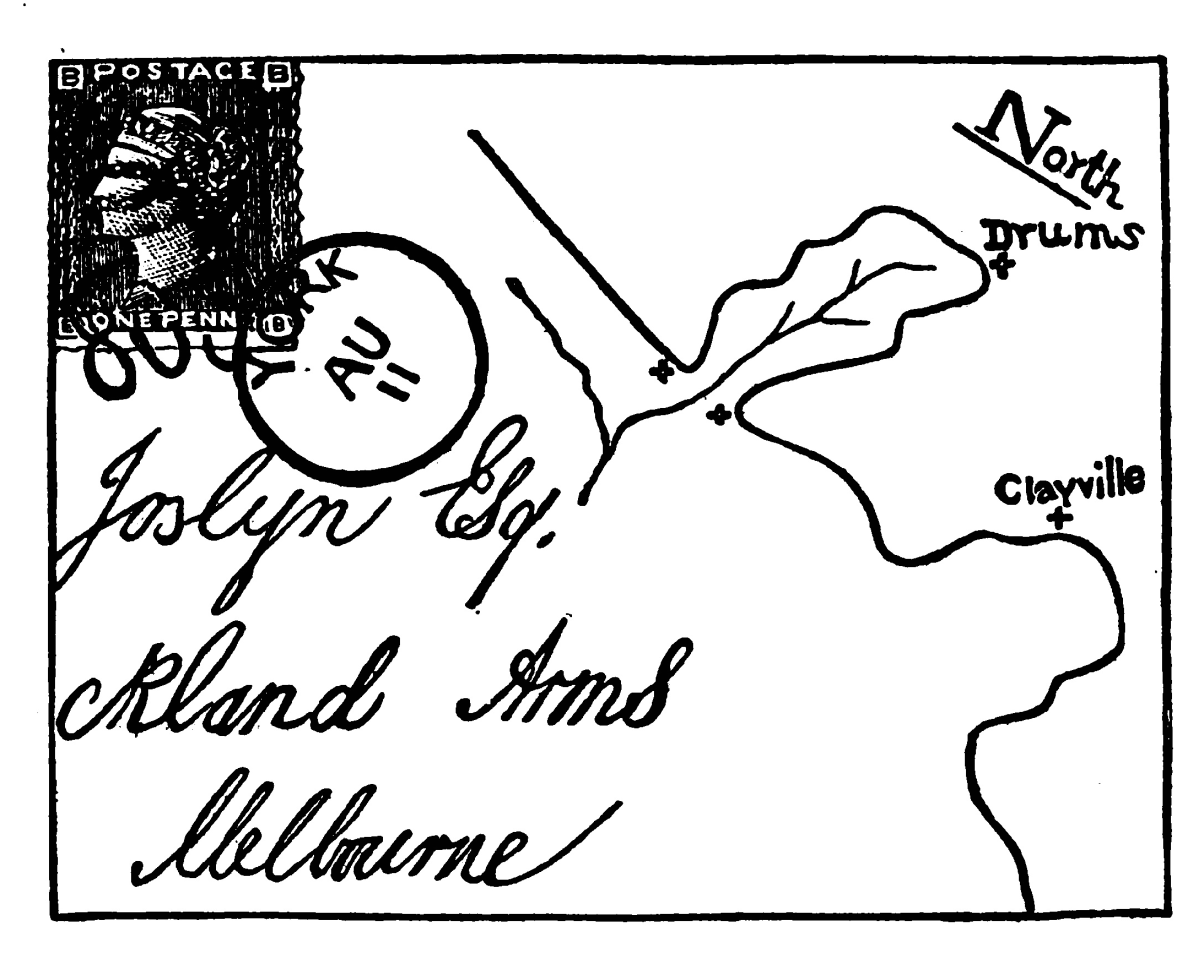
explainshis whole story completely. “Here we are,” said he. “This black line isthe Great Alleghanian,—double track, seventy pounds to the yard; nofiguring off there, I tell you. This was a good straight run, down gradea hundred and seventy-two feet on the mile. There, where I make this X,we came on the Chamoguin Valley, and turned short, nearly north. So weran wriggling about till Drums here, where we stopped if they showedlanterns,—what we call a flag-station. But there we got across thevalley, and worked south again to this other X, which was, as I say, notfive-eighths of a mile from this X above, though it had taken us elevenmiles to get there.”
He had said it was not more than half a mile; but this half-mile grew tofive-eighths as he became more accurate and serious.
“Well,” said he, now resuming the thread of his story, “it was Todhunterput it into my head. He owns he did. Todhunter says, says he, ‘Joslyn,what’s the use of crooking round all these valleys, when it would be soeasy to go across?’
“Well, sir, I saw it then, as clear as I see it now. When that trip wasdone, I had two days to myself,—one was Sunday,—and Todhunter had thesame; and he came round to my house. His wife knew mine, and we likedthem. Well, we fell talking about it; and I got down the Cyclopaedia,and we found out there about the speed of cannon-balls, and thedirection they had to give them. You know this was only talk then; wenever thought what would come of it; but very curious it all was.”
And here Mr. Joslyn went into a long mathematical talk, with which Iwill not harass the reader, perfectly sure, from other experiments whichI have tried with other readers, that this reader would skip it all ifit were written down. Stated very briefly, it amounted to this: In theold-fashioned experiments of those days, a cannon-ball travelled fourthousand and one hundred feet in nine seconds. Now, Joslyn wasconvinced, like every other engineman I ever talked to, that on a steepdown-grade he could drive a train at the rate of a hundred miles anhour. This is thirteen hundred and fourteen feet in nineseconds,—almost exactly one-third of the cannon-ball’s velocity. Atthose rates, if the valley at Chamoguin were really but five-eighths ofa mile wide, the cannon-ball would cross it in seven or eight seconds,and the train in about twenty-three seconds. Both Todhunter and Joslynwere good enough mechanics and machinists to know that the rate forthirty-three hundred feet, the width of the valley, was not quite thesame as that for four thousand feet; for which, in their book, they hadthe calculations and formulas; but they also knew that the differencewas to their advantage, or the advantage of the bold experiment whichhad occurred to both of them when Todhunter had made on the tender hisvery critical suggestion.
The reader has already conceived the idea of this experiment. These rashmen were wondering already whether it were not possible to leap anengine flying over the Chamoguin ravine, as Eclipse or Flying Childersmight have leaped the brook at the bottom of it. Joslyn believedimplicitly, as I found in talk with him, the received statement ofconversation, that Eclipse, at a single bound, sprang forty feet. “IfEclipse, who weighed perhaps one thousand two hundred, would springforty feet, could not my train, weighing two hundred tons, spring ahundred times as far?” asked he triumphantly. At least, he said that hesaid this to Todhunter. They went into more careful studies ofprojectiles, to see if it could or could not.
The article on “Gunnery” gave them just one of those convenient tableswhich are the blessing of wise men and learned men, and which leadhalf-trained men to their ruin. They found that for their “range,” whichwas, as they supposed, eleven hundred yards, the elevation of aforty-two pounder was one degree and a third; of a nine-pounder, threedegrees. The elevation for a railway train, alas! no man had calculated.But this had occurred to both of them from the beginning. In descendingthe grade, at the spot where, on his little map, Joslyn made the morewesterly X, they were more than eleven hundred feet above the spot wherehe had made his second, or easterly X. All this descent was to theadvantage of the experiment. A gunner would have said that the first X“commanded” the second X, and that a battery there would inevitablysilence a battery at the point below.
“We need not figure on it,” said Todhunter, as Mrs. Joslyn called themin to supper. “If we did, we should make a mistake. Give me your papers.When I go up, Monday night, I’ll give them to my brother Bill. I shallpass him at Faber’s Mills. He has studied all these things, of course;and he will like the fun of making it out for us.” So they sat down toMrs. Joslyn’s waffles; and, but for Bill Todhunter, this story wouldnever have been told to me, nor would John Joslyn and “this woman” everhave gone to Australia.
But Bill Todhunter was one of those acute men of whom the newcivilization of this country is raising thousands with every year; who,in the midst of hard hand-work, and a daily duty which to collegians andto the ignorant men among their professors seems repulsive, carry oncareful scientific study, read the best results of the latest inquiry,manage to bring together a first-rate library of reference, never spenda cent for liquor or tobacco, never waste an hour at a circus or a ball,but make their wives happy by sitting all the evening, “figuring,” oneside of the table, while the wife is hemming napkins on the other. Allof a sudden, when such a man is wanted, he steps out, and bridges theGulf of Bothnia; and people wonder, who forget that for two centuriesand a half the foresighted men and women of this country have beenbuilding up, in the face of the Devil of Selfishness on the one hand,and of the Pope of Rome on the other, a system of popular education,improving every hour.
At this moment Bill Todhunter was foreman of Repair Section No. II onthe “Great Alleghanian,”—a position which needed a man of first-ratepromptness, of great resource, of good education in engineering. Such aman had the “Great Alleghanian” found in him, by good luck; and they hadpromoted him to their hardest-worked and best-paid section,—the sectionon which, as it happened, was this Chamoguin run, and the long bendwhich I have described, by which the road “headed” that stream.
The younger Todhunter did meet his brother at Faber’s Mills, where therepair-train had hauled out of the way of the express, and where theexpress took wood. The brothers always looked for each other on suchoccasions; and Bill promised to examine the paper which Joslyn hadcarefully written out, and which his brother brought to him.
I have never repeated in detail the mass of calculations which BillTodhunter made on the suggestion thus given to him. If I had, I wouldnot repeat them here, for a reason which has been suggested already. Hebecame fascinated with the problem presented to him. Stated in thelanguage of the craft, it was this:
Given a moving body, with a velocity eight thousand eight hundred feetin a minute, what should be its elevation that it may fall elevenhundred feet in the transit of five-eighths of a mile?” He had not onlyto work up the parabola, comparatively simple, but he had to allow forthe resistance of the air, on the supposition of a calm, according tothe really admirable formulas of Robins and Coulomb, which were the besthe had access to. Joslyn brought me, one day, a letter from BillTodhunter, which shows how carefully he went into this intricateinquiry.
Unfortunately for them all, it took possession of this spirited andaccomplished young man. You see, he not only had the mathematicalability for the calculation of the fatal curve, but, as had been orderedwithout any effort of his, he was in precisely the situation of thewhole world for trying in practice his own great experiment. At each ofthe two X X of Joslyn’s map, the company had, as it happened, switchesfor repair-trains or wood-trains. Had it not, Bill Todhunter had amplepower to make them.
For the “experiment,” all that was necessary was, that under the pretextof re-adjusting these switches, he should lay out that at the upper X sothat it should run, on the exact grade which he required, to the westernedge of the ravine, in a line which should be the direct continuation ofthe long, straight run with which the little map begins.
An engine, then, running down that grade at the immense rapiditypracticable there, would take the switch with its full speed, would flythe ravine at precisely the proper slopes, and, if the switch had beenrightly aligned, would land on the similar switch at the lower X. Itwould come down exactly right on the track, as you sit precisely on achair when you know exactly how high it is.
“If.” And why should it not be rightly aligned, if Bill Todhunterhimself aligned it? This he was well disposed to do. He also would alignthe lower switch, that at the lower X, that it might receive into itswilling embrace the engine on its arrival.
When the bold engineer had conceived this plan, it was he who pushed theothers on to it, not they who urged him. They were at work on theirdaily duty, sometimes did not meet each other for a day or two. BillTodhunter did not see them more than once in a fortnight. But wheneverthey did meet, the thing seemed to be taken more and more for granted.At last Joslyn observed one day, as he ran down, that there was a largeworking-party at the switch above Drums, and he could see BillTodhunter, in his broad sombrero, directing them all. Joslyn was notsurprised, somehow, when he came to the lower switch, to find anotherworking-party there. The next time they all three met, Bill Todhuntertold them that all was ready if they were. He said that he had left afew birches to screen the line of the upper switch, for fear somenervous bungler, driving an engine down, might be frightened, and “blow”about the switch. But he said that any night when the others were readyto make the fly, he was; that there would be a full moon the nextWednesday, and, if there was no wind, he hoped they would do it then.
“You know,” said poor Joslyn, describing it to me, “I should never havedone it alone; August would never have done it alone; no, I do not thinkthat Bill Todhunter himself would have done it alone. But our heads werefull of it. We had thought of it and thought of it till we did not thinkof much else; and here was everything ready, and neither of us wasafraid, and neither of us chose to have the others think he was afraid.I did say, what was the truth, that I had never meant to try it with atrain. I had only thought that we should apply to the supe, and that hewould get up a little excursion party of gentlemen,—editors, you know,and stockholders,—who would like to do it together, and that I shouldhave the pleasure and honor of taking them over. But Todhunter poohed atthat. He said all the calculations were made for the inertia of a fulltrain, that that was what the switch was graded for, and that everythingwould have to be altered if any part of the plan were altered. Besides,he said the superintendent would never agree, that he would insist onconsulting the board and the chief engineer, and that they would fiddleover it till Christmas.
“‘No,’ said Bill, ‘next Wednesday, or never! If you will not do it then,I will put the tracks back again.’ August Todhunter said nothing; but Iknew he would do what we agreed to, and he did.
“So at last I said I would jump it on Wednesday night, if the night wasfine. But I had just as lief own to you that I hoped it would not befine. Todhunter—Bill Todhunter, I mean—was to leave the switch openafter the freight had passed, and to drive up to the Widow Jones’s CrossRoad. There he would have a lantern, and I would stop and take him up.He had a right to stop us, as chief of repairs. Then we should haveseven miles down-grade to get up our speed, and then—we should see!
“Mr. Ingham, I might have spared myself the hoping for foul weather. Itwas the finest moonlight night that you ever knew in October. And ifBill Todhunter had weighed that train himself, he could not have beenbetter pleased,—one baggage-car, one smoking-car, two regularfirst-class, and two palaces: she run just as steady as an old cow! Wecame to the Widow Jones’s, square on time; and there was Bill’s lanternwaving. I slowed the train: he jumped on the tender without stopping it.I ‘up brakes’ again, and then I told Flanagan, my fireman, to go back tothe baggage-car, and see if they would lend me some tobacco. You see, wewanted to talk, and we didn’t want him to see. ‘Mr. Todhunter and I willfeed her till you come back,’ says I to Flanagan. In a minute after hehad gone, August Todhunter came forward on the engine; and, I tell you,she did fly!
“‘Not too fast,’ said Bill, ‘not too fast: too fast is as bad as tooslow.’
“‘Never you fear me,’ says I. ‘I guess I know this road and this engine.Take out your watch, and time the mile-posts,’ says I; and he timedthem. ‘Thirty-eight seconds,’ says he; ‘thirty-seven and a half,thirty-six, thirty-six, thirty-six,’—three times thirty-six, as wepassed the posts, just as regular as an old clock! And then we cameright on the mile-post you know at Old Flander’s. ‘Thirty-six,’ saysBill again. And then she took the switch,—I can hear that switch-rodring under us now Mr. Ingham,—and then—we were clear!
“Wasn’t it grand? The range was a little bit up, you see, at first; butit seemed as if we were flying just straight across. All the rattle ofthe rail stopped, you know, though the pistons worked just as true asever; neither of us said one word, you know; and she just flew—well, asyou see a hawk fly sometimes, when he pounces, you know, only she flewso straight and true! I think you may have dreamed of such things. Ihave; and now,—now I dream it very often. It was not half a minute, youknow, but it seemed a good long time. I said nothing and they saidnothing; only Bill just squeezed my hand. And just as I knew we must behalf over,—for I could see by the star I was watching ahead that wewere not going up, but were falling again,—do you think the rope by myside tightened quick, and the old bell on the engine gave one savagebang, turned right over as far as the catch would let it, and stuckwhere it turned! Just that one sound, everything else was still; andthen she landed on the rails, perhaps seventy feet inside the ravine,took the rails as true and sweet as you ever saw a ship take the water,hardly touched them, you know, skimmed—well, as I have seen a swallowskim on the sea; the prettiest, well, the tenderest touch, Mr. Ingham,that ever I did see! And I could just hear the connecting rods tightenthe least bit in the world behind me, and we went right on.
“We just looked at each other in the faces, and we could not speak; no,I do not believe we spoke for three quarters of a minute. Then Augustsaid, ‘Was not that grand? Will they let us do it always, Bill?’ But wecould not talk then. Flanagan came back with the tobacco, and I had justthe wit to ask him why he had been gone so long. Poor fellow! he wasfrightened enough when we pulled up at Clayville, and he thought it wasDrums. Drums, you see, was way up the bend, a dozen miles aboveClayville. Poor Flanagan thought we must have passed there while he wasskylarking in the baggage-car, and that he had not minded it. We neverstopped at Drums unless we had passengers, or they. It was what we calla flag-station. So I blew Flanagan up, and told him he was gone toolong.
“Well, sir, at Clayville we did stop,—always stopped there for wood.August Todhunter, he was the palace conductor; he went back to look tohis passengers. Bill stayed with me. But in a minute August came runningback, and called me off the engine. He led me forward, where it wasdark; but I could see, as we went, that something was to pay. The minutewe were alone he says,—
“‘John, we’ve lost the rear palace.’
“‘Don’t fool me, August,’ says I.
“‘No fooling, John,’ says he. ‘The shackle parted. The cord parted, andis flying loose behind now. If you want to see, come and count the cars.The “General Fremont” is here all right; but I tell you the “JamesBuchanan” is at the bottom of the Chamoguin Creek.’
“I walked back to the other end of the platform, as fast as I could goand not be minded. Todhunter was there before me, tying up the loose endof the bell-cord. There was a bit of the broken end of the shackletwisted in with the bolt. I pulled the bolt and threw the iron into theswamp far as I could fling her. Then I nodded to Todhunter and walkedforward just as that old goose at Clayville had got his trousers on, sohe could come out, and ask me if we were not ahead of time. I tell you,sir, I did not stop to talk with him. I just rang ‘All aboard!’ andstarted her again; and this time I run slow enough to save the timebefore we came down to Steuben. We were on time, all right, there.”
Here poor Joslyn stopped a while in his story; and I could see that hewas so wrought up with excitement that I had better not interrupt,either with questions or with sympathy. He rallied in a minute or two,and said,—
“I thought—we all thought—that there would be a despatch somewherewaiting us. But no; all was as regular as the clock. One palace more orless,—what did they know, and what did they care? So daylight came. Wecould not say a word, you know, with Flanagan there; and we onlystopped, you know, a minute or two every hour; and just then was whenAugust Todhunter had to be with his passengers, you know. Was not I gladwhen we came into Pemaquid,—our road ran from Pemaquid across themountains to Eden, you know,—when we came into Pemaquid, and nobody hadasked any questions?
“I reported my time at the office of the master of trains, and I wenthome. I tell you, Mr. Ingham, I have never seen Pemaquid Station sincethat day.
“I had done nothing wrong, of course. I had obeyed every order, andminded every signal. But still I knew public opinion might be against mewhen they heard of the loss of the palace. I did not feel very wellabout it, and I wrote a note to say I was not well enough to take mytrain the next night; and I and Mrs. Joslyn went to New York, and I wentaboard a Collins steamer as fireman; and Mrs. Joslyn, she went asstewardess; and I wrote to Pemaquid, and gave up my place. It was a goodplace, too; but I gave it up, and I left America.
Bill Todhunter, he resigned his place too, that same day, though thatwas a good place. He is in the Russian service now. He is running theirline from Archangel to Astrachan; good pay, he says, but lonely. Augustwould not stay in America after his brother left; and he is nowcaptain’s clerk on the Harkaway steamers between Bangkok and Cochbang;good place he says, but hot. So we are all parted.
“And do you know, sir, never one of us ever heard of the lost palace!”
Sure enough, under that very curious system of responsibility, by whichone corporation owns the carriages which another corporation uses,nobody in the world has to this moment ever missed “The Lost Palace.” Oneach connecting line, everybody knew that “she” was not there; but noone knew or asked where she was. The descent into the rocky bottom ofthe Chamouin, more than fifteen hundred feet below the line of flight,had of course been rapid,—slow at first, but in the end rapid. In thefirst second, the lost palace had fallen sixteen feet; in the second,sixty-four; in the third, one hundred and forty-four; in the fourth, twohundred and fifty-six; in the fifth, four hundred feet; so that it musthave been near the end of the sixth second of its fall, that, with avelocity now of more than six hundred feet in a second, the fallingpalace, with its unconscious passengers, fell upon the rocks at thebottom of the Chamoguin ravine. In the dead of night, wholly without jaror parting, those passengers must have been sleeping soundly; and it isimpossible, therefore, on any calculation of human probability, that anyone of them can have been waked an instant before the completedestruction of the palace, by the sudden shock of its fall upon the bedof the stream. To them the accident, if it is fair to call it so, musthave been wholly free from pain.
The tangles of that ravine, and the swamp below it, are such that Isuppose that even the most adventurous huntsman never finds his waythere. On the only occasion when I ever met Mr. Jules Verne he expresseda desire to descend there from one of his balloons, to learn whether theinhabitants of “The Lost Palace” might not still survive, and be livingin a happy republican colony there,—a place without railroads, withouttelegrams, without mails, and certainly without palaces. But at themoment when these sheets go to press, no account of such an adventurehas appeared from his rapid pen.
99 LINWOOD STREET
A CHRISTMAS STORY
A GRAY morning, the deck wet, the iron all beaded with frost, all thelongshoremen in heavy pea-jackets or cardigans, the whole ship in abustle, and the favored first-class passengers just leaving.
One sad-looking Irish girl stands with her knit hood already spottedwith the rime, and you cannot tell whether those are tears which hangfrom her black eyelashes or whether the fog is beginning to freezethere. What you see is that the poor thing looks right and left and upthe pier and down the pier, and that in the whole crowd—they all seemso selfish—she sees nobody. Hundreds of people going and coming,pushing and hauling, and Nora’s big brother is not there, as he promisedto be and should be.
Mrs. Ohstrom, the motherly Swedish woman, who has four children and tentin cups and a great bed and five trunks and a fatuous, feckless husbandmakes time, between cousins and uncles and custom-house men andsharpers, to run up every now and then to say that Nora must not cry,that she must be easy, that she has spoken to the master and the masterhas said they are three hours earlier than they were expected. And allthis was so kindly meant and so kindly said that poor Nora brushed thetears away, if they were tears, and thanked her, though she did notunderstand one word that dear Mrs. Ohstrom said to her. What islanguage, or what are words, after all?
And the bright-buttoned, daintily dressed little ship’s doctor, whompoor Nora hardly knew in his shore finery,—he made time to stop andtell her that the ship was too early, and that she must not worry.Father, was it, she was waiting for? “Oh, brother! Oh, he will be sureto be here! Better sit down. Here is a chair. Don’t cry. I am afraid youhad no breakfast. Take this orange. It will cheer you up. I shall seeyou again.”
Alas! the little doctor was swept away and forgot Nora for a week, andshe “was left lamenting.”
For one hour went by, and two, and three. The Swedish woman went, andthe doctor went, and the girl could see the captain go, and the matethat gave them their orders every morning. The custom-house people beganto go. The cabs and other carriages for the gentry had gone long before.
And poor Nora was left lamenting.
Then was it that that queer Salvation Army girl, with a coal-scuttle fora bonnet, came up again. She had smiled pleasantly two or three timesbefore, and had asked Nora to eat a bun. Poor Nora broke down and criedheartily this time. But the other was patient and kind, and said justwhat the others had said. Only she did not go away. And she had thesense to ask if Nora knew where the brother lived.
“Why, of course I do, miss. See, here is the paper.”
And the little soldier lass read it: “99 Linwood Street, Boston.”
“My poor child, what a pity you did not let us see it before!”
Alas and alas! Nora’s box was of the biggest. But the army lass flinchedat nothing.
An immense wagon, with two giant horses, loaded with the mostextraordinary chests which have been seen since the days of the Vikings.Piled on the top were many feather-beds, and on the top of thefeather-beds a Scandinavian matron. With Mike, the good-naturedteamster, who was at once captain and pilot of this craft, the army lasshad easily made her treaty, when he was told the story. He was to carryNora and her outfit to the Linwood Street house after he had taken theseSwedes to theirs. “And indade it will not be farr, miss. There’s ashorrt cut behind Egan’s, if indade he did not put up a tinimint housesince I was that way.” And with new explanations to Nora that all wasright, that indeed it was better this way than it would have been hadher brother been called from his work, she was lifted, without muchconsent of her own, to the driver’s seat, and her precious “box” was soplaced that she could rest her little feet upon it.
Nora had proudly confided to the friendly lass the assurance that shehad money, had even shown a crisp $2 bill which had been sent to her forexigencies.
But when the lass made the contract with Mike Dermott, the good fellowsaid he should take Nora and her box for the love of County Cork.“Indade, indade, I don’t take money from the like of her.”
And so they started, with the Swedish men walking on one side of thecart with their rifles, keeping a good lookout for buffaloes and redIndians and grizzly bears, as men landing in a new country which theywere to civilize. More sailing for there was the ferry to cross to oldBoston. Much waiting, for there was a broken-down coal-wagon inSalutation Alley. Long conference between Nora and Mike, in which he didall the talking and she all the listening, as to home rule and Mr.McCarthy, and what O’Brien thought of this, and what Cunniff thought ofthat. Then an occasional question came in Swedish from the matron abovetheir heads, and was followed by a reply in Celtic English from Mike,each wholly ignorant of the views or wishes of the others. Andoccasionally the escort of riflemen, after some particular attack ofchaff, in words which they fortunately did not understand, looked up totheir matron, controller, and director, exchanged words with her, andthen studied the pavement again for tracks of buffalo. A long hour ofall this, the stone and brick of the city giving way to green treesbetween the houses as they come to Dorchester.
Poor Nora looks right and looks left, hoping to meet her big brother.She begins to think she shall remember him. Everybody else looks sodifferent from Fermoy that he must look like home.
But there is no brother.
There is at last a joyful cry as the Swedish matron and the riflemenrecognize familiar faces. And Mike smiles gladly, and brings round thestout bays with a twitch, so that the end of the cart comes square tothe sidewalk. Somebody produces a step-ladder, and the Swedish matron,with her bird-cage in her hand, descends in triumph. Much kissing, muchshaking of hands, much thanking of God, more or less reverent. Then thecords are cut, beds flung down, the giant boxes lifted, the sons of Anakonly know how. The money covenanted for is produced and paid, and Mikemounts lightly to Nora’s side.
“And now, Nora, my child, wherr is the paper? For in two minutes we’llsoon be therr, now that this rubbish is landed.”
And he read on the precious paper, “John McLaughlin, 99 Linwood Street.”
Strange to say, the paper said just what it had said two hours before.
“And now, my dear child, we will be therr in ten minutes, if only we cancross back of Egan’s.”
And although they could not cross back of Egan’s, for Egan had put up a“tinimint” house since Mike had passed that way, yet in ten minutesLinwood Street had been found. No. 99 at last revealed itself, betweenNos. 7 and 2,—a great six-story wooden tinder-box, with clothes-linesmysterious behind, open doors in front, long passages running through,three doors on each side of a passage, and the wondering heads of elevenwomen who belonged to five different races and spoke in six differentlanguages appearing from their eleven windows, as Mike and Nora and thetwo bays all stopped at one and the same moment at the door.
Mike was already anxious about his time, for he was to be at thecustom-house an hour away or more at eleven sharp. But he selected acertain Widow Flynn from the eleven white-capped women; he explained toher briefly that John McLaughlin was to be found; he told Nora for thethirty-seventh time that all was right and that she must not cry; helooked at his watch again, rather anxiously, mounted his box, and droveswiftly away.
He was the one thread which bound Nora to this world. And this threadbroke before her eyes.
Mrs. Flynn affected to be cheerful. But she was not cheerful. Mrs. Flynnwas a prominent person in her sodality. And well she knew that if anyJohn McLaughlin in those parts were expecting any sister from home, sheshould know him and where he lived. Well she knew, also, that JohnMcLaughlin, the mason, was born in Glasgow; that John McLaughlin, who ison the city work, had all his family around him, and, most distinct ofall, she knew that no McLaughlin, sisterless or many-sistered, lived inthis beehive which she lived in, though it were 99 Linwood Street. Intoher own cell of that beehive, however, she took poor, sad, desolateNora. Into the hallway she bade the loafing neighbor boys bring Nora’strunk; in a language Nora could hardly understand she explained to herthat all would be well as soon as the policeman passed by. She sent MaryMurphy, who happened to be at home from school, for a pint of milk, andso compelled Nora to drink a cup of tea and to eat a biscuit and adropped egg, while they waited for the policeman.
Of course he knew of seven John McLaughlins. He even went to thedrug-store and looked in the Boston Directory to find that there werethere the names of sixty-one more. But not one of them lived in LinwoodStreet, as they all knew already. All the same Nora was charged not tocry, to drink more tea and eat more bread and butter. The “cop” said hewould look in on three of the Johns whom he knew, and intelligent boysnow returning from school were sent to the homes of the other four tointerrogate them as to any expected sister. Within an hour, now nearlyone o’clock, answers were received from all the seven. No one of themexpected chick or child from Fermoy.
But the “cop” had a suggestion to make. His pocket list of names ofstreets revealed another Linwood Street—in Roxbury; not this one inDorchester. Be it known to unlearned readers, who in snug shelter inMontana follow along this little tale, that Roxbury and Dorchester areboth parts of that large municipality called Boston. Though no JohnMcLaughlin was in the directory for 99 Linwood Street, Roxbury, was notthat the objective? Poor Nora was questioned as to Roxbury. She was sureshe never heard of it.
But the clue was too good to be lost, and the authority of the friendly“cop” was too great to be resisted. He telephoned to the central officethat Nora McLaughlin, just from Ireland, had been found, in a fashion,but that no one knew where to put her. Then he stopped a milkman fromBraintree, who delivered afternoon milk for invalids.
Was he not going through Roxbury?
Of course he was.
Would he not take this lost child to 99 Linwood Street?
Of course he would. Milkmen, from their profession, have hearts warmtoward children.
Well, if he were to take her, he had better take her trunk too.
To which illogical proposal the milkman acceded—on the afternoon routethere is so much less milk to take than there is in the morning.
So Nora was lifted into the milk-wagon. In tears she kissed good Mrs.Flynn. The boys and girls assembled to bid her good-by, and even she hada hope for a few moments that her troubles were at an end.
At 99 Linwood Street, Roxbury, they were preparing for the Review Club.
The Review Club met once a fortnight at half-past two o’clock at thehouse of one or another of the members. They first arranged the littledetails of the business. Then the hostess read, or made some one read,the scraps which seemed most worthy in the reviews and magazines of thelast issues, and at four the husbands and brothers and neighborsgenerally dropped in, and there was afternoon tea.
“You are sure you have cream enough, Ellen?”
“Oh, yes, mum.”
“All kinds of tea, you know, that which the Chinese gentlemen sent, andbe sure of the chocolate for Mrs. Bunce.”
“Indeed yes, mum.”
“And let me know just before you bring up the hot water.” Doorbellrings. “There is Mrs. Walter now!”
No, it wasn’t Mrs. Walter. She came three minutes after. But before shecame, Howells, the milkman, had lifted Nora from her seat. As the snowfell fast on the doorsteps, he carried her carefully up to the door, andeven by the time Ellen answered the bell he had the heavy chest,dragging it over the snow by the stout rope at one end.
Ellen was amazed to find this group instead of Mrs. Walter. She calledher mistress, who heard Howells’s realistic story with amazement, not tosay amusement.
“You poor dear child!” she cried at once. “Come in where it is dry! JohnMcLaughlin? No, indeed! Who can John McLaughlin be? Ellen, what isMike’s last name?”
Mike was the choreman, who made the furnace fire and kept the sidewalk.
“Mike’s name, mum? I don’t know, mum. Mary will know, mum.”
And for the moment Ellen disappeared to find Mary.
“Never mind, never mind. Come in, you poor child. You are very good tobring her, Mr. Howells, very good indeed. We will take care of her. Isit going to storm?”
Mr. Howells thought it was going to storm, and turned to go away. Atthat moment Mrs. Walter arrived, the first comer of the Review Club. AndNora’s new hostess had to turn to her guests, while Ellen in the lastcares for the afternoon table had to comfort Nora by spasms. It was leftfor Margaret the chambermaid to pump out—or to screw out, as youchoose—the details of the story from the poor frightened waif, whoseemed more astray than ever.
John McLaughlin? No. Nobody knew anything about him. The last choremanwas named McManus, but he went to Ottawa three years ago!
And while the different facts and doubts were canvassed in the kitchen,upstairs they settled the Bulgarian question, the origin of the nativesof Tasmania, and the last questions about realism.
Only the mind of the lady of the house returned again and again toquestions as to the present residence of John McLaughlin.
For in spite of the gathering snow and the prospect of more, the membersof the Review Club had followed fast on Mrs. Walters and gathered infull force.
The hostess, though somewhat preoccupied, was courteous and ready.
Only the functions of the club, as they went forward, would beoccasionally interrupted. Thus she would read aloud “as in her privateduty bound”—
“‘The peasantry were excited, but were held in check by promises fromStambuloff. The emissaries of the Czar—’
“Mrs. Goodspeed, would you mind reading on? Here is the place. I see mypostman pass the window.”
And so, moving quickly to the front door, she interviewed the faithfulHarrington, dressed, heaven knows why, in Confederate uniform of gray.For Harrington had served his four years on the loyal side. Four times aday did Harrington with his letter-bag renew the connection of thishousehold with the world and other worlds.
“Dear Mr. Harrington, I thought you could tell us. Here is a girl namedNora McLaughlin, and here is her trunk, both left at the door by themilkman, and we do not know anything about where she belongs.”
“Insufficient address?” asked Harrington, professionally.
“Exactly. All she knows is that her brother is named John.”
“A great many of them are,” said Harrington, already writing on hismemorandum book, and in his memory fixing the fact that a large,two-legged living parcel, insufficiently addressed, had been left at thewrong door for John McLaughlin; also a trunk, too large for delivery bythe penny post.
“I will tell the other men, and if I was you I would send to thepolice.”
“Would you mind telling the first officer you meet? I hate to send mygirls out.” And so she returned to Bulgaria.
But Bulgaria was ended, and Mrs. Conover handed her an article on“Antarctic Discovery.” She was again reading:—
“Under these circumstances Captain Wilkes, who had collected a boatloadof stones from the front of the glacier,” when she gave back the “Forum”to Mrs. Conover. “Would you mind going on just a minute? “ she said, andran out to meet the icecream man. So soon as he had left his tins shesaid,—
“Mr. Fridge, would you mind stopping at the Dudley School as you go homeand telling Miss Lougee that there is a lost girl here?” etc.
Good Mr. Fridge was most eager to help, and the hostess returned, tookthe book again and read on with “the temperature, as they observed it,was 99 degrees C.; but, as the alcohol in their tins was frozen at themoment, there seemed reason to suspect the correctness of thisobservation.”
And a shiver passed over the Review Club.
Thus far the powers of confusion and error seemed to have beentriumphant over poor Nora, or such was the success of that power whouses these agencies, if the reader prefer to personify him.
But the time had come to turn his left flank and to attack his forces inthe rear, for the postman now took the field,—that is to say,Harrington, good fellow, finished his third delivery, four good milesand nine-tenths of a furlong, snow two inches deep, three, four, six,before he was done, and then returned to his branch office to report.
“Two-legged parcel; insufficient address; 99 Linwood Street! Jim, whatever come to that letter that went to 99 Linwood Street withinsufficient address six weeks ago?”
“Linwood Street? Insufficient address? Foreign letter? Why, of course,you know, went back to the central office.”
“I guess it did,” said Harrington, grimly; “so I must go there too.”
This meant that after Harrington had gone his rounds again on deliveryroute No. 6, four more miles and nine-tenths more of a furlong, 313doorbells and only 73 slit boxes, snow now ranging from 6 inches to 12on the sidewalks, and breast-deep where there was a chance for drifting,when all this was well done, so that Harrington had no more duties toUncle Sam, he could take Nora McLaughlin’s work in hand, and thus defeatthe prince of evil.
To the central office by a horse-car. Blocked once or twice, but well atthe office at 7.30 in the evening.
Christmas work heavy, so the whole home staff is on duty. That is well.Enemy of souls loses one point there.
Blind-letter clerks all here. Insufficient-delivery men both here. Chiefof returned bureau here. All summoned to the foreign office asHarrington tells his story. Indexes produced, ledgers, journals,day-books, and private passbooks. John McLaughlin’s biography followedout on 67 of the different avatars in which his personality has beenmanifested under that name. False trail here—clue breaks there—scentfails here, but at last—a joyful cry from Will Search:—
“Here you are! Insufficient address. November 1. Queenstownletter—‘Linwood, to John McLaughlin. Try Dorchester. Try Roxbury. TryEast Boston. Try Somerville’—and there it stops, and was not returned.”
“Try Somerville!”
In these words great light fell over the eager circle. Not becauseSomerville is the seat of an insane hospital. No! But because it is notin the Boston Directory.
If you please, Somerville is an independent city, and so, unless JohnMcLaughlin worked in Boston, if he lived in Somerville, he would not bein the Boston Directory.
Not much! Somerville has its own seven John McLaughlins besides thoseBoston ones.
“I say, Harry, Tom, Dick—somebody fetch Somerville Directory!”
Dick flew and returned with the book.
“Here you be! ‘John McLaughlin, laborer, 99 Linwood Street!’”
“Victory!”
Satan’s forces tremble, and as the different officers return to theirdesks “even the ranks of Tuscany” in that well-bred office “can scarceforbear to cheer.”
As for Harrington, he bids good-by, wraps his tartan around him, and isout in the snow again. Where Linwood Street is he “knows no more thanthe dead.” But somebody will know.
Somerville car. Draw of bridge open. Man falls into the river and has tobe rescued. Draw closes. Snow-drift at Margin Street. Shovels. Driftopen. Centre of Somerville. Apothecary’s shop open. “Please, where isLinwood Street?”
“Take your second left, cross three or four streets, turn to the rightby the water-pipe, take the third right, go down hill by the schoolhouseand take second left, and you come out at 11 Linwood Street.”
All which Harrington does. He experiences one continual burst of joythat his route does not take him through these detours daily. But hisprofessional experience is good for him. We have no need to describe hisfalse turns. Even aniseed would have been useless in that snow. At last,just as the Somerville bells ring for nine o’clock, Harrington alsorings triumphant at the door of the little five-roomed cottage, wherehis lantern has already revealed the magic number 99.
Ring! as for a gilt-edged special delivery! Door thrown open by a solidman with curly red hair, unshaven since Sunday, in his shirtsleeves andwith kerosene lamp in his hand.
“Are you John McLaughlin?”
“Indade I am; the same.”
“And where’s your sister Nora?”
The good fellow, who had been stern before, broke down. “And indade Iwas saying to Ellen it’s an awful night for ’em all in the gale off thecoast in the ship. The holy Virgin and the good God take care of ’em!”
“They have taken care of them,” said Harrington, reverently. “The shipis safe in dock, and your sister Nora is in Roxbury, at 99 LinwoodStreet!”
And a broad grin lighted his face as he spoke the words.
There was joy in every bed and at every door of the five rooms. ThenJohn hastily donned coat, cardigan, and ulster. He persuaded Harringtonto drink a cup of red-hot tea which was brewing on the stove. While thegood fellow did so, and ate a St. Anne’s bun, which Mrs. McLaughlinproduced in triumph, John was persuading Hermann Gross, the expressmannext door, to put the gray into a light pung he had for specialdelivery. By the time Harrington went to the door two lanterns wereflitting about in the snow-piled yard behind the two houses.
Harrington assisted in yoking the gray. In five minutes he and John weredefying the gale as they sped across the silent bridge, bound south toRoxbury. Poor little Nora was asleep in the parlor on the sofa. She hadbegged and begged that she need not be put to bed, and by her side herprotector sat reading about the antarctic. But of a sudden Harringtonreappeared.
Is it Santa Claus?
Indeed it is! Beard, hat, coat, all white with snow!
And Santa Claus has come for the best present he will deliver thatevening!
Dear little Nora is wrapped in sealskins and other skins, mauds andastrakhan rugs. She has a hot brick at her feet, and Pompey, the dog, ismade to lie over them, so John McLaughlin No. 68 takes her in triumph to99 Linwood Street.
That was a Christmas to be remembered! And Christmas morning, afterchurch, the Brothers of St. Patrick, which was the men’s society, andthe Sodality of St. Anne’s, which was the women’s, determined on a greatTwelfth-night feast to celebrate Nora’s return.
It was to show “how these brethren love one another.”
They proposed to take the rink. People didn’t use it for skating inwinter as much as in summer.
Nora was to receive, with John McLaughlin and his wife to assist. Theother 74 John McLaughlins were to act as ushers.
The Salvation Army came first, led by the lass who found Michael.
Procession No. 2 was Mike and the teamsters who “don’t take nothing forsuch as she.”
Third, in special horse-cars, which went through from Dorchester toSomerville by a vermilion edict from the West End Company, the elevenfamilies of that No. 99. They stopped in Roxbury to pick up Ellen andthe hostess of the Review Club.
Fourth, all the patrolmen who had helped and all who tried to help, ledby “cop” No. 47.
Fifth, all the school children who had told the story and had madeinquiries.
Sixth, the man who made the Somerville Directory.
Seventh and last, in two barouches, Harrington and the chiefs of staffat the general post-office. And the boys asked Father McElroy to make aspeech to all just before the dancing began.
And he said: “The lost sheep was never lost. She thought she was lost inthe wilderness, but she was at home, for she was met by the Christmasgreeting of the world into which the dear Lord was born!”
NOTE.—It may interest the reader to know that the important part ofthis story is true.
IDEALS
CHAPTER I
IN ACCOUNT
I HAVE a little circle of friends, among all my other friends quitedistinct, though of them. They are four men and four women; the husbandsmore in love with their wives than on the days when they married them,and the wives with their husbands. These people live for the good of theworld, to a fair extent, but much, very much, of their lives is passedtogether. Perhaps the happiest period they ever knew was when, indifferent subordinate capacities, they were all on the staff of the samemagazine. Then they met daily at the office, lunched together perforce,and could make arrangements for the evening. But, to say true, thingsdiffer little with them now, though that magazine long since took wingsand went to a better world.
Their names are Felix and Fausta Carter, Frederic and Mary Ingham,George and Anna Haliburton, George and Julia Hackmatack.
I get the children’s names wrong to their faces—except that in generaltheir name is Legion, for they are many—so I will not attempt themhere.
These people live in very different houses, with very different“advantages,” as the world says. Haliburton has grown very rich in therag and paper business, rich enough to discard rag money and believe ingold. He even spits at silver, which I am glad to get when I can.Frederic Ingham will never be rich. His regular income consists in hishalf-pay as a retired brevet officer in the patriot service of Garibaldiof the year 1859. For the rest, he invested his money in the Brick Moon,and, as I need hardly add, insured his life in the late ContinentalInsurance Company. But the Inghams find just as much in life as theHaliburtons, and Anna Haliburton consults Polly Ingham about the shadeof a flounce just as readily and as eagerly as Polly consults her aboutthe children’s dentistry. They are all very fond of each other.
They get a great deal out of life, these eight, partly because they areso closely allied together. Just two whist-parties, you see; or, if theygo to ride, they just fill two carriages. Eight is such a goodnumber—makes such a nice dinner-party. Perhaps they see a little toomuch of each other. That we shall never know.
They got a great deal of life, and yet they were not satisfied. Theyfound that out very queerly. They have not many standards. Ingham doestake the “Spectator;” Hackmatack condescends to read the “Evening Post;”Haliburton, who used to be in the insurance business, and keeps his oldextravagant habits, reads the “Advertiser” and the “Transcript;” all ofthem have the “Christian Union,” and all of them buy “Harper’s Weekly.”Every separate week of their lives they buy of the boys, instead ofsubscribing; they think they may not want the next number, but theyalways do. Not one of them has read the “Nation” for five years, forthey like to keep good-natured. In fact, they do not take much stock inthe general organs of opinion, and the standard books you find about arescandalously few. The Bible, Shakespeare, John Milton; Polly has Dante;Julia has “Barclay’s Apology,” with ever so many marks in it; one Georgehas “Owen Felltham,” and the other is strong on Marcus Aurelius. Well,no matter about these separate things; the uniform books besides those Inamed, in different editions but in every house, are the “ArabianNights” and “Robinson Crusoe.” Hackmatack has the priceless firstedition. Haliburton has Grandville’s (the English Grandville). Inghamhas a proof copy of the Stothard. Carter has a good copy of theCruikshank.
If you ask me which of these four I should like best, I should say asthe Laureate did when they gave him his choice of two kinds of cake,“Both’s as good as one.”
Well, “Robinson Crusoe” being their lay gospel and creed, not to sayepistle and psalter, it was not queer that one night, when the electionhad gone awfully, and the men were as blue as that little porcelainOsiris of mine yonder, who is so blue that he cannot stand on hisfeet—it was not queer, I say, that they turned instinctively to“Robinson Crusoe” for relief.
Now, Robinson Crusoe was once in a very bad box indeed, and to comforthimself as well as he could, and to set the good against the evil, thathe might have something to distinguish his case from worse, he statedimpartially, like debtor and creditor, the comforts and miseries,thus:—
| EVIL. | GOOD. |
I am cast upon a horribledesolate island, void of allrecovery. | But I am alive, and notdrowned as all my hope ofship’s company were. |
I am singled out and separated,as it were, from all the world, tobe miserable. | But I am singled out,too, from the ship’s crewto be spared from death. |
And so the debtor and creditor account goes on.
Julia Hackmatack read this aloud to them—the whole of it—and theyagreed, as Robinson says, not so much for their posterity as to keeptheir thoughts from daily poring on their trials, that for each familythey would make such a balance. What might not come of it? Perhaps apartial nay, perhaps a perfect cure!
So they determined that on the instant they would go to work, and two inthe smoking-room, two in the dining-room, two in George’s study, and twoin the parlor, they should in the next half-hour make up their lists ofgood and evil. Here are the results:—
| FREDERIC AND MARY INGHAM. | |
| GOOD. | EVIL. |
We have three nice boys | But the door-bell rings all |
We have enough to eat,drink, and wear. | But the coal bill is awful, |
We have more books than | But our friends borrow our |
We have many very dear | But we are behindhand 143 |
We have health in our | But the children may be |
We seem to be of some | But Mrs. Hogarth has left |
The country has gone to the dogs. | |
| GEORGE AND ANNA HALIBURTON. | |
| GOOD. | EVIL. |
We have a nice home in | You cannot give a cup of |
We have some of the nicest | A great many people call |
We have enough to do, and | We have to give a party to |
Business is good enough, | We do not do anything we |
The children are all well. | People vote as if they were |
| GEORGE AND JULIA HACKMATACK | |
| GOOD. | EVIL. |
We have eight splendid | The plumbers’ work always |
We have money enough, | The furnace will not heat the |
George will not have to go | We hate the Kydd School. |
Tom got through with scarlet | Lucy said “commence” yesterday, |
Dr. Witherspoon has accepted | How long any man can live |
| FELIX AND FAUSTA CARTER | |
| GOOD. | EVIL. |
Governments are stronger | But as the children grow |
All the boys are good and | But the children get no |
Old Mr. Porter died last | But the gas-meter lies; |
The lost volume of Fichte | But the Athenaeum is always |
The mistress of the Arbella | But our drains smell |
| We have to go to evening |
| The increasing |
With these papers they gathered all in the study just as the clockstruck nine, and, in good old Boston fashion, Silas was bringing in somehot oysters. They ate the oysters, which were good—trust Anna forthat—and then the women read the papers, while the smoking men smokedand pondered.
They all recognized the gravity of the situation. Still, as Julia said,they felt better already. It was like having the doctor come: you knewthe worst, and could make ready for it.
They did not discuss the statements much. They had discussed them toomuch in severalty. They did agree that they should be left to Felix toreport upon the next evening. He was, so to speak, to post them, tostrike out from each side the quantities which could be eliminated, andleave the equations so simplified that the eight might determine whatthey should do about it—indeed, what they could do about it.
The visitors put on their “things”—how strange that that word shouldonce have meant “parliaments!”—kissed good-by so far as they werewomanly, and went home. George Haliburton screwed down the gas, and theywent to bed.
CHAPTER II
STRIKING THE BALANCE
The next night they went to see Warren at the Museum. That probablyhelped them. After the play they met by appointment at the Carters’.Felix read his
REPORT.
1. Number.—There are twenty-one reasons for congratulation, twenty-fourfor regret. But of the twenty-four, four are the same; namely, thecursed political prospect of the country. Counting that as one only,there are twenty-one on each side.
2. Evil.—The twenty-one evils may be classified thus: political, 1;social, 12; physical, 5; terrors, 3.
All the physical evils would be relieved by living in a temperateclimate, instead of this abomination, which is not a climate, to whichour ancestors were sold by the cupidity of the Dutch.
The political evil would be ended by leaving the jurisdiction of theUnited States.
The social evils, which are a majority of all, would be reduced byresidence in any place where there were not so many people.
The terrors properly belong to all the classes. In a decent climate, ina country not governed by its vices, and a community not crowded, thethree terrors would be materially abated, if not put to an end.
Respectfully submitted,
Felix Carter.
How they discussed it now! Talk? I think so! They all talked awhile, andno one listened. But they had to stop when Phenice brought in the Welshrare-bit (good before bed, but a little indigestible, unless yourconscience is stainless), and Felix then put in a word.
“Now I tell you, this is not nonsense. Why not do what Winslow andStandish and those fellows thought they were doing when they sailed? Whynot go to a climate like France, with milder winters and cooler summersthan here? You want some winter, you want some summer.”
“I hate centipedes and scorpions,” said Anna.
“There’s no need of them. There’s a place in Mexico, not a hundred milesfrom the sea, where you can have your temperature just as you like.”
“Stuff!”
“No, it is not stuff at all,” said poor Felix, eagerly. “I do not meanjust one spot. But you live in this valley, you know. If you find it isgrowing hot, you move about a quarter of a mile to another place higherup. If you find that hot, why you have another house a little higher.Don’t you see? Then, when winter comes, you move down.”
“Are there many people there?” asked Haliburton; “and do they make manycalls?”
“There are a good many people, but they are a gentle set. They neverquarrel. They are a little too high up for the revolutions, and there issomething tranquillizing about the place; they seldom die, none aresick, need no aguardiente, do what the head of the village tells them todo—only he never has any occasion to tell them. They never make calls.”
“I like that,” said Ingham. That patriarchal system is the true systemof government.”
“Where is this place?” said Anna, incredulously.
“I have been trying to remember all day, but I can’t. It is in Mexico, Iknow. It is on this side of Mexico. It tells all about it in an old‘Harper’—oh, a good many years ago—but I never bound mine; there arealways one or two missing every year. I asked Fausta to look for it, butshe was busy. I thought,” continued poor Felix, a little crestfallen,“one of you might remember.”
No, nobody remembered; and nobody felt much like going to the publiclibrary to look, on Carter’s rather vague indications. In fact, it was asuggestion of Haliburton’s that proved more popular.
Haliburton said he had not laid in his coal. They all said the same.“Now,” said he, “the coal of this crowd for this winter will cost athousand dollars, if you add in the kindling and the matches, andpatching the furnace pots and sweeping the chimneys.”
To this they agreed.
“It is now Wednesday. Let us start Saturday for Memphis, take a cheapboat to New Orleans, go thence to Vera Cruz by steamer, explore theground, buy the houses if we like, and return by the time we can dowithout fires next spring. Our board will cost less than it would here,for it is there the beef comes from. And the thousand dollars will paythe fares both ways.”
The women, with one voice, cried, “And the children?”
“Oh yes,” cried the eager adventurer. “I had forgotten the children.Well, they are all well, are they not?”
Yes; all were well.
“Then we will take them with us as far as Yellow Springs, in Ohio, andleave them for the fall and winter terms at Antioch College. They willbe enough better taught than they are at the Kydd School, and they willget no scarlet fever. Nobody is ever sick there. They will be bettercared for than my children are when they are left to me, and they willbe seven hundred miles nearer to us than if they were here. The littleones can go to the Model School, the middling ones to the Academy, andthe oldest can go to college. How many are there, Felix?”
Felix said there were twenty-nine.
“Well,” said the arithmetical George, “it is the cheapest place I everknew. Why, their Seniors get along for three hundred dollars a year, andsqueeze more out of life than I do out of twenty thousand. The littleones won’t cost at that rate. A hundred and fifty dollars fortwenty-nine children; how much is that, Polly?”
“Forty-three hundred and fifty dollars, of course,” said she.
“I thought so. Well, don’t you see, we shall save that in wages to theseservants we are boarding here, of whom there are eleven, who cost us,say, six dollars a week; that is, sixty-six dollars for twenty weeks isthirteen hundred and twenty dollars. We won’t buy any clothes, but liveon the old ones, and make the children wear their big brothers’ andsisters’. There’s a saving of thirty-seven hundred dollars forthirty-seven of us. Why, we shall make money! I tell you what, if you’lldo it, I’ll pay all the bills till we come home. If you like, you shallthen each pay me three-quarters of your last winter’s accounts, and I’llcharge any difference to profit and loss. But I shall make by thebargain.”
The women doubted if they could be ready. But it proved they could.Still they did not start Saturday; they started Monday, in twopalace-cars. They left the children, all delighted with the change, atAntioch on Wednesday—a little tempted to spend the winter therethemselves; but, this temptation well resisted, they sped on to Mexico.
CHAPTER III
FULFILMENT
Such a tranquil three days on the Mississippi, which was as an autumnflood, and revealed himself as indeed King of Waters! Such delightfulthree days in hospitable New Orleans! Might it not be possible to tarryeven here? “No,” cried the inexorable George. “We have put our hand tothe plough. Who will turn back?” Two days of abject wretchedness on theGulf of Mexico. “Why were we born? Why did we not die before we leftsolid land?” And then the light-house at Vera Cruz.
“Lo, land! and all was well.”What a splendid city! Why had nobody told them of this queen on thesea-shore? Red and white towers, cupolas, battlements! It was all like astory-book. When they landed, to be sure, it was not quite so big aplace as they had fancied from all this show; but for this they did notcare. To land—that was enough. Had they landed on a sand-spit, theywould have been in heaven. No more swaying to and fro as they lay inbed, no more stumbling to and fro as they walked. They refused theamazed Mexicans who wanted them to ride to the hotel. To walk steadilywas in itself a luxury.
And then it was not long before the men had selected the little caravanof horses and mules which were to carry them on their expedition ofdiscovery. Some valley of paradise, where a man could change his climatefrom midwinter to midsummer by a journey of a mile. Did the consulhappen to have heard of any such valley?
Had he heard of them? He had heard of fifty. He had not, indeed, heardof much else. How could he help hearing of them?
Could the consul, then, recommend one or two valleys which might be forsale? Or was it, perhaps, impossible to buy a foothold in such an Eden?
For sale! There was nothing in the country, so far as the friend knew towhom the consul presented them, which was not for sale. Anywhere inQueretaro; or why should they not go to the Baxio? No; that was too flatand too far off. There were pretty places round Xalapa. Oh, plenty ofplantations for sale. But they need not go so far. Anywhere on the riseof Chiquihiti.
Was the friend quite sure that there were no plumbers in the regions henamed?
“Never a plumber in Mexico.”
Any life-insurance men?
“Not one.” The prudent friend did not add, “Risk too high.”
Were the public schools graded schools or district schools?
“Not a public school in six provinces.”
Would the neighbors be offended if we do not call?
“Cut your throats if you did.”
Did the friend think there would be many tramps?
The friend seemed more doubtful here, but suggested that the occasionaluse of a six-shooter reduced the number, and gave a certain reputationto the premises where it was employed which diminished much trampingafterward, and said that the law did not object to this method.
They returned to a dinner of fish, for which Vera Cruz is celebrated.“If what the man says be true,” said Ingham, “we must be very nearheaven.”
It was now in November. Oh, the glory of that ride, as they left VeraCruz and through a wilderness of color jogged slowly on to their newparadise!
“Through Eden four glad couples took their way.”Higher and higher. This wonder and that. Not a blade of grass such asthey ever saw before, not a chirping cricket such as they ever heardbefore; a hundred bright-winged birds, and not one that they had everseen before. Higher and higher. Trees, skies, clouds, flowers, beasts,birds, insects, all new and all lovely.
The final purchase was of one small plantation, with a house largeenough for a little army, yet without a stair. Oranges, lemons,pomegranates, mangoes, bananas, pine-apples, coffee, sugar—what did notripen in those perennial gardens? Half a mile above there were twosmaller houses belonging to the same estate; half a mile above, anotherwas purchased easily. This was too cold to stay in in November, but inJune and July and August the temperature would be sixty-six, withoutchange.
They sent back the mules. A telegram from Vera Cruz brought from Boston,in fifteen days, the best books in the world, the best piano in theworld, a few boxes of colors for the artists, a few reams of paper, anda few dozen of pencils for the men. And then began four months ofblessed life. Never a gas-bill nor a water-leak, never a crack in thefurnace nor a man to put in coal, never a request to speak for thebenefit of the Fenians, never the necessity of attending at a primarymeeting. The ladies found in their walks these gentle Mexican children,simple, happy, civil, and with the strange idea that the object forwhich life is given is that men may live. They came home with new wealthuntold every day—of ipomoea, convolvulus, passion-flowers, and orchids.The gentlemen brought back every day a new species, even a new genus,—anew illustration of evolution, or a new mystery to be accounted for bythe law of natural selection. Night was all sleep; day was all life.Digestion waited upon appetite; appetite waited upon exercise; exercisewaited upon study; study waited upon conversation; conversation waitedupon love. Could it be that November was over? Can life run by so fast?Can it be that Christmas has come? Can we let life go by so fast? Is itpossible that it is the end of January? We cannot let life go so fast.Really, is this St. Valentine’s Day! When ever did life go so fast?
And with the 1st of March the mules were ordered, and they moved to thenext higher level. The men and women walked. And there, on the grade ofa new climate, they began on a new botany, on new discoveries, and happylife found new forms as they began again.
So sped April and so sped May. Life had its battles,—oh yes, because itwas life. But they were not the pettiest of battles. They were not thebattles of prisoners shut up, to keep out the weather, in cells fifteenfeet square. They fought, if they fought, with God’s air in their veins,and God’s warm sunshine around them, and God’s blue sky above them. Sothey did what they could, as they wrote and read and drew and painted,as they walked and ran and swam and rode and drove, as they encouragedthis peon boy and taught that peon girl, smoothed this old woman’spillow and listened to that old man’s story, as they analyzed thesewonderful flowers, as they tasted these wonderful fruits, as theyclimbed these wonderful mountains, or, at night, as they pointed thetelescope through this cloudless and stainless sky.
With all their might they lived. And they were so many, and there wereso many round them to whom their coming was a new life, that they livedin love, and every day drank in of the infinite elixir.
But June came. The mules are sent for again. Again they walked a quarterof a mile. And here in the little whitewashed cottage, with only aselection from the books below, with two guitars and a flute in place ofthe piano,—here they made ready for three weeks of June. Only threeweeks; for on the 29th was the Commencement at Antioch, and Jane andWalter and Florence were to take their degrees. There would need fivedays from Vera Cruz to reach them. And so this summer was to be spent inthe North with them, before October should bring all the children andthe parents to the land of the open sky. Three busy weeks between the1st and the 22d, in which all the pictures must be finished, Ingham’snovel must be revised, Haliburton’s articles completed, the newinvention for measuring power must be gauged and tested, the driedflowers must be mounted and packed, the preserved fruits must be dividedfor the Northern friends. Three happy weeks of life eventful, but lifewithout crowding, and, above all, without interruption. “Think of it,”cried Felix, as they took their last walk among the lava crags, thedoor-bell has not rung all this last winter.’”
“‘This happy old kingOn his gate he did swing,
Because there was never a door-bell to ring.’”
This was Julia’s impromptu reply.
CHAPTER IV
HOME AGAIN
So came one more journey. Why can we not go and come without this mustysteamer, these odious smells, this food for dogs, and this surge—ah,how remorseless!—of the cruel sea?
But even this will end. Once more the Stars and Stripes! A land offurnaces and of waterpipes, a land of beggars and of caucuses, a land ofgas-meters and of liars, a land of pasteboard and of cards, a land ofetiquettes and of bad spelling, but still their country! A land oftelegraphs, which told in an instant, as they landed on the levee, thatall the twenty-nine were well, and begged them to be at the college onTuesday evening, so as to see “Much Ado about Nothing.” For at Antiochthey act a play the night before Commencement. A land of Pullman’spalace-cars. And lo! they secured sections 5 and 6, 7 and 8, in the“Mayflower.” Just time to kiss the baby of one friend, and to give abasket of guavas to another, and then whir for Cincinnati and Xenia andYellow Springs!
How beautiful were the live-oaks and the magnolias! How fresh the greenof the cotton! How black the faces of the little negroes, and how beyonddispute the perfume of the baked peanuts at the stations where sometimesthey had to stop for wood and water! Even the heavy pile of smoke aboveCincinnati was golden with the hopes of a new-born day as they rushed upto the Ohio River, and as they crossed it. And then, the land of happyhomes! It was Kapnist who said to me that the most favored places in theworld were the larger villages in Ohio. He had gone everywhere, too.Xenia, and a perfect breakfast at the station, then the towers ofAntioch, then the twenty-nine children waving their handkerchiefs as thetrain rushes in!
How much there was to tell, to show, to ask for, and to see! How muchpleasure they gave with their cochineal, their mangoes, their bananas,their hat-bands for the boys, and their fans for the girls! Yes; and howmuch more they took from nutbrown faces, from smiles beaming from ear toear, from the boy so tall that he looked down upon his father, from thegirl so womanly that you asked if her mother were not masquerading. “Yourascal Ozro, you do not pretend that those trousers were made for you?Why, my boy, you disgrace the family.” “I hope not, papa; I hadninety-eight in the botany examination, passed with honors in Greek, andwe beat the Buckeye Club to nothing in the return match yesterday.” “Youdid, you little beggar?” the proud papa replied. “You ran all thebetter, I suppose, because you had nothing to trip you.” And so on, andso on. The children did not live in paradise, perhaps, but this seemsvery like the kingdom come!
And after commencements and the president’s party, up to the YellowSprings platform came two unusual palaces, specially engaged. And onewas named the “Valparaiso,” and the other, as it happened, the“Bethlehem.” And they took all the children, and by good luck Mrs.Tucker was going also, and three or four of the college girls, and theytook them. So there were forty-two in all. And they sped and sped,without change of cars, save as Bethlehem visited Paradise and Paradisevisited Bethlehem, till they came to New Salem, which is the station menbuy tickets for when they would go to the beach below Quonochontaug,where the eight and the twenty-nine were to make their summer homebefore the final emigration.
They do not live at Quonochontaug, but to that post-office are theirletters sent. They live in a hamlet of their own, known to the neighborsas the Little Gau. Four large houses, whitewashed without and within,with deep piazzas all around, the roofs of which join the roofs of thehouses themselves, and run up on all sides to one point above thecentre. In each house a hall some twenty feet by fifty, and in thehall,—what is not in the hall?—maybe a piano, maybe a fish-rod, maybea rifle or a telescope, a volume of sermons or a volume of songs, aspinning-wheel, or a guitar, or a battledore. You might ask widely forwhat you needed, for study or for play, and you would find it, though itwere a deep divan of Osiat or a chibouque from Stamboul—you would findit in one of these simple whitewashed halls.
Little Gau is so near the sea-shore that every day they go down to thebeach to bathe, and the beach is so near the Gulf Stream that the swimis—well, perfection. Still, the first day the ladies would not swim.They had the trunks to open, they said, and the closets to arrange. Andthe four men and the fourteen boys went to that bath of baths alone. Andas Felix, the cynic grumbler, ran races naked on the beach with his boyand the boy beat him, even Felix was heard to say, “How little man needshere below to be perfectly happy!”
And at the Little Gau they spent the months from the Fourth of July tothe 13th of October—two great days in history—getting ready forMexico. New sewing-machines were bought, and the fall of the stream fromthe lake was taught to run the treadles. No end of clothing was gotready for a country which needs none; no end of memoranda made for thelast purchases; no end of lists of books prepared, which they could readin that land of leisure. And on the 14th of October, with a passingsigh, they bade good-by to boats and dogs and cows and horses andneighbors and beaches—almost to sun and moon, which had smiled on somuch happiness, and went back to Boston to make the last bargains, topay the last bills, and to say the last good-byes.
After one day of bill-paying and house-advertising and farewelling, theymet at Ingham’s to “tell their times.” And Julia told of her farewellcall on dear Mrs. Blake.
“The saint!” said she; “she does not see as well as she did. But it wasjust lovely there. There was the great bronze Japanese stork, whichseemed so friendly, and the great vases, and her flowers as fresh asever, and her books everywhere. She found something for Tom and Maud toplay with, just as she used to for Ben and Horace. And we sat and talkedof Mexico and Antioch and everything. I asked her if her eyes troubledher, and I was delighted because it seems they do not trouble her atall. She told all about Swampscott and her grandchildren. I asked her ifthe dust never troubled them on Gladstone Street, but she says it doesnot at all; and she told all about her son’s family in Hong-Kong. Iasked her if the failure of Rupee & Lac annoyed them, and she said notat all, and I was so glad, for I had been so afraid for them; and thenshe told about how much they were enjoying Macaulay. Then I asked her ifthe new anvil factory on the other side of the street did not troubleher, and she said not at all. And when I said, ‘How can that be?’ shesaid, ‘Why, Julia dear, we do not let these things trouble us, don’t yousee. If I were you, I would not let such things trouble me.’”
George Haliburton laid down his knife as Julia told the story.“Do you remember Rabia at Mecca?”
Yes, they all remembered Rabia at Mecca:—
“Oh heart, weak follower of the weak,That thou shouldst traverse landand sea;
In this far place that God to seek
Who long ago had come to thee!”
“Why should we not stay here, and not let these things trouble us?”
Why not, indeed?
And they stayed.
ONE CENT
A CHRISTMAS STORY
SCENE I
DOWN
MR. STARR rose very early that day. The sun was not up. Yet, certainly,it was too light to strike a match. Ah, Mr. Starr, a match may be aneconomy!
So it was that when, as always, the keys jingled out from his trouserspockets upon the floor, and the money as well, one cent rolled under thebureau unseen by Mr. Starr. He went down to his work now, after he hadgathered up the rest of the money and the keys, and answered yesterday’sletters.
Then, of course, he could loiter over his breakfast.
But not too long. Clara, his wife, was in good spirits, and the boyswere very jolly, but Mr. Starr, all the same, did the duty next hishand. He “kissed her good-by,” and started down-town. Edgar stopped, himto ask for fifty cents for his lunch; the postman wanted fifteen for anunderpaid parcel; Susan, the maid, asked for ten for some extra milk;and then he kissed his hand to the parlor window, and was off.
No! He was not off.
For Clara threw up the window and waved her lily hand. Mr. Starr ranback to the door. She flung it open.
“My dear John, here is your best coat. That coat you have on has afrayed button. I saw it yesterday, and I cannot bear to have you wear itat the Board.”
“Dear Clara, what a saint you are!” One more kiss, and Mr. Starrdeparted.
And loyally he did the duty next his hand. He stopped and signed thesewerage petition; he looked in on poor Colt and said a cheerful word tohim; he bade Woolley, the fruit man, send a barrel of Nonesuches to oldMrs. Cowen; he was on time at the Board meeting, took the chair, andthey changed the constitution. He looked in at the office and told Mr.Freemantle he should be late, but that he would look at the letters whenhe came back, and then, ho! for East Boston!
If only you knew, dear readers, that to East Boston you must go by aferry-boat, as if it were named Greenbush, or Brooklyn, or Camden.
As Mr. Starr took the street car after he had crossed the ferry, to gointo the unknown parts of East Boston, he did notice that he gave theconductor his last ticket. But what of that? “End of the route” came,and he girded his loins, trudged over to the pottery he was in searchof, found it at last, found the foreman and gave his orders, and then,through mud unspeakable, waded back to the street car. He was the onlypassenger. No wonder! The only wonder was that there was a car.
“Ticket, sir,” said the conductor, after half a mile.
Mr. Starr(smiling). I have no ticket, but you may sell me a dollar’sworth. (feels for pocketbook.) Hello! I have not my pocketbook; changedmy coat.
Conductor(savagely). They generally has changed their coats.
Mr. Starr(with dignity, offering a five-cent nickel). There’s yourfare, man.
Conductor. That won’t do, mud-hopper. Fare’s six cents.
Mr. Starr(well remembering the cent, which is, alas under the bureau,and grovelling for it in both pockets). I have a cent somewhere.
Conductor(stopping car and returning five-cent piece). We’ve had enoughof you tramps who change your coats and cannot find your pennies. Youstep off—and step off mighty quick.
Mr. Starr declines; when they come to Maverick Square he will report theman to the superintendent, who knows him well. Slight scuffle. Mr. Starrresists. Conductor calls driver. Mr. Starr is ejected. Coat torn badlyand hat thrown into mud. Car departs.
Tableau.
SCENE II
UP
(Muddy street in East Boston.Mr. Starr, wiping his hat with hishandkerchief, solus.)
Mr. Starr. If only Clara had not been so anxious about the Boardmeeting! (Eyes five-cent piece.) Where can that penny be?(Searches inpockets, is searching when—)
(Enter r. h. u. e. span of wild horses,swiftly dragging a carryall. Inthe carryall two children screaming. speed of horses,2.41.)
Mr. Starr. Under the present circumstances life is worthless, or nearlyso. Let me bravely throw it away!
(Rushes upon the span. catches each horse by the bit, and by sheerweight controls them. horses on their mettle;Mr. Starr on his. enter,running, John Cradock.)
John Cradock. Whoa, whoa! Ha! they stop. How can I thank you, my man?You have saved my children’s lives.
Mr. Starr(still holding bits). You had better take the reins.
John Cradock mounts the seat, seizes reins, but is eager to reward thepoor, tattered wretch at their heads. Passes reins to right hand, andwith left feels for a half eagle, which he throws, with grateful words,to Mr. Starr. Mr. Starr leaves the plunging horses, and they rush towardPrescott Street. (ExeuntJohn Cradock,horses and children.)
Half amused, half ashamed, Mr. Starr picks up the coin, which he alsosupposes to be half an eagle.
It proves to be a bright penny, just from the mint.
Mr. Starr lays it with delight upon the five-cent nickel.
(Enter a street car, l. h. l. e. Mr. Starrwaves his hand with dignity,and enters car. Pays his fare, six cents, as he passes conductor.)
In fifteen minutes they are at Maverick Square. Mr. Starr stops the carat the office of Siemens & Bessemer, and enters. Meets his friendFothergill.
Fothergill. Bless me, Starr, you are covered with mud! Pottery, eh?Runaway horse, eh? No matter; we are just in time to see Wendell off.William, take Mr. Starr’s hat to be pressed. Put on this light overcoat,Starr. Here is my tweed cap. Now, jump in, and we will go to the“Samaria” to bid Wendell good-by.
And indeed they both found Wendell. Mr. Starr bade him good-by, andadvised him a little about the man he was to see in Dresden. He met HerrBirnebaum, and talked with him a little about the chemistry of enamels.Oddly enough, Fonseca was there, the attache, the same whom Clara hadtaken to drive at Bethlehem. Mr. Starr talked a little Spanish with him.Then they were all rung onshore.
Tableau: departing steamer. crowd waves handkerchiefs.
SCENE III CHRISTMAS—THE END
At Mr. Starr’s Christmas dinner, beside their cousins from HarvardCollege and their second cousins from Wellesley College and their thirdcousins from Bradford Academy, they had young Clifford, the headbook-keeper. As he came in, joining the party on their way home fromchurch, he showed Mr. Starr a large parcel.
“It’s the ‘Alaska’s’ mail, and I thought you might like to see it.”
“Ah, well!” said Mr. Starr, “it is Christmas, and I think the letterscan wait, at least till after dinner.”
And a jolly dinner it was. Turkey for those who wished, and goose forthose who chose goose. And when the Washington pie and the Marlboroughpudding came, the squash, the mince, the cranberry-tart, and the blazingplum-pudding, then the children were put through their genealogicalcatechism.
“Will, who is your mother’s father’s mother’s father?”
“Lucy Pico, sir!” and then great shouting. Then was it that Mr. Starrtold the story which the reader has read in scene one,—of the perilswhich may come when a man has not a penny. He did not speak hastily, norcast reproach on Clara for her care of the button. Over that part of thestory he threw a cautious veil. But to boys and girls he pointed aterrible lesson of the value of one penny.
“How dangerous, papa, to drop it into a box for the heathen!”
But little Tom found this talk tiresome, and asked leave to slip away,teasing Clifford as he went about some postage-stamps Clifford hadpromised him.
“Go bring the parcel I left on the hall table, and your papa will giveyou some Spanish stamps.”
So the boy brought the mail.
“What in the world is this?” cried Mr. Starr, as he cut open the greatenvelope; and more and more amazed he was as he ran down the lines:—
“‘Much Esteemed and Respected Señor,Don John Starr, Knight of the Orderof the Golden Fleece:
“‘Señor,—It is with true yet inexpressible satisfaction that I writethis private note, that I may be the first of your friends in Madrid tosay to you that the order for your creation as a Knight Companion of themuch esteemed and truly venerable Order of the Golden Fleece passed theseals of the Chancellerie yesterday. His Majesty is pleased to say thatyour views on the pacification of Porto Rico coincide precisely with hisown; that the hands of the government will be strengthened as with theforce of giants when he communicates them to the very excellent and muchhonored governor of the island, and that, as a mark of his confidence,he has the pleasure of sending to you the cordon of the order, and ofasking your acceptance.’
“My dear Lady Dulcinea del Toboso, that is what came to you when thatCradock man threw a cent into the mud for me.”
“But, papa, what are the other letters?”
“Oh, yes, what are they? Here is English; it’s from Wendell.H’m—h’m—h’m. Shortpassage.Worcestershire—h’m—Wedgewood—h’m—Staffordshire—h’m. Why, Clara,George, listen:
“‘I suppose you will not be surprised when I say that your suggestionmade on the deck of the ‘Samaria,’ as to oxalate of strontium, wasreceived with surprise by Herr Fernow and Herr Klee. But such is therespect in which suggestions from America are now held, that theyordered a trial at once in the Royal kilns, the result of which arememoranda A and B, enclosed. They are so much delighted with theseresults that they have formed a syndicate with the Winkels, of Potsdam,and the Schonhoffs, of Berlin, to undertake the manufacture in Germany;and I am instructed to ask you whether you will accept a round sum, say150,000 marks, for the German patent, or join them, say as a partner,with twenty per cent of stock in their adventure.’
“I think so,” said Mr. Starr. “That is what the bright penny comes to atcompound interest. Let us try Birnebaum’s letter.”
“‘Gottfrieed Birnebaum to John Starr:
“‘My Honored Sir,—I am at a loss to express to you the satisfactionwith which I write. The eminently practical suggestions which you madeto me so kindly and freely, as we parted, have, indeed, also provedthemselves undoubtedly to be of even the first import. It has to me beenalso, indeed, of the very first pleasure to communicate them, as I saidindeed, to the first director in charge at the works at Sevres, as Ipassed through Paris, and now yet again, with equal precision also andreadiness, to the Herr first fabricant at Dresden. Your statementregarding the action of the oxides of gold, in combination with thetungstate of bdellium, has more than in practice verified itself. I amrequested by the authorities at Dresden to ask the acceptance, by youraccomplished and highly respected lady, of a dinner-set of their recentmanufacture, in token small of their appreciation, renewed daily, ofyour contribution so valuable to the resources of tint and color intheir rooms of design; and M. Foudroyant, of Sevres, tells me also, bytelegraph of to-day, that to the same much esteemed and highlydistinguished lady he has shipped by the ‘San Laurent’ a tea-service,made to the order of the Empress of China, and delayed only by theuntoward state of hostilities, greatly to be regretted, on the Annamitefrontier.’”
Mr. Starr read this long-winded letter with astonishment.
“Well, Dulcinea, you will be able to give a dinner-party to the King ofSpain when he comes to visit you at Toboso.
“So much for Brother Cradock’s penny.”
“Dear John, till I die I will never be afraid to call you back when yourbuttons are tattered.”
“And for me,” said little Jack, “I will go now and look under the bureaufor the lost cent, and will have it for my own.”
(Enter servants, r. h. l. e.,with the Dresden china.
They meet other servants,l. h. l. e.,with the Sevres china.)
Tableau.
CURTAIN.
THANKSGIVING AT THE POLLS
A THANKSGIVING STORY
I
FREDERICK DANE was on his way towards what he called his home. His home,alas, was but an indifferent attic in one of the southern suburbs ofBoston. He had been walking; but he was now standing still, at thewell-known corner of Massachusetts and Columbus Avenues.
As often happens, Frederick Dane had an opportunity to wait at thiscorner a quarter of an hour. As he looked around him on the silenthouses, he could not but observe the polling-booth, which a watchfulcity government had placed in the street, a few days before, inpreparation for the election which was to take place three weeksafterward. Dane is of an inquiring temper, and seeing that thepolling-booth had a door and the door had a keyhole, he tried in thekeyhole a steel key which he had picked up in Dock Square the daybefore. Almost to his surprise, the key governed the lock at once, andhe found himself able to walk in.
He left the door wide open, and the gaslight streaming in revealed tohim the aspect of the cells arranged for Australian voting. The railswere all in their places, and the election might take place the verynext day. It instantly occurred to Dane that he might save the fivecents which otherwise he would have given to his masters of the streetrailway, and be the next morning three miles nearer his work, if hespent the night in the polling-cabin. He looked around for a minute ortwo, and found some large rolls of street posters, which had been leftthere by some disappointed canvasser the year before, and which hadaccompanied one cell of the cabin in its travels. Dane is a prompt man,and, in a minute more, he had locked the door behind him, had struck awax taper which he had in his cigar-box, had rolled the paper roll outon the floor, to serve as a pillow. In five minutes more, covered withhis heavy coat, he lay on the floor, sleeping as soundly as he had sleptthe year before, when he found himself on the lee side of an icebergunder Peary’s command.
This is perhaps unnecessary detail, by way of saying that this is thebeginning of the arrangement which a city, not very intelligent, willmake in the next century for unsettled people, whose own houses are notagreeable to them. There exist in Boston at this moment three or fourhundred of the polling-booths,—nice little houses, enough better thanmost of the peasantry of most of Europe ever lived in. They are, alas,generally packed up in lavender and laid away for ten months of theyear. But in the twentieth century we shall send them down to the shoresof islands and other places where people like to spend the summer, andwe shall utilize them, not for the few hours of an election only, butall the year round. This will not then be called “Nationalism,” it willbe called “Democracy;” and that is a very good name when it is appliedto a very good thing.
Dane was an old soldier and an old seaman. He was not troubled bydisagreeable dreams, and in the morning, when the street-cars began totravel, he was awaked a little after sunrise, by their clatter on thecorner. He felt well satisfied with the success of his experiment, andbegan on a forecast, which the reader shall follow for a few weeks,which he thought, and thought rightly, would tend to his ownconvenience, possibly to that of his friends.
Dane telegraphed down to the office that he should be detained an hourthat morning, went out to his home of the day before at Ashmont, paidhis landlady her scot, brought in with him his little possessions in avalise to the office, and did not appear at his new home until afternightfall.
He was then able to establish himself on the basis which provedconvenient afterwards, and which it is worth while to explain to a worldwhich is not too well housed. The city had provided three or four chairsthere, a stove, and two tables. Dane had little literature, but, as hewas in the literary line himself, he did not care for this so much; menwho write books are not commonly eager to read books which are worsethan their own. At a nine-cent window of a neighboring tinman’s he wasable to buy himself the few little necessities which he wanted forhousekeeping. And not to detain the reader too long upon merely fleshlyarrangements, in the course of a couple of hours of Tuesday evening andWednesday evening, he had fitted up his convenient if not pretty bowerwith all that man requires. It was easy to buy a mince pie or a creamcake, or a bit of boiled ham or roast chicken, according as payday wasnear or distant. One is glad to have a tablecloth. But if one have alarge poster warning people, a year before, that they should vote theProhibition ticket, one’s conscience is not wounded if this poster, inkdown, takes the place which a tablecloth would have taken under othercircumstances. If there is not much crockery to use, there is but littleto wash. And, in short, as well trained a man of the world as Dane hadmade himself thoroughly comfortable in his new quarters before the weekwas over.
II
At the beginning Frederick’s views were purely personal, or, as thepreachers say, selfish. Here was an empty house, three miles nearer hiswork than his hired attic was, and he had taken possession. Butconscience always asserts itself, and it was not long before he feltthat he ought to extend the benefits of this new discovery of hissomewhat further. It really was a satisfaction to what the pulpits calla “felt want” when as he came through Massachusetts Avenue on Thursdayevening, he met a boy and a girl, neither of them more than ten yearsold, crying on the sidewalk. Dane is sympathetic and fond of children.He stopped the little brats, and satisfied himself that neither had hadany supper. He could not understand a word of the language in which theyspoke, nor could they understand him. But kindness needs little spokenlanguage; and accordingly Frederick led them along to his cabin, andafter waiting, as he always did, a minute or two, to be sure that no onewas in sight, he unlocked the door, and brought in his littlecompanions.
It was clear enough that the children were such waifs and strays thatnothing surprised them, and they readily accepted the modesthospitalities of the position. Like all masculine housekeepers,Frederick had provided three times as much food as he needed for his ownphysical wants, so that it was not difficult to make these childrenhappy with the pieces of mince pie and lemon pie and cream cake andeclairs which were left from his unknown festivals of the day before.Poor little things, they were both cold and tired, and, before half anhour was over, they were snugly asleep on and under a pile ofProhibition posters.
III
Fortunately for Frederick Dane, for the nine years before he joinedPeary, he had lived in the city of Bagdad. He had there served as theEnglish interpreter for the Caliph of that city. The Caliph did most ofhis business at night, and was in the habit of taking Mr. Dane with himon his evening excursions. In this way Mr. Dane had made the somewhatintimate acquaintance of Mr. Jaffrey, the private secretary of theCaliph; and he had indeed in his own employment for some time, awide-awake black man, of the name of Mezrour, who, for his “otherplace,” was engaged as a servant in the Caliph’s household. Dane wasthus not unfamiliar with the methods of unexpected evening visits; andit was fortunate for him that he was so. The little children whom he hadpicked up, explained to him, by pantomime which would have made thefortune of a ballet-girl, that they were much more comfortable in theirnew home than they had been in any other, and that they had no wish toleave it. But by various temptations addressed to them, in the form ofbarley horses and dogs, and sticks of barber’s candy, Dane, who was of aromantic and enterprising disposition, persuaded them to take him tosome of their former haunts.
These were mostly at the North End of Boston, and he soon found that heneeded all his recollections of Bagdad for the purpose of conducting anyconversation with any of the people they knew best. In a way, however,with a little broken Arabic, a little broken Hebrew, a great deal ofbroken China, and many gesticulations, he made acquaintance with two oftheir compatriots, who had, as it seemed, crossed the ocean with them inthe same steerage. That is to say, they either had or had not; but formany months Mr. Dane was unable to discover which. Such as they were,however, they had been sleeping on the outside of the upper attic of thehouse in Salutation Alley where these children had lodged, or notlodged, as the case might be, during the last few days. When Mr. Danesaw what were called their lodgings, he did not wonder that they hadaccepted pot-luck with him.
It is necessary to explain all this, that the reader may understand why,on the first night after the arrival of these two children, thepopulation of the polling-booth was enlarged by the presence of thesetwo Hebrew compatriots. And, without further mystery, it may be as wellto state that all four were from a village about nine hundred andtwenty-three miles north of Odessa, in the southern part of Russia. Theyhad emigrated in a compulsory manner from that province, first onaccount of the utter failure of anything to eat there; second, onaccount of a prejudice which the natives of that country had contractedagainst the Hebrew race.
The two North End friends of little Ezra and Sarah readily accepted theinvitation of the two children to join in the College Settlement at thecorner of the two avenues. The rules of the institution provedattractive, and before a second week was well advanced ten lightexcelsior mattresses were regularly rolled up every morning as thedifferent inmates went to their duties; while, as evening closed in,eight cheerful companions told stories around the hospitable board.
IV
It is no part of this little tale to follow, with Mr. Stevenson’s magic,or with that of the Arabian Nights, the fortunes from day to day of thelittle circle. Enough that men of Hebrew race do not prove lazyanywhere. Dane, certainly, gave them no bad example. The children wereat once entered in a neighboring school, where they showed the quicknessof their race. They had the advantage, when the week closed and began,that they could attend the Sabbath school provided for them by theHebrews on Saturday and the several Sunday-schools of the ParkerMemorial, the Berkeley Temple, and the other churches of theneighborhood. The day before the election, Frederick Dane asked Oleg andVladimir to help him in bringing up some short boards, which they laidon the trusses in the roof above them. On the little attic thusprepared, they stored their mattresses and other personal effects beforethe great election of that year began. They had no intention ofinterfering, even by a cup of cold coffee, with the great wave ofrighteous indignation which, on that particular day of that particularyear, “swept away, as by a great cosmic tidal flood, the pretences andambitions, etc., etc., etc.” These words are cited from Frederick Dane’seditorial of the next morning, and were in fact used by him or by someof his friends, without variations, in all the cosmic changes of theelections of the next six years.
V
But so soon as this election was well over, the country and the citysettled down, with what Ransom used to call “amazin’” readiness to thenew order, such as it was. Only the people who “take up the streets”detached more men than ever to spoil the pavement. For now a cityelection was approaching. And it might be that the pavers and ditchersand shovellers and curbstone men and asphalt makers should vote wrong.Dane and his settlement were well aware that after this election theywould all have to move out from their comfortable quarters. But, whilethey were in, they determined to prepare for a fit Thanksgiving to God,and the country which makes provision so generous for those in need. Itis not every country, indeed, which provides four hundred empty houses,every autumn, for the convenience of any unlodged night-editor with askeleton key, who comes along.
He explained to his companions that a great festival was near. Theyheard this with joy. He explained that no work would be done thatday,—not in any cigar-shop or sweating-room. This also pleased them. Hethen, at some length, explained the necessity of the sacrifice ofturkeys on the occasion. He told briefly how Josselyn and the fathersshot them as they passed through the sky. But he explained that now weshoot them, as one makes money, not directly but indirectly. We shootour turkeys, say, at shooting-galleries. All this proved intelligible,and Frederick had no fear for turkeys.
As for Sarah and Ezra, he found that at Ezra’s boys’ club and at Sarah’sgirls’ club, and each of her Sabbath-school classes and Sunday-schoolclasses, and at each of his, it had been explained that on the daybefore Thanksgiving they must come with baskets to places named, andcarry home a Thanksgiving dinner.
These announcements were hailed with satisfaction by all to whom Daneaddressed them. Everything in the country was as strange to them as itwould have been to an old friend of mine, an inhabitant of the planetMars. And they accepted the custom of this holiday among the rest. Oddlyenough, it proved that one or two of them were first-rate shots, and, byattendance at different shooting-galleries, they brought in more than aturkey apiece, as Governor Bradford’s men did in 1621. Many of them wereat work in large factories, where it was the custom of the house to givea roasted turkey and a pan of cranberry sauce to each person who hadbeen on the pay-list for three months. One or two of them were errandmen in the market, and it was the practice of the wholesale dealersthere, who at this season become to a certain extent retailers, toencourage these errand men by presenting to each of them a turkey, whichwas promised in advance. As for Dane himself, the proprietors of hisjournal always presented a turkey to each man on their staff. And inlooking forward to his Thanksgiving at the polls, he had expected toprovide a twenty-two pound gobbler which a friend in Vermont was keepingfor him. It may readily be imagined, then, that, when the day beforeThanksgiving came, he was more oppressed by an embarrassment of richesthan by any difficulty on the debtor side of his account. He had twelvepeople to feed, himself included. There were the two children, theireight friends, and a young Frenchman from Paris who, like all persons ofthat nationality who are six months in this country, had found manyenemies here. Dane had invited him to dinner. He had arranged that thereshould be plates or saucers enough for each person to have two. And nowthere was to be a chicken-pie from Obed Shalom, some mince pies andMarlborough pies from the Union for Christian Work, a turkey at each endof the board; and he found he should have left over, after the largestcomputation for the appetites of the visitors, twenty-three pies ofdifferent structure, five dishes of cranberry sauce, three or four boxesof raisins, two or three drums of figs, two roasted geese and eleventurkeys. He counted all the turkeys as roasted, because he had thepromise of the keeper of the Montgomery House that he would roast forhim all the birds that were brought in to him before nine o’clock onThanksgiving morning.
VI
Having stated all this on a list carefully written, first in the Englishlanguage and second in the language of the Hebrews, Frederick called hisfellow-lodgers together earlier than usual on the evening beforeThanksgiving Day. He explained to them, in the patois which they usedtogether, that it would be indecent for them to carry this supply offood farther than next Monday for their own purposes. He told them thatthe occasion was one of exuberant thanksgiving to the God of heaven. Heshowed them that they all had great reason for thanksgiving. And, inshort, he made three heads of a discourse which might have been expandedby the most eloquent preacher in Boston the next day, and would havewell covered the twenty-five minutes which the regulation would haverequired for a sermon. He then said that, as they had been favored withmuch more than they could use for their own appetites, they must look upthose who were not so well off as themselves.
He was well pleased by finding that he was understood, and what he saidwas received with applause in the various forms in which Southern Russiaapplauds on such occasions. As for the two children, their eyes werewide open, and their mouths, and they looked their wonder.
Frederick then proposed that two of their number should volunteer toopen a rival establishment at the polling-booth at the corner of GatesStreet and Burgoyne Street, and that the company should on the next dayinvite guests enough to make another table of twelve. He proposed thatthe same course should be taken at the corner of Shapleigh and BowditchStreets, and yet again at the booth which is at the corner of CurtisAvenue and Quincy Street. And he said that, as time would press uponthem, they had better arrange to carry a part at least of the stores tothese places that evening. To this there was a general assent. Thecompany sat down to a hasty tea, administered much as the Israelitestook their last meal in Egypt; for every man had on his long frieze coatand his heavy boots, and they were eager for the active work ofThanksgiving. For each the stewards packed two turkeys in a basket,filled in as far as they could with other stores, and Frederick headedhis procession.
It was then that he was to learn, for the first time, that he was notthe only person in Boston.
It was then that he found out that the revelation made to one man isfrequently made to many.
He found out that he was as wise as the next fellow, but was no wiser;was as good as the next fellow, but was no better; and that, in short,he had no special patent upon his own undertaking,
The little procession soon arrived at the corner of Shapleigh andBowditch Streets. Whoever had made the locks on the doors of the houseshad been content to use the same pattern for all. It proved, therefore,that the key of No. 237 answered for No. 238, and it was not necessaryto open the door with the “Jimmy” which Simeon had under his ulster.
But on the other hand, to Frederick’s amazement, as he threw the dooropen, he found a lighted room and a long table around which sat twelvemen, guised or disguised in much the same way as those whom he hadbrought with him. A few moments showed that another leader of the peoplehad discovered this vacant home a few weeks before, and had establishedthere another settlement of the un-homed. As it proved, this gentlemanwas a Mashpee Indian. He was, in fact, the member of the House ofRepresentatives from the town of Mashpee for the next winter. Arrivingin Boston to look for lodgings, he, not unnaturally, met with a Mohawk,two Dacotahs, and a Cherokee, who, for various errands, had come northand east. A similarity of color, not to say of racial relations, hadestablished a warm friendship among the five, and they had broughttogether gradually twelve gentlemen of copper color, who had beenresiding in this polling-booth since the second day after the generalelection. Their fortune had not been unlike that of Frederick and hisfriends, and at this moment they were discussing the methods by whichthey might distribute several brace of ducks which had been sent up fromMashpee, a haunch of venison which had come down from above Machias, andsome wild turkeys which had arrived by express from the St. RegisIndians of Northern New York. At the moment of the arrival of ourfriends, they were sending out two of their number to find how theymight best distribute thus their extra provender.
These two gladly joined in the little procession, and all went togetherto the corner of Quincy Street and Curtis Avenue. There a similarrevelation was made, only there was some difficulty at first in any realmutual understanding. For here they met a dozen, more or less, of FrenchCanadians. These gentlemen had left their wives and their children inthe province of Quebec, and, finding themselves in Boston, had takenpossession of the polling-booth, where they were living much morecomfortably than they would have lived at home. They too had been wellprovided for Thanksgiving, both by their friends at home and by theiremployers, and had been questioning as to the distribution which theycould make of their supplies. Reinforced by four of their number, thedelegation in search of hungry people was increased to fourteen innumber, and with a certain curiosity, it must be confessed, they wenttogether to try their respective keys on No. 311.
Opening this without so much as knocking at the door to know if herethey might not provide the “annex” or “tender” which they wished toestablish, they found, it must be confessed without any amazement oramusement, a company of Italians under the charge of one Antonio Fero,who had also worked out the problem of cheap lodgings, and hadestablished themselves for some weeks here. These men also had beentouched, either by some priest’s voice or other divine word, with asense of the duties of the occasion, and were just looking round to knowwhere they might spread their second table. Five of them joined thefourteen, and the whole company, after a rapid conversation, agreed thatthey would try No. 277 on the other side of the Avenue. And here theirfortunes changed.
For here it proved that the “cops” on that beat, finding nights growingsomewhat cold, and that there was no provision made by the policecommissioners for a club-room for gentlemen of their profession, hadthemselves arranged in the polling-booth a convenient place for thereading of the evening newspapers and for conference on their mutualaffairs. These “cops” were unmarried men, and did not much know wherewas the home in which the governor requested them to spend theirThanksgiving. They had therefore determined to spread their own table intheir club-room, and this evening had been making preparations for apicnic feast there at midnight on Thanksgiving Day, when they should berelieved from their more pressing duties. They also had found theliberality of each member of the force had brought in more than would berequisite, and were considering the same subject which had oppressed theconsciences of the leaders of the other bands.
No one ever knew who made the great suggestion, but it is probable thatit was one of these officials, well acquainted with the charter of thecity of Boston and with its constitution and by-laws, who offered theproposal which was adopted. In the jealousy of the fierce democracy ofBoston in the year 1820, when the present city charter was made, itreserved for itself permission to open Faneuil Hall at any time for apublic meeting. It proves now that whenever fifty citizens unite to askfor the use of the hall for such a meeting, it must be given to them. Atthe time of which we are reading the mayor had to preside at every suchmeeting. At the “Cops’” club it was highly determined that the names offifty citizens should at once be obtained, and that the Cradle ofLiberty should be secured for the general Thanksgiving.
It was wisely resolved that no public notice should be given of this inthe journals. It was well known that that many-eyed Argus called thepress is very apt not to interfere with that which is none of itsbusiness.
VII
And thus it happened that, when Thanksgiving Day came, the worthyjanitor of Faneuil Hall sent down his assistant to open it, and that theassistant, who meant to dine at home, found a good-natured friend fromthe country who took the keys and lighted the gas in his place. Beforethe sun had set, Frederick Dane and Antonio Fero and Michael Chevalierand the Honorable Mr. Walk-in-the-Water and Eben Kartschoff arrived withan express-wagon driven by a stepson of P. Nolan. There is no difficultyat Faneuil Hall in bringing out a few trestles and as many boards as onewants for tables, for Faneuil Hall is a place given to hospitality. Andso, before six o’clock, the hour assigned for the extemporized dinner,the tables were set with turkeys, with geese, with venison, withmallards and plover, with quail and partridges, with cranberry andsquash, and with dishes of Russia and Italy and Greece and Bohemia, suchas have no names. The Greeks brought fruits, the Indians broughtvenison, the Italians brought red wine, the French brought walnuts andchestnuts, and the good God sent a blessing. Almost every man found upeither a wife or a sweetheart or a daughter or a niece to come with him,and the feast went on to the small hours of Friday. The Mayor came downon time, and being an accomplished man, addressed them in English, inLatin, in Greek, in Hebrew, and in Tuscan. And it is to be hoped thatthey understood him.
But no record has ever been made of the feast in any account-book onthis side the line. Yet there are those who have seen it, or somethinglike it, with the eye of faith. And when, a hundred years hence, someantiquary reads this story in a number of the “Omaha Intelligencer,”which has escaped the detrition of the thirty-six thousand days andnights, he will say,—
“Why, this was the beginning of what we do now! Only these people seemto have taken care of strangers only one month in the twelve. Why didthey not welcome all strangers in like manner, until they had made themfeel at home? These people, once a year, seem to have fed the hungry.Would it not have been simpler for them to provide that no man shouldever be hungry? These people certainly thanked God to some purpose oncea year; how happy is the nation which has learned to thank Him always!”
THE SURVIVOR’S STORY
FORTUNATELY we were with our wives.
It is in general an excellent custom, as I will explain if opportunityis given.
First, you are thus sure of good company.
For four mortal hours we had ground along, and stopped and waited andstarted again, in the drifts between Westfield and Springfield. We hadshrieked out our woes by the voices of five engines. Brave men had dug.Patient men had sat inside and waited for the results of the digging. Atlast, in triumph, at eleven and three quarters, as they say in“Cinderella,” we entered the Springfield station.
It was Christmas Eve!
Leaving the train to its devices, Blatchford and his wife (her name wasSarah), and I with mine (her name was Phebe), walked quickly with ourlittle sacks out of the station, ploughed and waded along the whitestreet, not to the Massasoit—no, but to the old Eagle and Star, whichwas still standing, and was a favorite with us youngsters. Good waffles,maple syrup ad lib., such fixings of other sorts as we preferred, andsome liberty. The amount of liberty in absolutely first-class hotels isbut small. A drowsy boy waked, and turned up the gas. Blatchford enteredour names on the register, and cried at once, “By George, Wolfgang ishere, and Dick! What luck!” for Dick and Wolfgang also travel with theirwives. The boy explained that they had come up the river in the NewHaven train, were only nine hours behind time, had arrived at ten, andhad just finished supper and gone to bed. We ordered rare beefsteak,waffles, dip-toast, omelettes with kidneys, and omelettes without; wetoasted our feet at the open fire in the parlor; we ate the supper whenit was ready; and we also went to bed; rejoicing that we had home withus, having travelled with our wives; and that we could keep our MerryChristmas here. If only Wolfgang and Dick and their wives would join us,all would be well. (Wolfgang’s wife was named Bertha, and Dick’s wasnamed Hosanna,—a name I have never met with elsewhere.)
Bed followed; and I am a graceless dog that I do not write a sonnet hereon the unbroken slumber that followed. Breakfast, by arrangement of usfour, at nine. At 9.30, to us enter Bertha, Dick, Hosanna, and Wolfgang,to name them in alphabetical order. Four chairs had been turned down forthem. Four chops, four omelettes, and four small oval dishes of friedpotatoes had been ordered, and now appeared. Immense shouting, immensekissing among those who had that privilege, general wondering, and greatcongratulating that our wives were there. Solid resolution that we wouldadvance no farther. Here, and here only, in Springfield itself, would wecelebrate our Christmas Day.
It may be remarked in parenthesis that we had learned already that notrain had entered the town since eleven and a quarter; and it was knownby telegraph that none was within thirty-four miles and a half of thespot, at the moment the vow was made.
We waded and ploughed our way through the snow to church. I think Mr.Rumfry, if that is the gentleman’s name who preached an admirableChristmas sermon in a beautiful church there, will remember the platoonof four men and four women who made perhaps a fifth of his congregationin that storm,—a storm which shut off most church-going. Home again: ajolly fire in the parlor, dry stockings, and dry slippers. Turkeys, andall things fitting for the dinner; and then a general assembly, not in acaravansary, not in a coffee-room, but in the regular guests’ parlor ofa New England second-class hotel, where, as it was ordered, there wereno “transients” but ourselves that day; and whence all the “boarders”had gone either to their own rooms or to other homes.
For people who have their wives with them, it is not difficult toprovide entertainment on such an occasion.
“Bertha,” said Wolfgang, “could you not entertain us with one of yournative dances?”
“Ho! slave,” said Dick to Hosanna, “play upon the virginals.” AndHosanna played a lively Arab air on the tavern piano, while the fairBertha danced with a spirit unusual. Was it indeed in memory of theChristmas of her own dear home in Circassia?
All that, from “Bertha” to “Circassia,” is not so. We did not do this atall. That was all a slip of the pen. What we did was this. JohnBlatchford pulled the bell-cord till it broke (they always break innovels, and sometimes they do in taverns). This bell-cord broke. Thesleepy boy came; and John said, “Caitiff, is there never a barber in thehouse?” The frightened boy said there was; and John bade him send him.In a minute the barber appeared—black, as was expected—with a shiningface, and white teeth, and in shirtsleeves, and broad inquiry.
“Do you tell me, Caesar,” said John, “that in your country they do notwear their coats on Christmas Day?”
“Sartin, they do, sah, when they go outdoors.”
“Do you tell me, Caesar,” said Dick, “that they have doors in yourcountry?”
“Sartin, they do,” said poor Caesar, flurried.
“Boy,” said I, “the gentlemen are making fun of you. They want to knowif you ever keep Christmas in your country without a dance.”
“Never, sah,” said poor Caesar.
“Do they dance without music?”
“No, sah; never.”
“Go, then,” I said, in my sternest accents,—“go fetch a zithern, or abanjo, or a kit, or a hurdy-gurdy, or a fiddle.”
The black boy went, and returned with his violin. And as the light grewgray, and crept into the darkness, and as the darkness gathered morethick and more, he played for us, and he played for us, tune after tune;and we danced—first with precision, then in sport, then in wild holidayfrenzy. We began with waltzes—so great is the convenience of travellingwith your wives—where should we have been, had we been all sole alone,four men? Probably playing whist or euchre. And now we began withwaltzes, which passed into polkas, which subsided into other rounddances; and then in very exhaustion we fell back in a grave quadrille. Idanced with Hosanna; Wolfgang and Sarah were our vis-a-vis. We wentthrough the same set that Noah and his three boys danced in the ark withtheir four wives, and which has been danced ever since, in every moment,on one or another spot of the dry earth, going round it with the sun,like the drum-beat of England—right and left, first two forward, righthand across, pastorale—the whole series of them; we did them with asmuch spirit as if it had been on a flat on the side of Ararat, groundyet too muddy for croquet. Then Blatchford called for “Virginia Reel,”and we raced and chased through that. Poor Caesar began to getexhausted, but a little flip from downstairs helped him amazingly. Andafter the flip Dick cried, “Can you not dance ‘Money-Musk’?” And in onewild frenzy of delight we danced “Money-Musk” and “Hull’s Victory” and“Dusty Miller” and “Youth’s Companion,” and “Irish jigs” on thecloset-door lifted off for the occasion, till the men lay on the floorscreaming with the fun, and the women fell back on the sofas, fairlyfaint with laughing.
All this last, since the sentence after “Circassia,” is a mistake. Therewas not any bell, nor any barber, and we did not dance at all. This wasall a slip of my memory.
What we really did was this:
John Blatchford said, “Let us all tell stories.” It was growing dark andhe put more logs on the fire.
Bertha said,—
“Heap on more wood, the wind is chill;But let it whistle as it will,
We’ll keep our merry Christmas still.”
She said that because it was in “Bertha’s Visit,”—a very stupid book,which she remembered.
Then Wolfgang told
THE PENNY-A-LINER’S STORY
[Wolfgang is a reporter, or was then, on the staff of the “Star.”]
When I was on the “Tribune” [he never was on the “Tribune” an hour,unless he calls selling the “Tribune” at Fort Plains being on the“Tribune.” But I tell the story as he told it. He said:] When I was onthe “Tribune,” I was despatched to report Mr. Webster’s great reply toHayne. This was in the days of stages. We had to ride from Baltimore toWashington early in the morning to get there in time. I found my bootswere gone from my room when the stage-man called me, and I reported thatspeech in worsted slippers my wife had given me the week before. As wecame into Bladensburg, it grew light, and I recognized my boots on thefeet of my fellow-passenger,—there was but one other man in the stage.I turned to claim them, but stopped in a moment, for it was Websterhimself. How serene his face looked as he slept there! He woke soon,passed the time of day, offered me a part of a sandwich, for we were oldfriends,—I was counsel against him in the Ogden case. Said Webster tome, “Steele, I am bothered about this speech; I have a paragraph in itwhich I cannot word up to my mind;” and he repeated it to me. “How wouldthis do?” said he. “‘Let us hope that the sense of unrestricted freedommay be so intertwined with the desire to preserve a connection of theseveral parts of the body politic, that some arrangement, more or lesslasting, may prove in a measure satisfactory.’ How would that do?”
I said I liked the idea, but the expression seemed involved.
“And it is involved,” said Webster; “but I can’t improve it.”
“How would this do?” said I.
“‘Liberty and Union,now and forever, one and inseparable!’”
“Capital!” he said, “capital! write that down for me.” At that moment wearrived at the Capitol steps. I wrote down the words for him, and frommy notes he read them, when that place in the speech came along.
All of us applauded the story.
Phebe then told
THE SCHOOLMISTRESS’S STORY
You remind me of the impression that very speech made on me, as I heardHenry Chapin deliver it at an exhibition at Leicester Academy. Iresolved then that I would free the slave, or perish in the attempt. Buthow? I, a woman—disfranchised by the law? Ha! I saw!
I went to Arkansas. I opened a “Normal College, or Academy forTeachers.” We had balls every second night, to make it popular. Immensenumbers came. Half the teachers of the Southern States were trainedthere. I had admirable instructors in oil painting and music—the mostessential studies. The arithmetic I taught myself. I taught it well. Iachieved fame. I achieved wealth; invested in Arkansas five per cents.Only one secret device I persevered in. To all—old and young, innocentgirls and sturdy men—I so taught the multiplication table that onefatal error was hidden in its array of facts. The nine line is thedifficult one. I buried the error there. “Nine times six,” I taughtthem, “is fifty-six.” The rhyme made it easy. The gilded falsehoodpassed from lip to lip, from State to State,—one little speck in achain of golden verity. I retired from teaching. Slowly I watched thegrowth of the rebellion. At last the aloe blossom shot up—after itshundred years of waiting. The Southern heart was fired. I brooded overmy revenge. I repaired to Richmond. I opened a first-classboarding-house, where all the Cabinet and most of the Senate came fortheir meals; and I had eight permanents. Soon their brows clouded. Thefirst flush of victory passed away. Night after night they sat overtheir calculations, which all came wrong. I smiled—and was a villain!None of their sums would prove. None of their estimates matched theperformance! Never a muster-roll that fitted as it should do! And I—thedespised boarding-mistress—I alone knew why! Often and often, whenMemminger has said to me, with an oath, “Why this discordancy in ourtotals?” have my lips burned to tell the secret! But no! I hid it in mybosom. And when at last I saw a black regiment march into Richmond,singing “John Brown,” I cried, for the first time in twenty years, “Sixtimes nine is fifty-four,” and gloated in my sweet revenge.
Then was hushed the harp of Phebe, and Dick told his story.
THE INSPECTOR OF GAS-METERS’ STORY
Mine is a tale of the ingratitude of republics. It is well-nigh thirtyyears since I was walking by the Owego and Ithaca Railroad,—a crookedroad, not then adapted to high speed. Of a sudden I saw that a longcross timber, on a trestle, high above a swamp, had sprung up from itsties. I looked for a spike with which to secure it. I found a stone withwhich to hammer the spike. But at this moment a train approached, downhill. I screamed. They heard! But the engine had no power to stop theheavy train. With the presence of mind of a poet, and the courage of ahero, I flung my own weight on the fatal timber. I would hold it down,or perish. The engine came. The elasticity of the pine timber whirled mein the air! But I held on. The tender crossed. Again I was flung in wildgyrations. But I held on. “It is no bed of roses,” I said; “but what actof Parliament was there that I should be happy?” Three passenger carsand ten freight cars, as was then the vicious custom of that road,passed me. But I held on, repeating to myself texts of Scripture to giveme courage. As the last car passed, I was whirled into the air by therebound of the rafter. “Heavens!” I said, “if my orbit is a hyperbola, Ishall never return to earth.” Hastily I estimated its ordinates, andcalculated the curve. What bliss! It was a parabola! After a flight of ahundred and seventeen cubits, I landed, head down, in a soft mud-hole!
In that train was the young U. S. Grant, on his way to West Point forexamination. But for me the armies of the Republic would have had noleader.
I pressed my claim, when I asked to be appointed Minister to England.Although no one else wished to go, I alone was forgotten. Such isgratitude with republics!
He ceased. Then Sarah Blatchford told
THE WHEELER AND WILSON’S OPERATIVE’S STORY
My father had left the anchorage of Sorrento for a short voyage, ifvoyage it may be called. Life was young, and this world seemed heaven.The yacht bowled on under tight-reefed staysails, and all was happy.Suddenly the corsairs seized us; all were slain in my defence; butI—this fatal gift of beauty bade them spare my life!
Why linger on my tale? In the Zenana of the Shah of Persia I found myhome. “How escape his eye?” I said; and, fortunately, I remembered thatin my reticule I carried one box of F. Kidder’s indelible ink. InstantlyI applied the liquid in the large bottle to one cheek. Soon as it wasdry, I applied that in the small bottle, and sat in the sun one hour. Myhead ached with the sunlight, but what of that? I was a fright, and Iknew all would be well.
I was consigned, so soon as my hideous deficiencies were known, to thesewing-room. Then how I sighed for my machine! Alas! it was not there;but I constructed an imitation from a cannon-wheel, a coffee-mill, andtwo nut-crackers. And with this I made the underclothing for the palaceand the Zenana.
I also vowed revenge. Nor did I doubt one instant how; for in my youth Ihad read Lucretia Borgia’s memoirs, and I had a certain rule for slowlyslaying a tyrant at a distance. I was in charge of the Shah’s own linen.Every week I set back the buttons on his shirt collars by the width ofone thread; or, by arts known to me, I shrunk the binding of the collarby a like proportion. Tighter and tighter with each week did the viceclose around his larynx. Week by week, at the high religious festivals,I could see his face was blacker and blacker. At length the hated tyrantdied. The leeches called it apoplexy. I did not undeceive them. Hisguards sacked the palace. I bagged the diamonds, fled with them toTrebizond, and sailed thence in a caique to South Boston. No more! suchmemories oppress me.
Her voice was hushed. I told my tale in turn.
THE CONDUCTOR’S STORY
I was poor. Let this be my excuse, or rather my apology. I entered aThird Avenue car at Thirty-sixth Street, and saw the conductor sleeping.Satan tempted me, and I took from him his badge, 213. I see the hatedfigures now. When he woke, he knew not he had lost it. The car started,and he walked to the rear. With the badge on my coat I collected eightfares within, stepped forward, and sprang into the street. Poverty is myonly apology for the crime. I concealed myself in a cellar where menwere playing with props. Fear is my only excuse. Lest they shouldsuspect me, I joined their game, and my forty cents were soon threedollars and seventy. With these ill-gotten gains I visited the goldexchange, then open evenings. My superior intelligence enabled me toplace well my modest means, and at midnight I had a competence. Let mebe a warning to all young men. Since that night I have never gambledmore.
I threw the hated badge into the river. I bought a palace on MurrayHill, and led an upright and honorable life. But since that night ofterror the sound of the horse-cars oppresses me. Always since, to go uptown or down, I order my own coupe, with George to drive me; and neverhave I entered the cleanly, sweet, and airy carriage provided for thepublic. I cannot; conscience is too much for me. You see in me amonument of crime.
I said no more. A moment’s pause, a few natural tears, and a single sighhushed the assembly; then Bertha, with her siren voice, told
THE WIFE OF BIDDEFORD’S STORY
At the time you speak of I was the private governess of two lovely boys,Julius and Pompey—Pompey the senior of the two. The black-eyed darling!I see him now. I also see, hanging to his neck, his blue-eyed brother,who had given Pompey his black eye the day before. Pompey was generousto a fault; Julius parsimonious beyond virtue. I, therefore, instructedthem in two different rooms. To Pompey I read the story of “Waste not,want not.” To Julius, on the other hand, I spoke of the All-love of hisgreat Mother Nature, and her profuse gifts to her children. Leaving himwith grapes and oranges, I stepped back to Pompey, and taught him how tountie parcels so as to save the string. Leaving him winding the stringneatly, I went back to Julius, and gave him ginger-cakes. The dear boysgrew from year to year. They outgrew their knickerbockers, and hadtrousers. They outgrew their jackets, and became men; and I felt that Ihad not lived in vain. I had conquered nature. Pompey, the littlespendthrift, was the honored cashier of a savings-bank, till he ran awaywith the capital. Julius, the miser, became the chief croupier at theNew Crockford’s. One of those boys is now in Botany Bay, and the otheris in Sierra Leone!
“I thought you were going to say in a hotter place,” said JohnBlatchford; and he told his story.
THE STOKER’S STORY
We were crossing the Atlantic in a Cunarder. I was second stoker on thestarboard watch. In that horrible gale we spoke of before dinner, thecoal was exhausted, and I, as the best-dressed man, was sent up to thecaptain to ask him what we should do. I found him himself at the wheel.He almost cursed me, and bade me say nothing of coal, at a moment whenhe must keep her head to the wind with her full power, or we were lost.He bade me slide my hand into his pocket, and take out the key of theafter freight-room, open that, and use the contents for fuel. I returnedhastily to the engine-room, and we did as we were bid. The roomcontained nothing but old account books, which made a hot and effectivefire.
On the third day the captain came down himself into the engine-room,where I had never seen him before, called me aside, and told me that bymistake he had given me the wrong key; asking me if I had used it. Ipointed to him the empty room; not a leaf was left. He turned pale withfright. As I saw his emotion, he confided to me the truth. The bookswere the evidences or accounts of the British national debt; of what isfamiliarly known as the Consolidated Fund, or the “Consols.” They hadbeen secretly sent to New York for the examination of James Fiske, whohad been asked to advance a few millions on this security to the EnglishExchequer, and now all evidence of indebtedness was gone!
The captain was about to leap into the sea. But I dissuaded him. I toldhim to say nothing; I would keep his secret; no man else knew it. Thegovernment would never utter it. It was safe in our hands. Hereconsidered his purpose. We came safe to port and did—nothing.
Only on the first quarter-day which followed, I obtained leave ofabsence, and visited the Bank of England, to see what happened. At thedoor was this placard, “Applicants for dividends will file a writtenapplication, with name and amount, at desk A, and proceed in turn to thePaying Teller’s Office.” I saw their ingenuity. They were making out newbooks, certain that none would apply but those who were accustomed to.So skilfully do men of government study human nature.
I stepped lightly to one of the public desks. I took one of the blanks.I filled it out, “John Blatchford, £1747 6s. 8d.” and handed it in atthe open trap. I took my place in the queue in the teller’s room. Afteran agreeable hour, a pile, not thick, of Bank of England notes was givento me; and since that day I have quarterly drawn that amount from thematernal government of that country. As I left the teller’s room, Iobserved the captain in the queue. He was the seventh man from thewindow, and I have never seen him more.
We then asked Hosanna for her story.
THE N. E. HISTORICAL GENEALOGIST’S STORY
“My story,” said she, “will take us far back into the past. It will benecessary for me to dwell on some incidents in the first settlement ofthis country, and I propose that we first prepare and enjoy theChristmas tree. After this, if your courage holds, you shall hear anover-true tale.” Pretty creature, how little she knew what was beforeus!
As we had sat listening to the stories, we had been preparing for thetree. Shopping being out of the question, we were fain from our ownstores to make up our presents, while the women were arranging nuts, andblown egg-shells, and popcorn strings from the stores of the Eagle andStar. The popping of corn in two corn-poppers had gone on through thewhole of the story-telling. All being so nearly ready, I called thedrowsy boy again, and, showing him a very large stick in the wood-box,asked him to bring me a hatchet. To my great joy he brought the axe ofthe establishment, and I bade him farewell. How little did he think whatwas before him! So soon as he had gone I went stealthily down thestairs, and stepping out into the deep snow, in front of the hotel,looked up into the lovely night. The storm had ceased, and I could seefar back into the heavens. In the still evening my strokes might havebeen heard far and wide, as I cut down one of the two pretty Norwaysthat shaded Mr. Pynchon’s front walk, next the hotel. I dragged it overthe snow. Blatchford and Steele lowered sheets to me from the largeparlor window, which I attached to the larger end of the tree. Withinfinite difficulty they hauled it in. I joined them in the parlor, andsoon we had as stately a tree growing there as was in any home of joythat night in the river counties.
With swift fingers did our wives adorn it. I should have said above,that we travelled with our wives, and that I would recommend that customto others. It was impossible, under the circumstances, to maintain muchsecrecy; but it had been agreed that all who wished to turn their backsto the circle, in the preparation of presents, might do so withoutoffence to the others. As the presents were wrapped, one by one, inpaper of different colors, they were marked with the names of giver andreceiver, and placed in a large clothes-basket. At last all was done. Ihad wrapped up my knife, my pencil-case, my letter-case, for Steele,Blatchford, and Dick. To my wife I gave my gold watch-key, whichfortunately fits her watch; to Hosanna, a mere trifle, a seal ring Iwore; to Bertha, my gold chain; and to Sarah Blatchford, the watch whichgenerally hung from it. For a few moments we retired to our rooms whilethe pretty Hosanna arranged the forty-nine presents on the tree. Thenshe clapped her hands, and we rushed in. What a wondrous sight! What ashout of infantine laughter and charming prattle! for in that happymoment were we not all children again?
I see my story hurries to its close. Dick, who is the tallest, mounted astep-ladder, and called us by name to receive our presents. I had a nicegold watch-key from Hosanna, a knife from Steele, a letter-case fromPhebe, and a pretty pencil-case from Bertha. Dick had given me hiswatch-chain, which he knew I fancied; Sarah Blatchford, a little toy ofa Geneva watch she wore; and her husband, a handsome seal ring,—apresent to him from the Czar, I believe; Phebe, that is my wife,—for wewere travelling with our wives,—had a pencil-case from Steele, a prettylittle letter-case from Dick, a watch-key from me, and a French repeaterfrom Blatchford; Sarah Blatchford gave her the knife she carried, withsome bright verses, saying that it was not to cut love; Bertha, awatch-chain; and Hosanna, a ring of turquoise and amethysts. The otherpresents were similar articles, and were received, as they were given,with much tender feeling. But at this moment, as Dick was on the top ofthe flight of steps, handing down a red apple from the tree, a slightcatastrophe occurred.
The first thing I was conscious of was the angry hiss of steam. In amoment I perceived that the steam-boiler, from which the tavern waswarmed, had exploded. The floor beneath us rose, and we were driven withit through the ceiling and the rooms above,—through an opening in theroof into the still night. Around us in the air were flying all theother contents and occupants of the Star and Eagle. How bitterly was Ireminded of Dick’s flight from the railroad track of the Ithaca andOwego Railroad! But I could not hope such an escape as his. Still myflight was in a parabola; and, in a period not longer than it has takento describe it, I was thrown senseless, at last, into a deep snow-banknear the United States Arsenal.
Tender hands lifted me and assuaged me. Tender teams carried me to theCity Hospital. Tender eyes brooded over me. Tender science cared for me.It proved necessary, before I recovered, to amputate my two legs at thehips. My right arm was wholly removed, by a delicate and curiousoperation, from the socket. We saved the stump of my left arm, which wasamputated just below the shoulder. I am still in the hospital to recruitmy strength. The doctor does not like to have me occupy my mind at all;but he says there is no harm in my compiling my memoirs, or writingmagazine stories. My faithful nurse has laid me on my breast on apillow, has put a camel’s-hair pencil in my mouth, and, feeling almostpersonally acquainted with John Carter, the artist, I have written outfor you, in his method, the story of my last Christmas.
I am sorry to say that the others have never been found.
FOOTNOTES:
[1] Wherever Q. is referred to in these pages my brother Nathan ismeant. One of his noms de plumewas Gnat Q. Hale, because G and Q may besilent letters.
[2] “Every man,” says Dr. Peabody, “should have a vocation and anavocation.” To which I add, “A third.”
[3] The St. Leger of these stories was Francis Brown Hayes, H. C. 1839.
[4] Maria Theresa’s husband, Francis, Duke of Tuscany, was hanging aboutloose one day, and the Empress, who had got a little tired, said to themaids of honor, “Girls, whenever you marry, take care and choose ahusband who has something to do outside of the house.”
-
On Horsemanship, by XenophonSecond April, by Edna St. Vincent MillayLove for Love, by William CongreveSecond April, by Edna St. Vincent MillayThe Project Gutenberg eBook of Heidi, by Johanna SpyriSecond April, by Edna St. Vincent MillaySecond April, by Edna St. Vincent MillaySecond April, by Edna St. Vincent MillayThe Club of Queer Trades, by G. K. ChestertonUnconscious Comedians, by Honore de Balzac
- ·Some Reminiscences, by Joseph Conrad
- ·Unconscious Comedians, by Honore de Balzac
- ·Unconscious Comedians, by Honore de Balzac
- ·Second April, by Edna St. Vincent Millay
- ·The Iron Puddler, by James J. Davis
- ·Love for Love, by William Congreve
- ·Unconscious Comedians, by Honore de Balzac
- ·Second April, by Edna St. Vincent Millay
- ·A Charmed Life, by Richard Harding Davis
- ·Second April, by Edna St. Vincent Millay
- ·Second April, by Edna St. Vincent Millay
- ·Love for Love, by William Congreve
- ·The Red Inn and Others by Honore de Balzac
- ·Unconscious Comedians, by Honore de Balzac
- ·Unconscious Comedians, by Honore de Balzac
- ·Love for Love, by William Congreve
- ·The Sportsman, by Xenophon
- ·Unconscious Comedians, by Honore de Balzac
- ·Unconscious Comedians, by Honore de Balzac
- ·Love for Love, by William Congreve
- ·The Drums of Jeopardy, by Harold Macgrath
- ·Second April, by Edna St. Vincent Millay
- ·Unconscious Comedians, by Honore de Balzac
- ·Love for Love, by William Congreve
- ·Dream Days, by Kenneth Grahame
- ·Love for Love, by William Congreve
- ·The Project Gutenberg eBook of Toy
- ·The Project Gutenberg eBook of How to Make Electrical Machines, by R. A. R. Bennett
- ·The Project Gutenberg eBook of Making Tin Can Toys, by Edward Thatcher.
- ·The Project Gutenberg eBook of Advanced Toy Making for Schools, by David M. Mitchell
- ·The Project Gutenberg eBook of Making Tin Can Toys, by Edward Thatcher.
- ·The Project Gutenberg eBook of Advanced Toy Making for Schools, by David M. Mitchell
- ·The Project Gutenberg eBook of How to Make Electrical Machines, by R. A. R. Bennett
- ·The Project Gutenberg eBook of Toy
- ·The Project Gutenberg eBook of French Cave Paintings
- ·The Touchstone, by Edith Wharton
- ·Amours de Voyage, by Arthur Hugh Clough
- ·Second April, by Edna St. Vincent Millay
- ·Unconscious Comedians, by Honore de Balzac
- ·Unconscious Comedians, by Honore de Balzac
- ·1492, by Mary Johnson
- ·Unconscious Comedians, by Honore de Balzac
- ·Unconscious Comedians, by Honore de Balzac
- ·Second April, by Edna St. Vincent Millay
- ·The Exiles, by Honore de Balzac
- ·Love for Love, by William Congreve